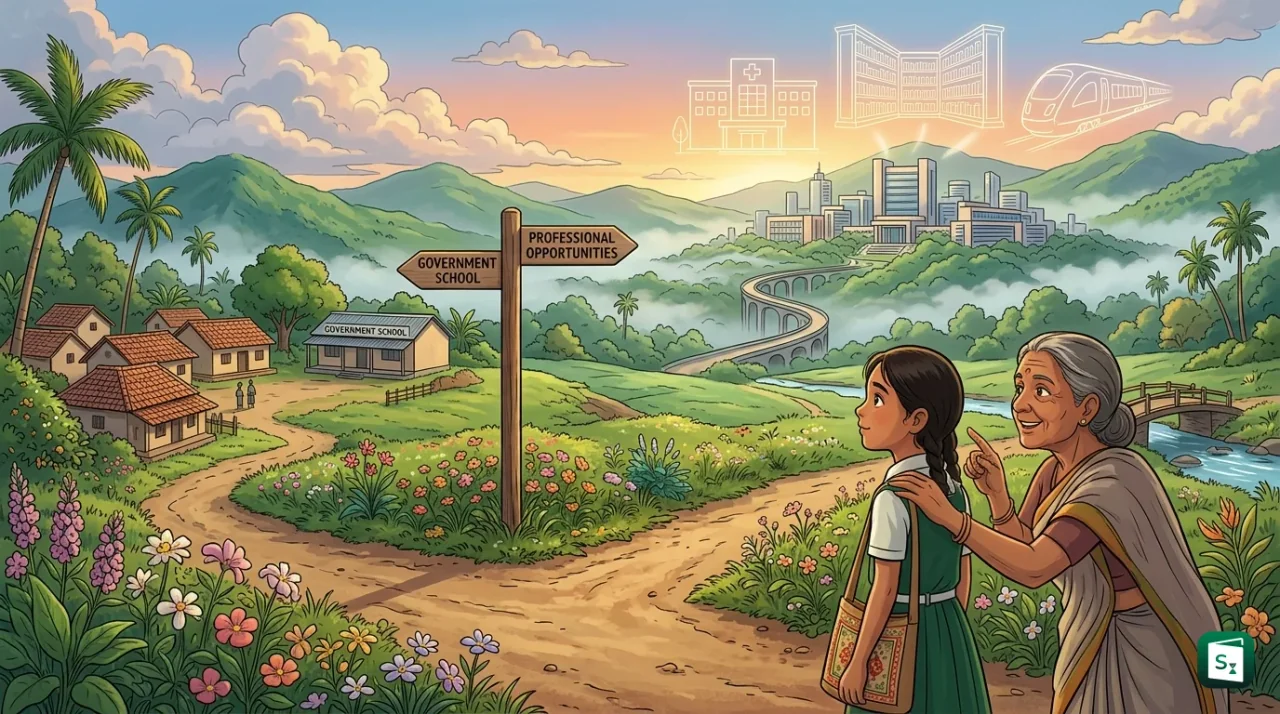
The Karnataka government has launched the Vidyarthi Sahayahasta scheme to give students from rural government schools better access to professional education. Chief Minister D K Shivakumar announced the scheme during the 80th Independence Day celebrations on 15 August 2026 at the Field Marshal Manekshaw Parade Ground in Bengaluru. Under the scheme, students who studied in rural government schools from Class 1 to Class 10 will get a 7.5% reservation within the existing 15% rural quota for admission to professional courses such as medical and engineering.
What Is the Vidyarthi Sahayahasta Scheme?
The Vidyarthi Sahayahasta scheme, which translates to helping hand for students, is a new initiative of the Karnataka government to improve access to professional higher education for rural learners. It was announced by Chief Minister D K Shivakumar on 15 August 2026 during the state’s 80th Independence Day celebrations at the Field Marshal Manekshaw Parade Ground in Bengaluru. The Department of School Education and Literacy shared details of the scheme on its official handle and described it as a landmark step for rural students.
The core of the scheme is a special reservation of 7.5% for rural government school students. This is not a new quota added on top of existing reservations. It is carved out from within the 15% rural reservation that Karnataka already provides for admission to professional courses. In effect, half of the rural quota is now set aside exclusively for students with a full government school background in rural areas.
The government said the initiative is part of a broader vision to ensure educational equity and to help rural youth gain skills that match national and global standards. Along with the reservation, officials also referred to a complementary support initiative called Sahaya-Hasta, Hosa-Hasta, aimed at helping rural students pursue higher education. Detailed guidelines on implementation are expected to be notified by the Department of Education in the coming weeks.
Who Is Eligible and How the Reservation Works
Eligibility under Vidyarthi Sahayahasta is defined strictly by schooling history. Only students who have studied continuously from Class 1 to Class 10 in a government school located in a rural area of Karnataka can claim the benefit. The government has clarified that the rural location of the school matters, not just government management. Students who studied in private schools, even if those schools are in rural areas, are not eligible for this 7.5% share.
The reservation will apply during centralised counselling for professional courses. Admissions will continue to be based on merit in entrance examinations, but eligible students will compete within this protected pool. The government has not yet released the list of documents required to prove eligibility, the format of the rural study certificate, or the exact date from which the new rule will apply. Those details will be notified separately by the education department.
Understanding Horizontal Reservation
The 7.5% quota under Vidyarthi Sahayahasta is a horizontal reservation. Horizontal reservation cuts across existing vertical categories such as Scheduled Castes (SC), Scheduled Tribes (ST), Other Backward Classes (OBC) and General. This means the benefit is adjusted within each vertical category.
For example, if a college has 100 seats under the rural quota, about 15 seats are earmarked as rural. Under the new scheme, about half of those, or 7 to 8 seats, would be for rural government school students. Within those 7 to 8 seats, the SC, ST, OBC and General shares remain as per state policy. A rural government school student belonging to SC competes for the SC share within the horizontal pool, and a General category student competes for the General share. If enough eligible students from a particular vertical category are not available, those seats go back to other rural students as per existing rules.
| Feature | Vertical Reservation | Horizontal Reservation |
|---|---|---|
| Purpose | Provides separate share for social categories like SC, ST, OBC | Provides share for special groups like rural, women or persons with disabilities across all social categories |
| How it works | Seats are added as distinct vertical blocks | Seats are adjusted inside each vertical block |
| Example in Karnataka | 50% of professional course seats are reserved for SC, ST and OBC as per state policy | 15% rural quota, and now 7.5% within it for rural government school students |
| Legal basis | Article 15(4) and Article 16(4) of the Constitution allow special provision for socially and educationally backward classes | Article 15(3) and government policy allow special provision that cuts across vertical groups |
The Existing 15 Percent Rural Quota
Karnataka’s 15% rural reservation has existed for many years for admissions to professional courses and also for appointments in state civil services. The rural quota traces its origin to the Karnataka Reservation of Appointments or Posts in the Civil Services of the State for Rural Candidates Act, 2000, which came into force on 30 January 2001. The same principle was later extended to admission in professional educational institutions.
Under the present rules, any student who has studied from Class 1 to Class 10 in a rural area, whether in a government or private school, can claim rural reservation. Allotment of government seats is done by the Karnataka Examinations Authority (KEA) through a single window counselling system based on ranks in the Karnataka Common Entrance Test (KCET) for engineering and related courses and on National Eligibility cum Entrance Test (NEET) scores for medical and dental courses.
Why Was a Special Quota Needed
The government created a separate share for rural government school students because the existing rural quota was not reaching them. Most rural quota seats were being taken by students from rural private schools, especially those affiliated to the Central Board of Secondary Education (CBSE) and the Indian Certificate of Secondary Education (ICSE).
The Karnataka Administrative Reforms Commission-2 (KARC-2), headed by former Chief Secretary T M Vijay Bhaskar, highlighted this gap in its report in February 2023. The commission analysed NEET 2022 data for admissions to MBBS seats under the government quota.
Key findings of the report showed a sharp imbalance:
| Group | Share of Rural Class 10 Students | Share of Rural Quota MBBS Seats Secured |
|---|---|---|
| Rural students from state board (SSLC) government schools | About 49% of all rural Class 10 pass outs | Only about 23% of rural quota MBBS seats |
| Rural students from CBSE and ICSE schools | Only about 5% of rural Class 10 students | About 51% of rural quota MBBS seats |
| All SSLC board students in Karnataka | About 89% of total Class 10 pass outs | Only 49% of government quota MBBS seats |
| All CBSE and ICSE students in Karnataka | About 11% of total Class 10 pass outs | About 48% of government quota MBBS seats |
The report noted that rural CBSE and ICSE schools often have infrastructure, teaching quality and socio economic backgrounds comparable to urban private schools, and much better than rural government schools. Rural government school children, many of whom come from farming, landless labour and artisan families, face larger barriers of poverty, distance, limited coaching and fewer subject options.
The commission therefore recommended modifying the rural quota. It gave three options, convert the entire 15% rural quota into a rural government school quota, or a rural SSLC board quota that includes private SSLC schools, or split the 15% quota so that 7.5% is reserved for rural government school students and the remaining 7.5% remains open to other rural students. The Vidyarthi Sahayahasta scheme follows the third option. A similar request had been pending from the Association of Government Primary School Teachers of Karnataka for several months.
Tamil Nadu offers a parallel. In 2020, it introduced a 7.5% horizontal reservation for students who studied from Class 6 to Class 12 in government schools for admission to MBBS, BDS and AYUSH courses through NEET. The move was based on a commission headed by retired Justice P Kalaiyarasan, which found that government school students secured only about 0.15% of medical seats despite forming 41% of higher secondary students. Karnataka’s new step applies the same logic to a broader set of professional courses.
Which Courses Are Covered and How Admission Works
The 7.5% sub reservation will apply to professional courses where admission is made through government seats. While the detailed seat matrix is awaited, the government and the education department have said the scheme will cover medical and engineering programmes in the first phase.
In Karnataka, these admissions are governed by the Karnataka Professional Educational Institutions (Regulation of Admission and Determination of Fee) Act, 2006, which was passed by the state legislature to regulate admission and fee in professional colleges and to provide reservation for SC, ST and OBC students. The Act was aligned with the Constitution (Ninety Third Amendment) Act, 2005, which added Article 15(5) to allow special provisions for backward classes and SC and ST in admission to educational institutions, including private unaided institutions.
| Course Group | Entrance Examination | Conducting Body for Counselling | Seats Covered |
|---|---|---|---|
| Medical: MBBS, BDS | NEET UG conducted by the National Testing Agency | KEA conducts counselling for state quota seats | Government seats in government and private medical and dental colleges |
| AYUSH: BAMS, BUMS, BHMS, BNYS | NEET UG | KEA | Government seats in AYUSH colleges |
| Engineering, Technology, Architecture | KCET (Karnataka Common Entrance Test / UGCET) conducted by KEA since 1994 | KEA | Government share of seats in government, aided and private unaided colleges |
| Farm Science: BSc Agriculture, Horticulture, Sericulture, Forestry and related courses | KCET | KEA | Government share |
| Pharmacy, Nursing, Veterinary | KCET or NEET depending on course | KEA | Government share |
Admission to government seats is made on the basis of merit in the common entrance test followed by centralised counselling, subject to the state’s reservation policy. The Karnataka Examinations Authority (KEA), which was created as the Common Entrance Test Cell in 1994 and converted into an autonomous body under the Societies Registration Act in 2006, is the nodal agency for this process. It is headquartered in Bengaluru and functions under the Department of Higher Education.
Students seeking the new benefit will need to establish two facts, that the school is a government school and that it is located in an area classified as rural at the time of study. Karnataka treats a transitional area or town panchayat as urban for this purpose, so study in such areas is not counted as rural. The education department is expected to clarify the procedure for obtaining the rural study certificate from the Block Education Officer, the documents required and the verification process at KEA help centres.
Karnataka at a Glance
Karnataka, which was formed as Mysore State on 1 November 1956 under the States Reorganisation Act and renamed Karnataka in 1973, is the largest state in South India. Its capital and largest city is Bengaluru, often called the Silicon Valley of India for its role in information technology.
The state covers 1,91,791 square kilometres, making it the sixth largest state by area. According to the 2011 Census, its population was 6.11 crore, making it the eighth most populous state. About 61.3% of the population lives in rural areas. Kannada is the official language and the legislature is bicameral, with a Legislative Assembly of 224 seats and a Legislative Council of 75 seats. The state sends 28 members to the Lok Sabha and 12 members to the Rajya Sabha.
Administratively, Karnataka has 31 districts and four revenue divisions. The economy is among the stronger in India. The state’s economy is largely driven by services, manufacturing, agriculture and information technology.
Chief Minister D K Shivakumar, an eight time legislator from Kanakapura, took oath as the 25th Chief Minister on 3 June 2026 at Lok Bhavan in Bengaluru, succeeding Siddaramaiah. G Parameshwara was sworn in as Deputy Chief Minister. Governor Thaawarchand Gehlot administered the oath.
Significance and the Way Forward
The Vidyarthi Sahayahasta scheme addresses a direct equity gap in higher education. By reserving half of the rural quota for government school students, the state aims to ensure that rural seats actually reach children who study in resource limited settings, rather than those who happen to attend well resourced private schools in rural localities.
If implemented as announced, the scheme could increase the number of rural government school students in medical, engineering and other professional colleges. This would improve social mobility, create more doctors, engineers and scientists from rural backgrounds who are more likely to serve in their home regions, and reduce regional disparity in access to coveted courses. It also builds on the principle that equality sometimes requires treating unequals differently, which is permitted under the Constitution through reasonable classification under Articles 14 and 15.
Challenges remain. The government is yet to notify the eligibility certificate process, seat matrix adjustments, and the academic year from which the quota will apply. Ensuring accurate identification of rural areas, preventing misuse through false certificates, and creating awareness among eligible families will be important. Support measures beyond reservation, such as financial aid, coaching for KCET and NEET, bridge courses and hostel facilities, will determine whether students can not only secure admission but also complete demanding professional programmes.
In the coming months, the Department of School Education and Literacy and KEA are expected to issue detailed guidelines. The success of the scheme will be judged by how smoothly the new horizontal share is implemented during the next counselling cycle and how many rural government school students actually enter professional colleges.
Key Takeaways
- The Vidyarthi Sahayahasta scheme was announced on 15 August 2026 in Bengaluru by Chief Minister D K Shivakumar during the 80th Independence Day celebrations.
- It provides a 7.5% horizontal reservation within the existing 15% rural quota for students who studied from Class 1 to Class 10 in rural government schools for admission to professional courses like medical and engineering.
- The existing 15% rural quota originates from the Karnataka Reservation for Rural Candidates Act, 2000, effective from 30 January 2001, and applies to admissions through KCET and NEET via KEA.
- The Karnataka Administrative Reforms Commission-2 headed by T M Vijay Bhaskar in February 2023 found that rural CBSE and ICSE students formed only 5% of rural Class 10 students but took 51% of rural quota MBBS seats, while rural government school students formed 49% but got only 23%.
- The scheme is modelled on Tamil Nadu’s 7.5% horizontal reservation for government school students introduced in 2020 for MBBS, BDS and AYUSH admissions based on the Justice P Kalaiyarasan Commission report.