Japan’s Defence Minister Shinjiro Koizumi made his first official visit to India on 20 August 2026, holding talks in New Delhi and Mumbai to strengthen bilateral defence and maritime security cooperation. In the capital, he inspected a ceremonial tri-service Guard of Honour at the Manekshaw Centre in the presence of Defence Minister Rajnath Singh. His itinerary also included tributes at naval memorials and a visit aboard the indigenous stealth destroyer INS Chennai at the Western Naval Command.
Who Is Shinjiro Koizumi?
Shinjiro Koizumi, born on 14 April 1981 in Yokosuka, Kanagawa Prefecture, is Japan’s Minister of Defense and a senior leader of the Liberal Democratic Party (LDP). He is the second son of former Prime Minister Junichiro Koizumi, who led Japan from 2001 to 2006, and represents a fourth generation political family. Koizumi has been a Member of the House of Representatives for Kanagawa’s 11th district since 2009, after completing a B.A. in Economics from Kanto Gakuin University in 2004 and a Master of Arts in Political Science from Columbia University in the United States in 2006.
He served as Minister of the Environment from September 2019 to October 2021 and as Minister of Agriculture, Forestry and Fisheries from May to October 2025. He was first appointed Minister of Defense on 21 October 2025 by Prime Minister Sanae Takaichi, who became Japan’s first woman prime minister, and was reappointed in February 2026 after Takaichi’s re-election. As Defence Minister, he heads the Ministry of Defense in Tokyo, which oversees the Japan Self-Defense Forces, including the Japan Maritime Self-Defense Force (JMSDF), the Japan Air Self-Defense Force (JASDF) and the Japan Ground Self-Defense Force (JGSDF). His visit to India was his first official visit to the country in this role.
Ceremonial Engagements in New Delhi and Mumbai
Koizumi’s two day programme covered Mumbai and New Delhi from 19 to 20 August 2026, combining formal military honours, memorial tributes and operational visits. The schedule was designed to showcase both ceremonial respect and frontline naval capability.
Guard of Honour at the Manekshaw Centre
In New Delhi on 20 August 2026, Koizumi inspected a ceremonial tri-service Guard of Honour at the Manekshaw Centre in Delhi Cantonment. Defence Minister Rajnath Singh was present for the reception and inspection. The Manekshaw Centre is named after Field Marshal Sam Manekshaw, India’s first Field Marshal and chief of the Army during the 1971 India Pakistan War, and serves as a premier venue for high level defence engagements and tri-service ceremonies. The Guard of Honour, presented by contingents of the Indian Army, Indian Navy and Indian Air Force, is a formal military salute offered to visiting dignitaries and reflects the importance India attaches to the bilateral defence relationship.
Tributes at the National War Memorial and Gaurav Stambh
In the capital, Koizumi also laid a wreath at the National War Memorial near India Gate. The memorial, inaugurated on 25 February 2019 and spread over 40 acres, honours soldiers of independent India who made the supreme sacrifice in conflicts with Pakistan and China, in Goa in 1961, in operations such as Operation Pawan and Operation Rakshak, and in UN peacekeeping missions. Its design features four concentric circles called the Amar Chakra (Circle of Immortality with the eternal flame), Veerta Chakra (Circle of Bravery), Tyag Chakra (Circle of Sacrifice with granite tablets bearing names in golden letters) and Raksha Chakra (Circle of Protection).
In Mumbai, the minister laid a wreath at the Gaurav Stambh at the Naval Dockyard. The Gaurav Stambh, meaning Pillar of Pride, is a victory at sea monument dedicated in December 2020 during the golden jubilee year of the 1971 war, known as Swarnim Vijay Varsh. Set against the ramparts of Bombay Castle within the dockyard complex, the monument depicts a submariner, a surface warrior and a naval aviator to represent the three dimensions of the Navy. It is inscribed with a Sanskrit shloka from Chapter 18, Verse 43 of the Bhagavad Gita that extols the virtues of a warrior, and pays tribute to the valour of personnel of the Western Naval Command.
Visit to the Western Naval Command and INS Chennai
At Mumbai, Koizumi inspected a separate Guard of Honour at the headquarters of the Western Naval Command (WNC). The WNC, headquartered at INS Angre in Mumbai and formed on 1 March 1968, is the senior most of the three naval commands of the Indian Navy. It is responsible for all naval forces in the Arabian Sea and the western Indian Ocean and is commanded by a Vice Admiral with the title Flag Officer Commanding-in-Chief, Western Naval Command (FOC-in-C WNC). The current FOC-in-C is Vice Admiral Sanjay Vatsayan, who took over on 30 May 2025. During the visit, Koizumi held discussions with senior naval leadership and received operational briefings on the Navy’s western seaboard responsibilities.
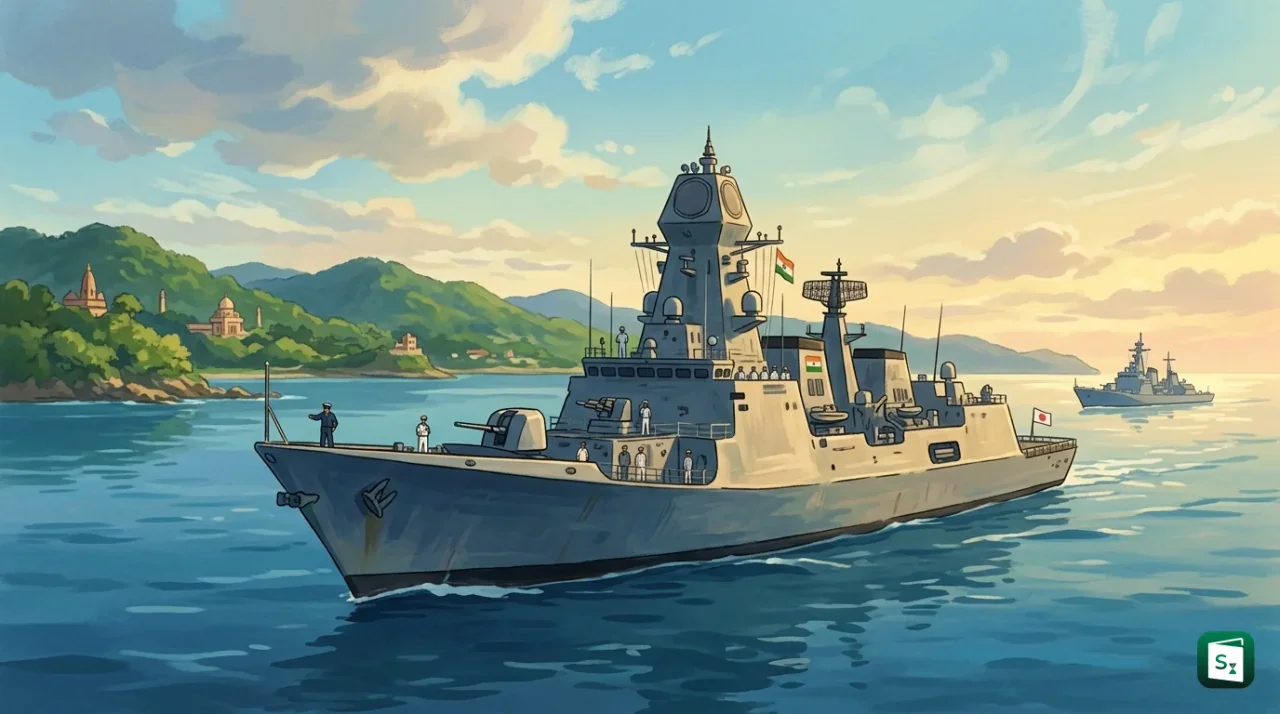
He also visited INS Chennai (D65), an indigenous stealth guided missile destroyer berthed at the Naval Dockyard, and was briefed on its capabilities and indigenous systems. The visit underlined Japan’s interest in India’s shipbuilding and operational experience in the Indian Ocean Region.
Strengthening India Japan Defence Partnership
The central outcome of the visit was the bilateral meeting between Rajnath Singh and Shinjiro Koizumi in New Delhi on 20 August 2026, where both sides reaffirmed their commitment to deepen defence cooperation under the Japan India Special Strategic and Global Partnership. This partnership was elevated to this level in 2014 during Prime Minister Narendra Modi’s first term and has since been anchored by shared democratic values and a common vision for a Free and Open Indo-Pacific.
Memorandum of Arrangement on Maritime Security Cooperation
During the talks, the two ministers signed a Memorandum of Arrangement (MoA) on Maritime Security Cooperation between the defence ministries of the two countries. The MoA provides a structured framework for practical cooperation between the Indian Navy and the Japan Maritime Self-Defense Force (JMSDF).
The arrangement focuses on several practical areas. It strengthens Maritime Domain Awareness (MDA), which means sharing information to build a common picture of activities at sea, including vessel movements and emerging threats. It enhances cooperation in Search and Rescue (SAR) and Humanitarian Assistance and Disaster Relief (HADR) to coordinate responses to accidents and natural disasters. It also seeks to protect Sea Lines of Communication (SLOCs), the vital shipping routes in the Indian and Pacific Oceans through which global trade and energy supplies move, through reciprocal naval ship visits, joint exercises, personnel and expert exchanges and logistical support including access to ports and maintenance facilities. In addition, it covers cooperation to enhance mine countermeasures capabilities, which is the ability to detect and neutralise sea mines that can block ports and sea lanes, and exploring joint development in naval shipbuilding and design by combining Japan’s technological expertise with India’s production capabilities under the Make in India initiative. Progress towards a reciprocal ship repair arrangement that would allow each navy to repair its ships in the other country’s yards is also part of the framework. Both sides agreed to move swiftly to turn these discussions into concrete operational cooperation that meets their strategic and operational needs.
Aligning MAHASAGAR and FOIP
Rajnath Singh stressed that a close alignment between India’s MAHASAGAR vision and Japan’s Free and Open Indo-Pacific (FOIP) initiative is more important now than ever before. MAHASAGAR stands for Mutual and Holistic Advancement for Security and Growth Across Regions. Announced by India as an expanded vision for the Indian Ocean Region, it views the oceans as a shared space that supports stability and growth and helps partner countries safeguard their maritime interests through their own efforts.
Japan’s FOIP, first proposed in 2016, calls for a free, open and rules based order in the Indo-Pacific, with freedom of navigation and overflight, unimpeded lawful commerce and peaceful settlement of disputes. Singh noted that the security of the Indian Ocean and the Pacific Ocean is deeply interlinked and that maritime lifelines face growing vulnerabilities, making freedom of navigation and overflight not just an economic necessity but a strategic imperative. The two ministers expressed strong opposition to any unilateral actions that impede these freedoms or attempt to change the status quo by force or coercion.
They also recalled the discussions between Prime Minister Narendra Modi and Prime Minister Sanae Takaichi during the 16th India Japan Annual Summit in July 2026, when both leaders agreed to expand cooperation in maritime security, critical minerals and economic security. Koizumi also called on Prime Minister Modi during his stay and briefed him on progress in bilateral defence cooperation.
INS Chennai: India’s Indigenous Stealth Destroyer in Focus
The visit to INS Chennai (D65) highlighted India’s indigenous warship building capability, a key interest area for Japan as both sides explore joint shipbuilding.
INS Chennai is the third and last ship of the Kolkata class, also known as the Project 15A (P-15A) guided missile destroyers. It was indigenously designed by the Indian Navy’s Directorate of Naval Design (DND) and constructed by Mazagon Dock Shipbuilders Limited (MDL) in Mumbai. The ship was laid down in February 2006, launched on 1 April 2010 and commissioned into the Navy on 21 November 2016 by then Defence Minister Manohar Parrikar at the Naval Dockyard in Mumbai. It is the first naval ship named after the city of Chennai, the capital of Tamil Nadu, and carries the motto Shatro Sanharaka, which means Vanquisher of Enemies.
The destroyer is regarded as one of the most potent warships built in India and showcases a high level of indigenisation under the Make in India initiative. Indigenous systems onboard include the Combat Management System, Rocket Launcher, Torpedo Tube Launcher, Automated Power Management System, Foldable Hangar Doors, Helo Traversing System and Bow mounted SONAR.
| Feature | Details |
|---|---|
| Class | Kolkata class (Project 15A) guided missile destroyer |
| Displacement | About 7,400 to 7,500 tonnes at full load |
| Dimensions | Length 163 metres, breadth 17.4 metres, draught 6.5 metres |
| Propulsion | Combined Gas and Gas (COGAG) with four Zorya-Mashproekt DT-59 reversible gas turbines |
| Speed and Range | Speed more than 30 knots, range about 6,000 nautical miles at 18 knots |
| Complement | About 300 personnel, including 50 officers (accommodation for up to about 395) |
| Stealth Features | Reduced Radar Cross Section (RCS) through hull shaping, full beam superstructure, plated masts and radar transparent materials on exposed decks |
| Weapons and Sensors | BrahMos surface to surface missiles, Barak-8 surface to air missiles, modern surveillance radar, indigenous rocket launchers and torpedo launchers for anti-submarine warfare, towed array sonar |
| Other Capabilities | Equipped to fight in Nuclear, Biological and Chemical (NBC) conditions, carries two helicopters with hangar facilities |
After commissioning, INS Chennai was placed under the operational and administrative control of the Flag Officer Commanding-in-Chief, Western Naval Command and is base ported at Mumbai as part of the Western Fleet. Its visit demonstrated to the Japanese delegation how India combines design, construction and systems integration within the country, an experience Tokyo seeks to leverage for future co-production.
Broader Strategic Context: Quad, Exercises and Technology Cooperation
India and Japan are members of the Quadrilateral Security Dialogue, commonly known as the Quad, along with the United States and Australia. The grouping, which holds regular leader level and foreign minister level meetings, is seen as a key platform to promote a rules based order and counter assertive behaviour in the Indo-Pacific. Both countries also share a long cultural history dating back to 752 AD, when the Indian monk Bodhisena consecrated the Great Buddha at Todaiji Temple in Nara, and modern links deepened through figures such as Swami Vivekananda, Rabindranath Tagore, Netaji Subhas Chandra Bose and Rash Behari Bose. The Japan India Association, founded in 1903, is Japan’s oldest international friendship body.
Defence cooperation between the two countries has expanded steadily since the early 2000s. A Joint Declaration on Security Cooperation was signed in 2008, a Memorandum of Defence Cooperation followed, and in 2020 the two sides signed the Reciprocal Provision of Supplies and Services (RPSS) agreement, which allows their militaries to provide logistics support to each other during exercises and operations. The Special Strategic and Global Partnership, formalised in 2014, has been reinforced by leadership level engagement, including eight visits by Prime Minister Modi to Japan over the past decade.
Operational cooperation is most visible in joint exercises. The three services now exercise together regularly, and in 2023 all three bilateral exercises were held in the same calendar year for the first time. The table below summarises the key drills.
| Exercise | Service | Nature |
|---|---|---|
| Dharma Guardian | Army | Bilateral army exercise focused on counter terrorism and peacekeeping operations |
| JAIMEX / JIMEX | Navy | Japan India Maritime Exercise between the Indian Navy and the JMSDF |
| Veer Guardian | Air Force | Bilateral fighter exercise between the Indian Air Force (IAF) and the Japan Air Self-Defense Force (JASDF). The next edition, Veer Guardian 26, will see Japanese fighter aircraft fly to India to participate for the first time |
| Malabar and Milan | Multilateral | Large multilateral naval exercises in which both navies participate alongside partners |
Technology cooperation is moving from exercises to co-production. The two sides have identified the UNICORN (Unified Complex Radio Antenna) mast as the symbol of their defence industrial partnership. The shipborne UNICORN system integrates multiple communication antennas into a single unified mast, which reduces the ship’s Radar Cross Section and improves stealth. A Memorandum of Implementation for its co-development was signed in 2024, and it is the first defence equipment and technology transfer project between India and Japan. The system, originally fitted on JMSDF destroyers, is now being adapted for Indian warships with joint work between India’s Defence Research and Development Organisation (DRDO), established in 1958 and headquartered in New Delhi, and Japan’s Acquisition, Technology and Logistics Agency (ATLA), established in 2015 under the Ministry of Defense.
This cooperation has been enabled by Japan’s review of its defence equipment and technology transfer framework. On 21 April 2026, the cabinet of Prime Minister Takaichi approved a change that lifts restrictions on the export of lethal finished military equipment to 17 partner countries with active defence transfer agreements, including India. Rajnath Singh welcomed this review and said it would open the door for deeper joint projects. Discussions are also underway on co-production of advanced platforms such as the Mogami class stealth frigate, where Japanese design could be combined with Indian shipyard production for use by both navies and for export to friendly foreign nations.
Both sides also cooperate through the Indo-Pacific Logistics Network (IPLN), which supports partner countries during natural disasters by transporting personnel and supplies for humanitarian assistance and disaster relief. The second IPLN tabletop exercise is scheduled at Japan’s Ministry of Defense in September 2026.
The Way Forward
The two ministers agreed to establish a Working Group headed at the Director General / Joint Secretary level to coordinate cooperation across operational, intelligence, equipment, technology and industrial domains. The group will oversee implementation of the agreed areas, maximise synergies across different strands and accelerate execution. A Defence Industry Forum involving companies from both sides will also be convened to bring industry into the collaboration.
In the near term, both sides will work towards concluding a ship repair arrangement that allows reciprocal provision of maintenance and repair facilities, and towards concrete outcomes in mine countermeasures and naval shipbuilding and design. The ministers concurred that Japan should make greater use of India’s shipbuilding capacity under Make in India, integrating Japanese design strengths with India’s large scale, cost competitive manufacturing.
They also agreed to accelerate discussions for the fourth India Japan 2+2 Foreign and Defence Ministerial Dialogue in Tokyo later in 2026, a format that brings the foreign and defence ministers of both countries together for comprehensive security discussions. The previous, third 2+2 meeting was held in New Delhi on 20 August 2024. The two sides further welcomed the first trilateral PASSEX involving India, Japan and Indonesia held in February 2026 and agreed to expand cooperation with third countries through exercises and high level exchanges.
By combining ceremonial signalling with concrete agreements on information sharing, logistics and co-production, the visit has moved the partnership from goodwill to a more operational footing, which will be tested in upcoming exercises and in the timely delivery of projects such as UNICORN.
Key Takeaways
- Japan’s Defence Minister Shinjiro Koizumi made his inaugural visit to India on 20 August 2026, inspecting a tri-service Guard of Honour at the Manekshaw Centre in New Delhi in the presence of Rajnath Singh.
- In Mumbai, he inspected a Guard of Honour at the Western Naval Command (WNC), headquartered at Mumbai and formed on 1 March 1968, laid a wreath at the Gaurav Stambh at the Naval Dockyard, and visited the indigenous stealth destroyer INS Chennai (D65).
- India and Japan signed a Memorandum of Arrangement on Maritime Security Cooperation to deepen cooperation in Maritime Domain Awareness, Search and Rescue and Humanitarian Assistance and Disaster Relief, and to protect Sea Lines of Communication.
- INS Chennai is the third and last Kolkata class (Project 15A) guided missile destroyer, designed by the Directorate of Naval Design and built by Mazagon Dock Shipbuilders Limited, commissioned on 21 November 2016 with the motto Shatro Sanharaka.
- The visit aligned India’s MAHASAGAR vision and Japan’s Free and Open Indo-Pacific (FOIP) initiative, with both ministers opposing unilateral actions that impede freedom of navigation and overflight.
- The two sides will set up a Working Group at Director General / Joint Secretary level, convene a Defence Industry Forum, and accelerate the fourth 2+2 Foreign and Defence Ministerial Dialogue in Tokyo in 2026, while advancing the UNICORN mast as the first joint defence equipment co-development project.