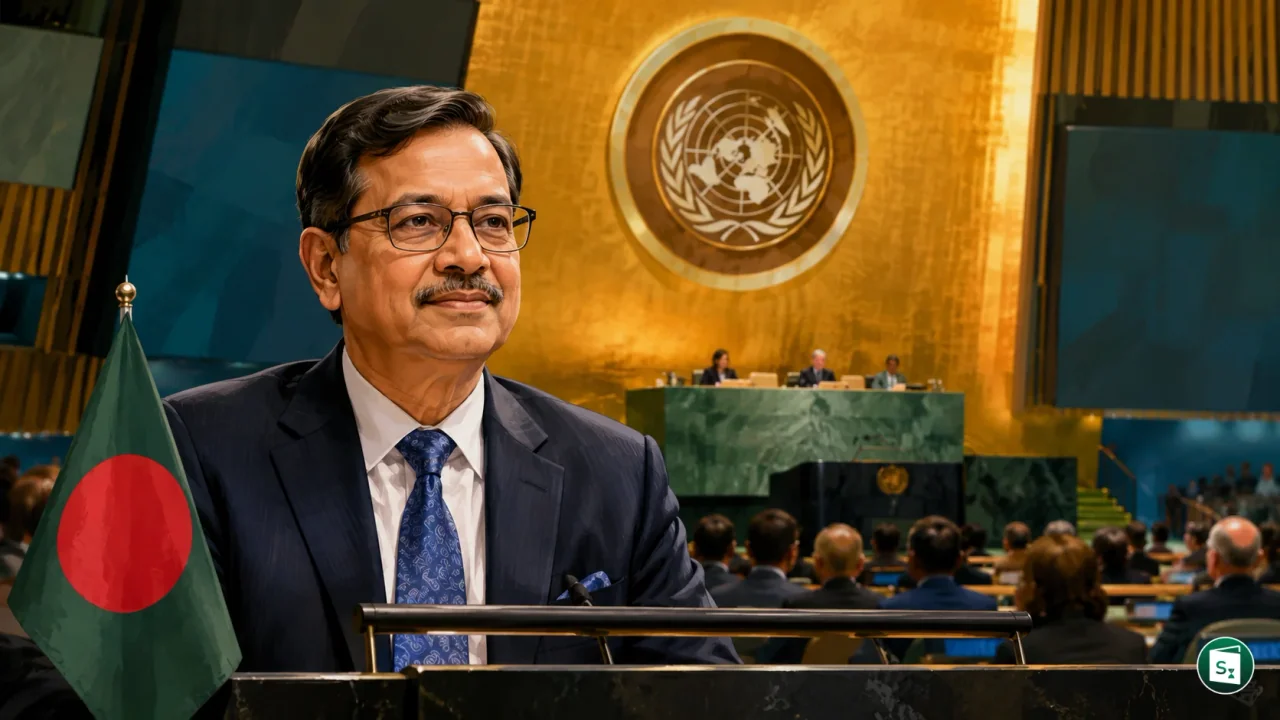
The Foreign Minister of Bangladesh, Dr. Khalilur Rahman, has been elected as the President of the 81st session of the United Nations General Assembly (UNGA). In a secret-ballot election, he secured the presidency for a one-year term starting on September 8, 2026. He succeeds Annalena Charlotte Alma Baerbock of Germany, who has been leading the 80th session of the assembly.
Election Details and Regional Rotation
The election for the presidency of the 81st session of the United Nations General Assembly was conducted through a secret ballot. Dr. Khalilur Rahman secured the seat after receiving 99 votes, defeating Cyprus’s candidate, Ambassador Andreas Kakouris, who secured 91 votes. A total of 190 member states cast their ballots during the voting process.
The presidency of the General Assembly rotates annually among the five established regional groups. These groups include the African Group, the Asia-Pacific Group, the Eastern European Group, the Latin American and Caribbean Group, and the Western European and Others Group. For the 81st session, the presidency was designated to be chosen from the Asia-Pacific Group.
About Dr. Khalilur Rahman
Dr. Khalilur Rahman is a distinguished economist and career diplomat who was appointed as the Minister of Foreign Affairs of Bangladesh on February 17, 2026. Born on April 1, 1954, he has a solid academic background, holding a Master of Arts in Economics from the University of Dhaka, followed by a Master of Arts in Law and Diplomacy from the Fletcher School of Law and Diplomacy at Tufts University, and a PhD in Economics from Harvard University.
He began his career in the Bangladesh Foreign Service in 1979, having secured the top rank in the first regular Bangladesh Civil Service examination. From 1983 to 1991, he worked in the Ministry of Foreign Affairs and at the Permanent Mission of Bangladesh to the United Nations in New York, where he represented his country in the Economic and Financial Committee and served as a spokesperson for the Least Developed Countries (LDCs).
Between 1999 and 2024, Dr. Rahman spent 25 years working in senior administrative roles at the United Nations Secretariat. This included serving as a Special Adviser at the United Nations Conference on Trade and Development (UNCTAD) in Geneva, Switzerland. He also served as the High Representative for the Rohingya Issue and as the National Security Adviser to the Chief Adviser of Bangladesh before taking over the foreign ministry.
Key Priorities of the 81st UNGA Session
The theme chosen for the presidency of the 81st session is “Restoring Trust, Managing Transformation: A United Nations that Delivers for All”. This theme focuses on rebuilding confidence in multilateral diplomacy, addressing global divisions, and finding collective solutions to global challenges.
Under his presidency, the General Assembly will focus on managing major global transformations. These include addressing climate change, regulating digital technologies and artificial intelligence (AI), reducing economic disparities, and advocating for the interests of the Global South. Additionally, reforming global governance institutions to make them more representative and responsive to the needs of developing nations will be a core objective.
History of Bangladesh at the UNGA Presidency
The election of Dr. Khalilur Rahman marks the second time Bangladesh has secured the presidency of the General Assembly. The country last held this prestigious position during the 41st session in 1986, when Humayun Rashid Choudhury, who was the Foreign Minister of Bangladesh at the time, was elected as the President.
During the 41st session, the General Assembly adopted the Declaration on the Right to Development under Resolution 41/128, which was a landmark achievement. Bangladesh officially became a member state of the United Nations in 1974, and its leadership in the UNGA represents a key milestone in its global diplomatic engagements.
Functions of the United Nations General Assembly
Established in 1945 under the Charter of the United Nations, the United Nations General Assembly is based in New York, United States. It serves as the primary deliberative, policymaking, and representative organ of the United Nations. As the only UN body in which all 193 member states have equal representation, it provides a unique platform for multilateral discussion on the full spectrum of international issues.
The General Assembly is responsible for reviewing and approving the budget of the United Nations, electing the non-permanent members of the UN Security Council, and appointing the Secretary-General based on the recommendation of the Security Council. While the resolutions passed by the General Assembly are generally non-binding on member states, they carry significant political weight and represent the collective consensus of the international community.
Key Takeaways
- Dr. Khalilur Rahman, the Foreign Minister of Bangladesh, was elected as the President of the 81st session of the United Nations General Assembly (UNGA).
- In a secret-ballot election, Dr. Rahman secured the seat with 99 votes, defeating Cyprus’s Ambassador Andreas Kakouris, who received 91 votes.
- Dr. Rahman will assume the presidency for a one-year term starting on September 8, 2026, succeeding Annalena Charlotte Alma Baerbock of Germany.
- The theme of the 81st UNGA session is “Restoring Trust, Managing Transformation: A United Nations that Delivers for All”.
- This is the second time Bangladesh has held the UNGA presidency, with the first presidency occurring during the 41st session in 1986 under Humayun Rashid Choudhury.
- The United Nations General Assembly was established in 1945 under the Charter of the United Nations, and is headquartered in New York, United States.