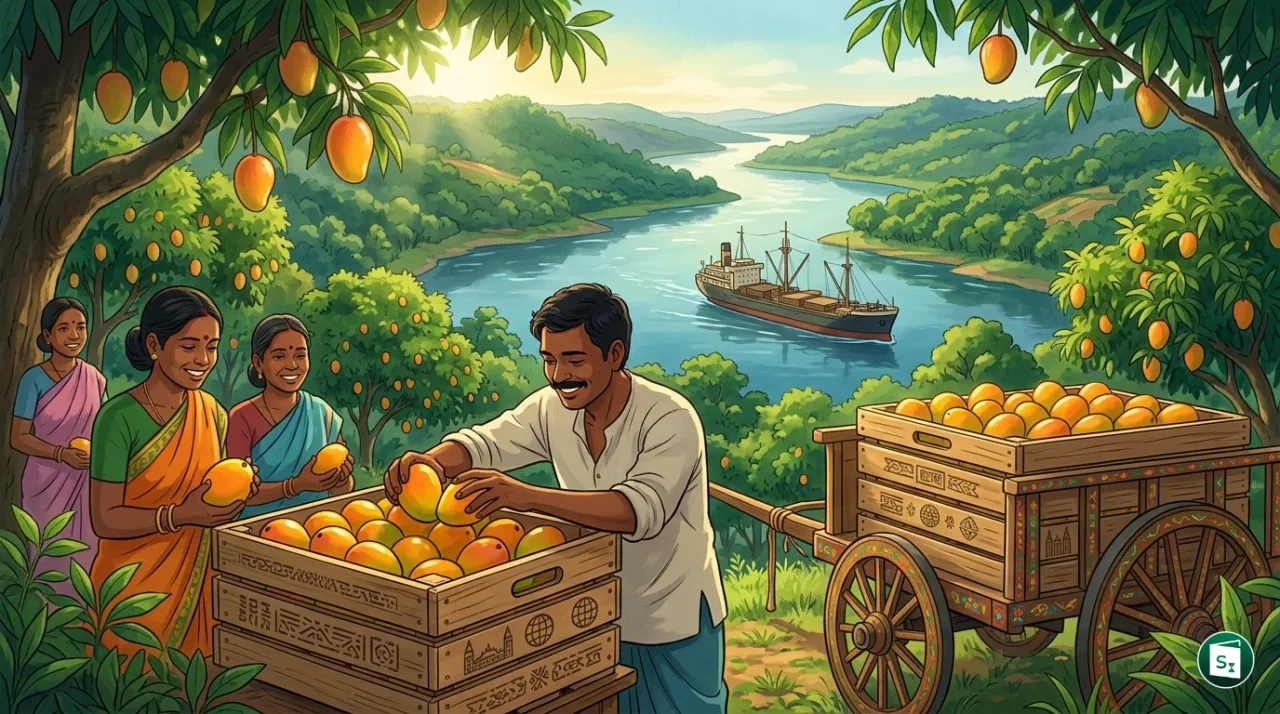
The Agricultural and Processed Food Products Export Development Authority (APEDA) successfully facilitated the first commercial export of fresh Amrapali mangoes from Jharkhand to the United Kingdom on June 4, 2026. Sourced from an all-women Farmer Producer Company in the Simdega district, the 1.5 metric tonne consignment was sent from Kolkata to London. This landmark initiative integrates the state’s rural horticultural sector into global trade networks and establishes direct market linkages for local women farmers.
Sourcing and Consignment Logistics
The export consignment comprised 1.5 metric tonnes of premium Amrapali mangoes, a sweet, high-pulp hybrid variety developed in 1971 at the Indian Agricultural Research Institute (IARI). The fruits were grown and harvested by the Beura Farmer Producer Company Ltd., an all-women agricultural cooperative based in the Bano Block of the Simdega district in Jharkhand. This cooperative model aggregates produce from local smallholders, allowing small-scale women farmers to pool their yields and access commercial scale.
The shipping logistics were handled by Kolkata-based exporter M/s JGB Agrofresh Pvt. Ltd., which managed the phytosanitary checks, packing, and cold-chain transport to Kolkata before the final air dispatch to London. By bypassing intermediate local traders, the cooperative structure secured premium prices for the farmers, yielding returns substantially higher than those available in regional wholesale markets.
APEDA and Capacity Building Initiatives
The successful export shipment was preceded by an Export-Oriented Capacity Building Programme organised by APEDA on May 5, 2026, in Simdega. The training programme was designed to educate local tribal farmers and Farmer Producer Organisations (FPOs) on international export requirements, strict phytosanitary regulations, post-harvest handling, and packaging standards demanded by European markets. By bridging the knowledge gap, the programme enabled the cooperative to produce export-grade fruits that comply with international safety regulations.
Beyond training, APEDA played a crucial role in trade facilitation by establishing a direct commercial linkage between the local women-led Farmer Producer Company (FPC) and the Kolkata-based exporting agency. This direct connection eliminated intermediate middlemen, allowing rural farmers to participate directly in the international agricultural value chain.
As a statutory body established on February 13, 1986, under the Agricultural and Processed Food Products Export Development Authority Act, 1985, APEDA operates under the Union Ministry of Commerce and Industry. Headquartered in New Delhi, the authority is responsible for the export promotion and development of scheduled agricultural commodities, including fruits, vegetables, meat products, and processed foods.
Strategic Impact on Jharkhand’s Agriculture
While Jharkhand is traditionally recognized for its rich mineral deposits, the state has significant untapped potential in horticulture. This first-ever mango export to the United Kingdom demonstrates the viability of high-value agriculture in the region. By accessing premium international markets, smallholder farmers can shift from subsistence farming to lucrative, commercial agriculture. This initiative acts as a catalyst for other farming communities in Jharkhand to adopt scientific pre-harvest management, pest control, and grading practices to meet global standards.
Furthermore, this development underscores the role of women in transforming rural economies. The entire supply of the exported Amrapali mangoes was managed by an all-women Farmer Producer Company. Supporting such collectives enhances rural financial independence, enhances female participation in agricultural trade, and ensures that the economic benefits of global exports flow directly back to rural households. Succeeding in the highly regulated British market also elevates the credibility of agricultural produce from eastern India, paving the way for future exports of other regional horticultural products.
Key Takeaways
- The first commercial export of Amrapali mangoes from Jharkhand to the United Kingdom was flagged off on June 4, 2026.
- Sourced from the all-women Beura Farmer Producer Company Ltd. based in the Simdega district, the consignment comprised 1.5 metric tonnes of fresh mangoes.
- The Agricultural and Processed Food Products Export Development Authority (APEDA) was established on February 13, 1986, under the Agricultural and Processed Food Products Export Development Authority Act, 1985.
- Operating under the Union Ministry of Commerce and Industry, APEDA is headquartered in New Delhi.
- The Amrapali mango is a dwarf, regular-bearing hybrid variety developed in 1971 at the Indian Agricultural Research Institute (IARI) by crossing Dasheri and Neelam parental varieties.