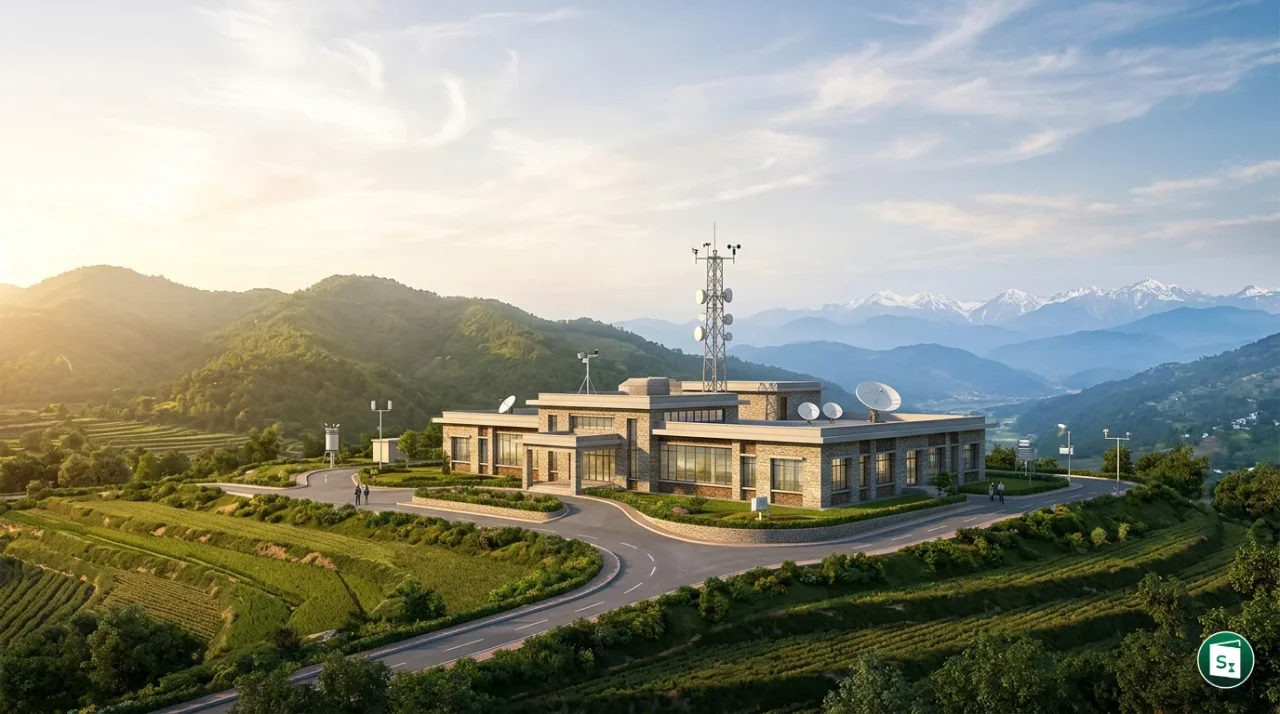
Union Minister of State for Science and Technology and Earth Sciences Dr. Jitendra Singh inaugurated India’s seventh Regional Meteorological Centre (RMC) in Jammu on June 5, 2026. The newly established facility will provide specialized, localized weather forecasting, climate monitoring, and disaster warning services to the Union Territories of Jammu & Kashmir and Ladakh, as well as Himachal Pradesh. This initiative marks a significant step in the decentralization of weather services in Northern India, with an eighth RMC also planned for Lucknow to manage services for Uttar Pradesh and Uttarakhand.
Overview of the New Regional Meteorological Centres
The establishment of the seventh Regional Meteorological Centre in Jammu represents a crucial expansion of the administrative and technical network of the India Meteorological Department (IMD). Prior to this, the northern region was largely supervised by the regional headquarters in New Delhi. The new centres in Jammu and Lucknow will take over regional forecasting responsibilities, allowing the New Delhi facility to focus exclusively on Delhi, Haryana, and Punjab.
The table below outlines the expanded structure of the India Meteorological Department, including the newly added seventh and eighth centres:
| Regional Meteorological Centre (RMC) | Headquarters | Primary Service Territories |
|---|---|---|
| RMC New Delhi | New Delhi | Delhi, Haryana, Punjab |
| RMC Mumbai | Mumbai | Maharashtra, Goa, Gujarat |
| RMC Chennai | Chennai | Tamil Nadu, Kerala, Karnataka, Andhra Pradesh, Telangana, Puducherry, Lakshadweep |
| RMC Kolkata | Kolkata | West Bengal, Bihar, Jharkhand, Odisha, Sikkim, Andaman and Nicobar Islands |
| RMC Nagpur | Nagpur | Madhya Pradesh, Chhattisgarh |
| RMC Guwahati | Guwahati | Assam, Meghalaya, Arunachal Pradesh, Nagaland, Manipur, Mizoram, Tripura |
| RMC Jammu | Jammu | Jammu & Kashmir, Ladakh, Himachal Pradesh |
| RMC Lucknow | Lucknow | Uttar Pradesh, Uttarakhand |
Strategic and Regional Importance of the Jammu Centre
The Himalayan territories of Jammu and Kashmir, Ladakh, and Himachal Pradesh are ecologically fragile and highly vulnerable to severe weather hazards. Natural disasters such as cloudbursts, flash floods, landslides, avalanches, and heavy snowfall frequently disrupt local life and damage critical infrastructure. By establishing a dedicated regional centre in Jammu, the India Meteorological Department can deliver highly localized, district-level forecasts and early warning services to mitigate these risks.
The strategic and economic benefits of this new centre extend across several key sectors:
- Infrastructure Protection: The high-altitude areas of the Chenab River basin are currently home to major national hydroelectric projects, including the Pakal Dul, Kiru, and Ratle dams. Accurate, real-time warnings for cloudbursts and flash floods are essential to protect these multi-crore assets and ensure operational safety.
- Safety of Pilgrims: The region hosts major annual pilgrimages, including the Amarnath Yatra and the travel to the Shri Mata Vaishno Devi shrine. Localized weather monitoring will help disaster management agencies coordinate and safeguard the movement of millions of devotees.
- Transport and Connectivity: Vital transport links, such as the Jammu-Srinagar National Highway (NH-44) and the Udhampur-Srinagar-Baramulla Rail Link (USBRL), are susceptible to landslides and snow blockages. Improved meteorological coordination ensures timely warnings to manage transport disruptions.
- Agriculture and Horticulture: Apple orchards, saffron cultivation, and other agricultural activities in Jammu and Kashmir and Himachal Pradesh rely heavily on weather patterns. Early warnings regarding frost, hailstorms, and temperature variations will help farmers protect their crops.
Upgraded Weather Infrastructure under Mission Mausam
The expansion of the regional forecasting network coincides with the ongoing implementation of Mission Mausam, a flagship initiative approved by the Union Cabinet on September 11, 2024, and officially launched on January 14, 2025. Administered by the Ministry of Earth Sciences, the mission carries a budget of ₹2,000 crore for the period from 2024 to 2026. Its primary goal is to make India weather-ready and climate-smart by upgrading technological infrastructure, expanding observational networks, and integrating high-resolution models.
A core component of this infrastructure upgrade is the deployment of Doppler Weather Radars (DWRs). These radar systems use radio waves to calculate the velocity of precipitation in the atmosphere, providing precise tracking of wind speeds, cloud density, and rainfall intensity. In 2014, there were no operational Doppler radars in the Jammu, Kashmir, and Ladakh territories. Today, four systems are functional:
- Jammu
- Srinagar
- Leh
- Banihal Top
Under Mission Mausam, the government has proposed five additional Doppler radar installations in Anantnag, Rajouri, Baramulla, Kishtwar, and Doda. This will be supported by a growing network of Automatic Weather Stations (AWSs) and rain gauges, bringing the total number of observatories in the region to 56.
Legacy and Structure of the India Meteorological Department
The India Meteorological Department (IMD), established on January 15, 1875, is the principal government agency responsible for meteorological observations, weather forecasting, and seismology. It was created by the British colonial administration following catastrophic tropical cyclones in 1864 and 1872 to centralize weather reporting and protect the agrarian economy from monsoon failures. The agency operates under the administrative control of the Ministry of Earth Sciences (MoES).
Over its long history, the headquarters of the department has shifted to meet administrative and strategic needs:
- Calcutta (Kolkata): Served as the initial headquarters from the department’s founding in 1875.
- Shimla: The headquarters was moved here to facilitate closer supervision of mountain weather services.
- Pune (Poona): Shifted in 1928 to leverage the scientific and academic facilities in the city.
- New Delhi: Established at Mausam Bhavan, Lodhi Road, in 1944, where it functions as the national administrative hub.
Headed by the Director General of Meteorology, the department celebrated its 150th foundation anniversary in 2025. The establishment of regional centers like Jammu and Lucknow helps the department transition from macro-level forecasting to high-resolution, decentralized weather services tailored to local topographies.
Key Takeaways
- India’s seventh Regional Meteorological Centre (RMC) was inaugurated in Jammu on June 5, 2026, to serve Jammu & Kashmir, Ladakh, and Himachal Pradesh.
- The India Meteorological Department (IMD) announced the establishment of an eighth regional centre in Lucknow to manage services for Uttar Pradesh and Uttarakhand.
- Prior to the restructuring, weather forecasting services in Northern India were primarily managed by the RMC New Delhi, which will now focus on Delhi, Haryana, and Punjab.
- The expansion is aligned with Mission Mausam, a flagship initiative launched on January 14, 2025, with a budget of ₹2,000 crore under the Ministry of Earth Sciences.
- The India Meteorological Department (IMD) was established on January 15, 1875, and is headquartered at Mausam Bhavan in New Delhi.