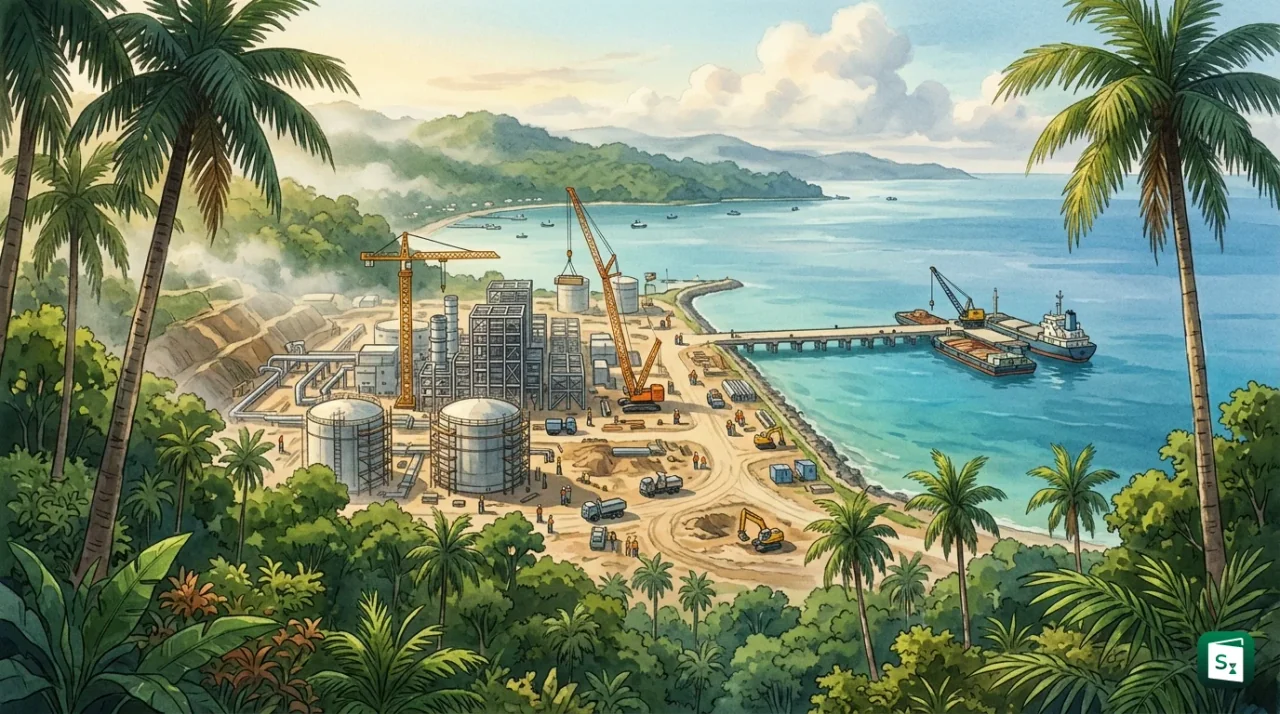
Sri Lanka based Lakdhanavi Limited has secured a $75 million turnkey contract to build a 57 MW natural gas fired power plant at Hope Town in Port Blair. The award was given by NTPC Vidyut Vyapar Nigam Limited after international competitive bidding, and the agreement was signed on 21 September 2026 at Noida. The Andaman power plant will replace costly diesel generation with LNG infrastructure and improve long term energy security for the islands.
What Is the 57 MW Hope Town Power Plant Project?
The 57 MW Hope Town power plant is a natural gas based power project to be built at Hope Town in Port Blair, now officially called Sri Vijaya Puram, in the Andaman and Nicobar Islands. The plant will run on regasified LNG and supply power to South Andaman. It is designed as a cleaner and more economical alternative to diesel sets that dominate the islands today.
The project was awarded by NTPC Vidyut Vyapar Nigam Limited (NVVN), a wholly owned subsidiary of NTPC Limited incorporated on 1 November 2002. NVVN acted as the project implementation agency after international competitive bidding. Lakdhanavi Limited emerged as the lowest bidder, described as L1 in tender terms, and won the turnkey Engineering, Procurement and Construction (EPC) contract worth about Rs 25 billion. An EPC contract means one contractor handles design, purchase of equipment, civil work, erection, testing and handover of a ready plant.
Key project facts are given below.
| Fact | Detail |
|---|---|
| Location | Hope Town, Port Blair (Sri Vijaya Puram), South Andaman |
| Capacity | 57 MW gas engine power plant (tender scope was 50 MW plus or minus 10 percent) |
| Contract value | $75 million (about Rs 25 billion) |
| Awarding agency | NVVN, subsidiary of NTPC |
| EPC contractor | Lakdhanavi Limited of Sri Lanka, part of LTL Group |
| Equipment supplier | Wartsila Corporation of Finland |
| Land allotted | 0.82 hectare by Andaman and Nicobar Administration |
| Agreement signed | 21 September 2026 at NTPC office complex, Noida |
| Letter of Award | 28 August 2026 for EPC and civil packages |
| Commissioning target | Within 28 months of award, expected by August 2028 |
The tender documents describe the plant as the Andaman and Nicobar gas engine power project. It will use reciprocating gas engines. These engines burn gas in a piston cylinder to turn a generator. Leading global suppliers for such engines include Wartsila and MAN Energy. This design suits small to medium island grids because it starts fast, handles load changes well and keeps high efficiency even at partial load.
How Does Andaman Get Electricity Today?
The Andaman and Nicobar Islands are a Union Territory of India in the Bay of Bengal. The capital is Port Blair, renamed Sri Vijaya Puram in 2024. Because the islands are spread over sea at long distances, there is no single power grid for the whole territory. Each island or cluster depends on its own standalone powerhouse.
Diesel dominates this system. The Electricity Department of the Andaman and Nicobar Administration handles generation, transmission and distribution. Its network includes more than 40 diesel power houses with small sets ranging from 6 kW to 5,000 kW. Recent estimates place total installed diesel capacity near 92.7 MW and peak demand for South Andaman near 61 MW. About 95 percent of total generation comes from diesel, and fuel cost forms about 80 percent of the cost of diesel power. In 2022 to 2023, about 45 percent of all diesel used in the islands, around 72,000 tonnes, went only to make electricity.
Other sources are small. The Kalpong River hydroelectric station in North Andaman has a capacity of 5.25 MW. A 20 MW diesel station at Bambooflat in South Andaman is run by a private operator under a power purchase agreement. Solar capacity, including rooftop and ground plants, is near 29 MW but varies by season and daylight. Transmission and distribution losses remain high at above 20 percent in some years. This mix makes power costly, polluting and vulnerable to fuel shipping delays.
What Is LNG and How Is It Used to Generate Electricity?
LNG stands for Liquefied Natural Gas. LNG is natural gas, mainly methane, that is cooled to about minus 162 degrees Celsius to become a liquid. The liquid form takes up about 600 times less space than gas, so it can be shipped by sea to places where pipelines cannot reach.
An LNG power plant works in three steps. First, LNG arrives by ship and is stored in insulated tanks. Second, it is heated and changed back to gas in a process called regasification. Third, the gas is burned in a gas engine or gas turbine to spin a generator and make electricity. For Hope Town, Indian Oil Corporation Limited (IOCL) will set up the receiving, storage and regasification system, including a Floating Storage and Regasification Unit (FSRU). An FSRU is a ship that stores LNG and converts it to gas offshore or near shore.
LNG is not a renewable energy source. It is a fossil fuel. It burns far cleaner than diesel and coal, with less carbon dioxide, almost no sulphur and far less particulate matter. For islands that cannot yet run fully on solar or wind, LNG offers a bridge fuel that cuts emissions and fuel cost while keeping supply stable.
Diesel Power Plant vs LNG Power Plant
| Feature | Diesel Plant | LNG Plant |
|---|---|---|
| Fuel | High speed diesel shipped in drums or tankers | Regasified natural gas supplied through FSRU and pipeline |
| Full form link | No cooling needed, fuel used directly | LNG means Liquefied Natural Gas, CNG means Compressed Natural Gas used mainly in vehicles |
| Emissions | High carbon, nitrogen oxides and soot | Lower carbon, very low sulphur and particles |
| Fuel cost in islands | Very high due to transport and price swings | Lower and more stable once supply chain is set |
| Efficiency | Lower for small old sets | Higher for modern gas engines, above 40 percent in simple cycle |
LNG and CNG both come from natural gas. The difference is storage. LNG is cooled to liquid for bulk sea transport and power generation. CNG is squeezed under high pressure and used mainly for buses, cars and city gas.
Who Are the Key Players Behind the Project?
The Hope Town project brings together Indian public agencies, a Sri Lankan contractor and a Finnish technology supplier.
NTPC Limited, set up in 1975 and headquartered in New Delhi, is India’s largest power utility. NVVN is its trading arm and now also implements distributed projects such as this island plant. NVVN signed a Power Purchase Agreement with the Andaman and Nicobar Administration and will sell the power to the island grid.
Lakdhanavi Limited, headquartered in Colombo and established in 1996, is the flagship subsidiary of LTL Holdings. LTL Group is Sri Lanka’s largest private power group with interests in generation, transmission and distribution. The Sri Lankan state owned National Transmission Network System Provider holds a 35 percent stake in LTL Holdings. Lakdhanavi has over 25 years of work as an Independent Power Producer, EPC contractor and plant operator. Its past projects include the 300 MW Yugadhanavi plant and the 350 MW Sobadhanavi LNG ready plant at Kerawalapitiya in Sri Lanka, plus plants in Bangladesh, Nepal, Maldives and Oman. The Hope Town award marks its first EPC entry into India.
Wartsila Corporation of Finland will supply the gas engines. Wartsila is a global leader in marine and energy engines. Lakdhanavi’s engineers will handle design, civil work, installation, testing and one year of supervised operation.
Indian Oil Corporation Limited (IOCL), set up in 1959 and headquartered in New Delhi, will build the LNG receiving and regasification chain and supply gas under a Gas Supply Agreement with NTPC. The Ministry of Power approved the agreements on 16 June 2026.
The project timeline shows steady progress.
| Date | Milestone |
|---|---|
| May 2022 | Environment Ministry amends island coastal rules to allow gas plants on islands larger than 100 sq km |
| 16 June 2026 | Ministry of Power approves Power Purchase Agreement and Gas Supply Agreement |
| 21 July 2026 | Power Purchase Agreement and land use agreement signed at Sri Vijaya Puram |
| 28 August 2026 | NVVN issues Letter of Award for EPC and civil packages |
| 21 September 2026 | $75 million EPC contract with Lakdhanavi signed at Noida |
| August 2028 | Target for commissioning, 28 months from award |
Why the Project Matters for Energy Security and Growth
The 57 MW plant is large for South Andaman. It can cover most of the evening peak and create reserve margin for maintenance and sudden demand spikes. That improves grid stability and cuts blackouts. Reliable power also helps hospitals, water supply, ports and the airport at Port Blair.
Cost is the second gain. Diesel power in remote islands costs far more than mainland power because every litre travels by sea. LNG, once the FSRU and supply chain run steady, lowers fuel cost and shields tariffs from diesel price swings. The Electricity Department expects lower generation cost, better efficiency and room to add rooftop solar without stressing the grid.
The project also supports growth. Tourism, fisheries cold chains, food processing and small industry all need steady power. The islands also host strategic defence and coast guard facilities. A clean base load plant backs urban growth in Sri Vijaya Puram and future projects in ports, jetties and roads.
The deal carries weight for India and Sri Lanka ties. For decades, capital and aid flowed mainly from India to Sri Lanka. Lakdhanavi’s win shows expertise flowing the other way. Sri Lanka’s Energy Minister welcomed the success as proof that Sri Lankan engineering can compete in a large market like India. For India, it brings proven regional experience plus Finnish engine technology at a competitive L1 price.
Key Takeaways
- Lakdhanavi Limited won a $75 million contract to build a 57 MW gas fired power plant at Hope Town, Port Blair.
- The EPC contract was awarded by NVVN, a wholly owned subsidiary of NTPC, and signed on 21 September 2026.
- The plant will run on LNG, which stands for Liquefied Natural Gas, with regasification support by IOCL through an FSRU.
- Andaman power today comes mainly from diesel sets, with only 5.25 MW of hydro from the Kalpong station and small solar capacity.
- The project targets commissioning by August 2028 and aims to cut diesel use, lower costs and strengthen energy security.