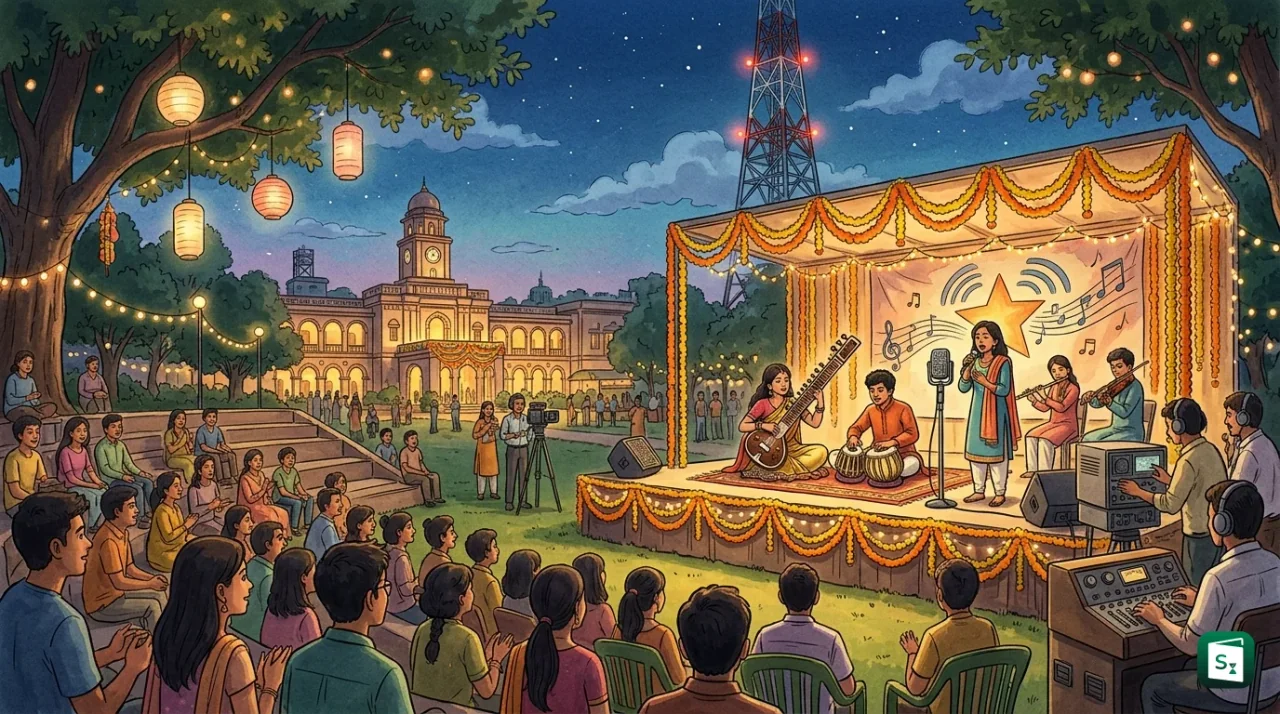
Akashvani, the national radio broadcaster known as All India Radio, has launched AIR Rising Stars Season 1 for musicians below 30 years of age. The series will hold 26 concerts across 18 states and Union Territories from 15 to 30 November 2026. It is part of the 90 years celebration of Akashvani.
What Is AIR Rising Stars Season 1?
AIR Rising Stars Season 1 is a nationwide concert series for young musicians below 30 years of age. Akashvani organises the series to give emerging vocalists and instrumentalists a public stage beyond regular studio broadcasts.
The first season runs from 15 to 30 November 2026. It brings together both graded artists, who have cleared Akashvani auditions, and ungraded youth artists selected by local stations. The network has linked 26 stations across 18 states and Union Territories for this season.
Concerts are open to the public and are held in town halls, cultural centres and Akashvani auditoriums. In Lucknow, a classical evening with artist Ayush Dwivedi was scheduled for 25 November 2026 at Kalamandapam in Bhatkhande Sanskriti Vishwavidyalaya. In Kolkata, Akashvani Kolkata presented young classical artist Subhajit Patra on 30 November 2026 at the Vivekananda Hall in the Ramakrishna Mission Institute of Culture at Golpark. In Miraj in Maharashtra, Akashvani Sangli hosted young artists at the Balgandharva Theatre.
What Is Akashvani and Is All India Radio Still Active?
Akashvani is the national public radio broadcaster of India, also known as All India Radio. The word Akashvani comes from Sanskrit and means voice from the sky. Akashvani and All India Radio are two names for the same organisation, and Akashvani is its on air name since 1956.
Akashvani is active today and is one of the largest radio networks in the world. It works as the radio arm of Prasar Bharati, the statutory public broadcaster of India. It informs, educates and entertains listeners, and its headquarters is at Akashvani Bhavan on Sansad Marg in New Delhi.
When Was Akashvani Established and Why Is It Called Akashvani?
Akashvani traces its start to 8 June 1936. On that day, the Indian State Broadcasting Service was renamed All India Radio. The first news bulletin from Delhi had gone on air earlier that year on 19 January 1936.
Radio broadcasting in India began much earlier. The Radio Club of Bombay made the first broadcast in June 1923. The private Indian Broadcasting Company started stations in Mumbai in July 1927 and in Kolkata in August 1927, but it closed in 1930. The government then took over the service and ran it as the Indian State Broadcasting Service from 1 April 1930.
The name Akashvani has two roots. Poet Rabindranath Tagore used the word Akashvani in a poem for the launch of the Kolkata short wave service. In September 1935, professor M. V. Gopalaswami had also started a private station named Akashvani Mysore from his house Vittal Vihar in Mysore. The scholar Rallapalli Ananta Krishna Sharma had suggested that name to him. In 1956, All India Radio adopted Akashvani as its on air name. In May 2023, the central government ordered that the broadcaster be referred to only as Akashvani in all programmes, in line with the Prasar Bharati Act, 1990.
What Is the Motto of All India Radio and How Many Stations Does It Have?
The motto of Akashvani is Bahujan Hitaya Bahujan Sukhaya. The phrase comes from Sanskrit and means welfare and happiness of the masses. It guides the focus on rural listeners, farmers, women, children, tribal communities and people in border and remote areas.
The size of the network is large. Akashvani now operates 591 broadcasting centres with 755 transmitters in recent official counts. It reaches about 98 percent of the population and covers about 90 to 92 percent of the area of the country. Programmes originate in 23 languages and 146 dialects, while some official profiles list up to 179 dialects including regional variations. The External Services Division broadcasts to more than 100 countries in 11 Indian and 16 foreign languages.
Why 26 Concerts Were Planned for the 90 Years Celebration
Akashvani completed 90 years on 8 June 2026. The date marks 90 years since the Indian State Broadcasting Service became All India Radio on 8 June 1936. The year long celebration honours the journey from six stations at Independence to a pan India network.
At Independence in 1947, Akashvani had only six stations at Delhi, Mumbai, Kolkata, Chennai, Lucknow and Tiruchirappalli. Coverage was limited to 2.5 percent of the area and 11 percent of the population, with about 2,75,000 radio sets in the country. Today it reaches almost every home through terrestrial signals, FM, DTH, the NewsOnAir app and digital platforms.
The 90 years programme includes cultural shows across the country. Akashvani organised a folk programme called Spectrum at Rang Bhavan in New Delhi with Punjabi folk songs and the Kalbeliya dance of Rajasthan. Akashvani Jalandhar and Patiala held walkathons with staff, anchors and listeners. Akashvani Jalandhar also held a classical concert titled Ek Shaam Shastri Sangeet Dey Naam at the K L Saigal Auditorium. Akashvani Agartala held a classical guitar and tabla evening at Sukanta Academy, while Akashvani Shillong held a musical evening with leading bands of Meghalaya.
| Milestone | Date and Detail |
|---|---|
| First club broadcast | June 1923 by Radio Club of Bombay, followed by Calcutta Radio Club in November 1923 |
| Private company phase | Indian Broadcasting Company stations at Mumbai on 23 July 1927 and Kolkata on 26 August 1927 |
| State service begins | Indian State Broadcasting Service from 1 April 1930 |
| All India Radio born | 8 June 1936, renaming of Indian State Broadcasting Service |
| News organisation set up | Central News Organisation on 1 August 1937, later split into News Services Division and External Services Division |
| Akashvani name adopted | 1956 for on air use |
| Vividh Bharati launched | 3 October 1957 with film music |
| Prasar Bharati formed | Statutory corporation from 23 November 1997 under the Prasar Bharati Act, 1990 |
| 90 years completed | 8 June 2026 |
AIR Rising Stars fits into this calendar as the youth music segment. While the Sangeet Sammelan features senior and established artists, Rising Stars reserves the stage for artists below 30 and links concerts in different language regions in the same fortnight.
How Akashvani Promotes Music Through Auditions and Concerts
Akashvani has acted as a patron of music since the 1950s. After Independence, many princely states stopped supporting court musicians. The then Information and Broadcasting Minister B. V. Keskar pushed Akashvani to fill that gap with a clear system for selecting artists and regular national concerts.
Akashvani Music Audition Grades and Annual Music Competition
Akashvani runs a music audition system that has worked for more than 50 years. A committee of senior musicians and experts judges voice quality, command over melody and rhythm, and purity of lyrics and composition. Recording is done without echo or artificial effects.
Artists receive four grades in most categories: B, B High, A and Top. Music composers receive three grades: Grade II, Grade I and Top. A station level board awards the B grade in light, devotional, folk and tribal music after a live audition. A central board at the Directorate General decides higher grades and all grades in classical music. An A grade artist can apply for Top grade after seven years in the grade.
Akashvani organises the All India Radio Music Competition every year to find young talent in classical, light, folk, vocal and instrumental music. The age group in recent editions has been 16 to 24 years. Winners earn recognition as graded artists and move faster to national programmes. Many past winners have later become well known performers.
Akashvani Sangeet Sammelan, Yuvavani and Vividh Bharati
The Akashvani Sangeet Sammelan started in 1954 and is the flagship classical festival. The first edition was a three day concert held on 23 October 1954 at Sapru House in New Delhi. The 67th edition was held from 2 to 29 November 2025 across 24 centres with the Ministry of Culture, with separate concerts for classical and light or folk music at each venue. Panaji and Shillong hosted western classical presentations that year. Performances were later broadcast on the Akashvani network, Raagam channel, DD Bharati and the WAVES platform.
The National Programme of Music began on 20 July 1952. The first Radio Sangeet Sammelan followed in 1954. These national hooks give A and Top grade artists a chance to reach listeners across the country.
Akashvani also runs Yuvavani for youth voices and programmes in which young presenters and artists take part. For mass entertainment, the Vividh Bharati Service, started in 1957, carries film songs, light music, plays and other popular content. FM Gold, FM Rainbow, Akashvani Maitree and Akashvani Geetanjali are among the well known channels and services that carry music and news to different audiences. AIR Rising Stars builds on all these strands by taking young artists out of the studio and before a live audience.
How All India Radio Is Run Under Prasar Bharati
Akashvani functions under the Ministry of Information and Broadcasting. It is the radio wing of Prasar Bharati. The television wing is Doordarshan. Prasar Bharati was set up as a statutory corporation on 23 November 1997 under the Prasar Bharati Act, 1990.
The Director General heads the Directorate General of All India Radio. The network works on three tiers. National programmes go out across the country on medium wave and FM. Regional stations produce programmes in regional languages and dialects. Local Radio Stations serve small towns and local communities, mostly on FM, with flexible programmes on local culture, farming, weather, health and education.
Prasar Bharati Chairman Prasoon Joshi took charge in May 2026. Chief Executive Officer Gaurav Dwivedi leads the executive side. The News Services Division puts out 647 bulletins daily for about 56 hours in 90 languages and dialects across home, regional, external and DTH services. This wide news and music system is why Akashvani is still seen as a reliable source in rural and remote areas, even with 908 private television channels and 388 private FM stations in the country.
Key Takeaways
- AIR Rising Stars Season 1 runs from 15 to 30 November 2026 with 26 concerts across 18 states and Union Territories for musicians below 30 years of age.
- All India Radio was created on 8 June 1936 when the Indian State Broadcasting Service was renamed, and it adopted the on air name Akashvani in 1956.
- The motto of Akashvani is Bahujan Hitaya Bahujan Sukhaya, which means welfare and happiness of the masses.
- Akashvani operates 591 broadcasting centres and broadcasts in 23 languages and 146 dialects, reaching about 98 percent of the population.
- Akashvani is the radio wing of Prasar Bharati, set up on 23 November 1997 under the Prasar Bharati Act, 1990, with headquarters at Akashvani Bhavan in New Delhi.