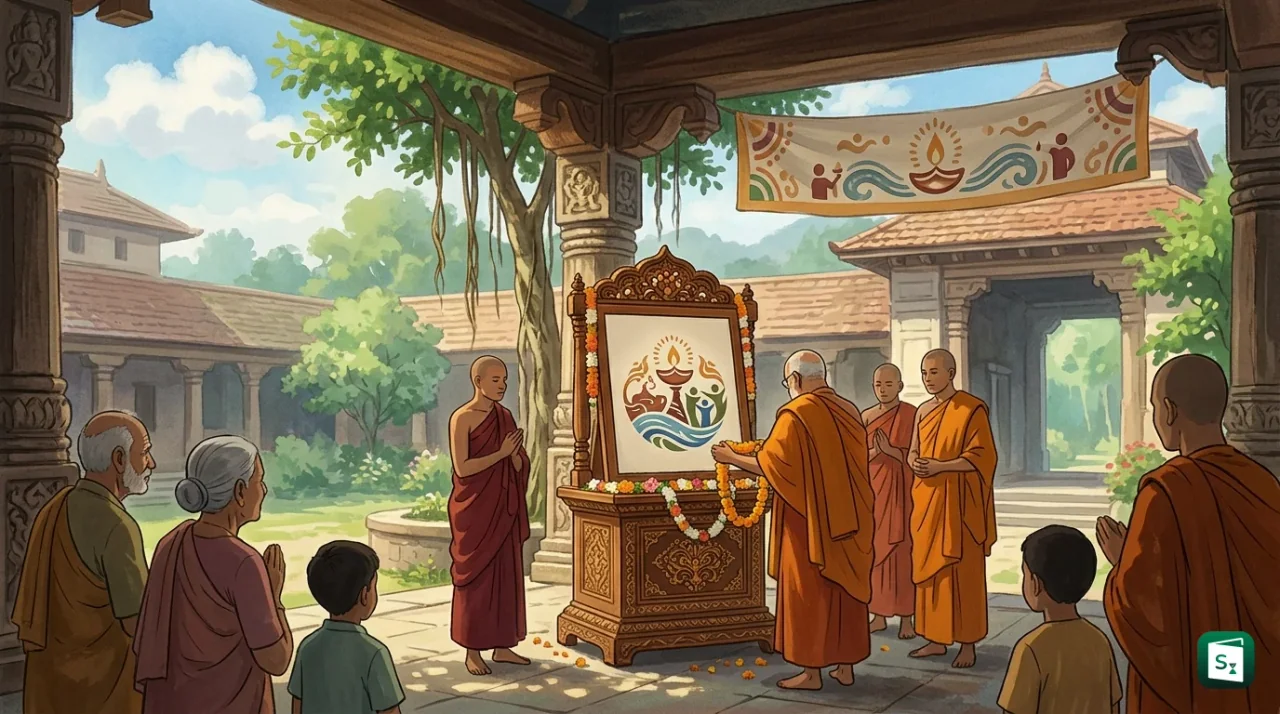
Prime Minister Narendra Modi unveiled the logo for the birth centenary celebrations of Yatikula Chakravarti Sri Vishwesha Tirtha Swamiji in New Delhi on 22 September 2026. The Prime Minister met Sri Sri Vishwaprasanna Tirtha Swamiji of Sri Pejavara Adhokshaja Matha, Udupi, along with other dignitaries at the event. The unveiling marks the start of commemorative initiatives leading to the 100th birth anniversary of the Pejawar seer, who was posthumously honoured with the Padma Vibhushan in 2020.
Centenary Logo Unveiled in New Delhi
Prime Minister Narendra Modi met Sri Sri Vishwaprasanna Tirtha Swamiji, the present seer of Sri Pejavara Adhokshaja Matha of Udupi in Karnataka, in New Delhi on 22 September 2026. During the meeting, the Prime Minister unveiled the centenary logo for the birth centenary celebrations of Yatikula Chakravarti Sri Vishwesha Tirtha Swamiji. The title Yatikula Chakravarti means the foremost among ascetics, and it was conferred on the late Pejawar seer in recognition of his long monastic leadership.
The Prime Minister said the life of Vishwesha Tirtha Swamiji, rooted in devotion, learning and service, continues to inspire countless people. He added that the initiatives planned in the run up to the birth centenary will carry forward his noble ideals among the younger generation. The Pejawar Mutt later noted that Vishwaprasanna Tirtha Swamiji congratulated the Prime Minister on assuming office for a third consecutive term and said the country was making steady progress under his leadership.
A day earlier, Union Home Minister Amit Shah also met Vishwaprasanna Tirtha Swamiji in New Delhi during the seer’s 39th Chaturmasya Vrata. Chaturmasya is the four month period in the rainy season when wandering monks stay at one place for intense prayer, study and restraint. Shah said he sought the seer’s blessings and described the practice as a lesson in renunciation, meditation and inner awakening.
Who Was Vishwesha Tirtha Swamiji
Sri Vishwesha Tirtha Swamiji was the long serving pontiff of the Sri Pejavara Adhokshaja Matha, one of the eight Udupi Mutts in Karnataka. He was born as Venkatramana Bhat on 27 April 1931 at Ramakunja in Dakshina Kannada district of Karnataka to Narayanacharya and Kamalamma. He entered sannyasa, the Hindu order of renunciation, in 1938 at the age of seven and received his scriptural training under Vidyamanya Tirtha Swamiji of Bhandarkeri and Palimaru Mutts.
Vishwesha Tirtha Swamiji headed the Pejawar Mutt from 1952 until his death on 29 December 2019 at the age of 88 in Udupi. In 1988, he ordained Sri Vishwaprasanna Tirtha Swamiji as his successor, who has led the Mutt since 2019. As per his wish, his Brindavana, the final resting memorial of a Hindu monk, was built at the Poornaprajna Vidyapeetha in Bengaluru, the Sanskrit and Vedanta school he founded.
The seer combined deep scholarship in Dvaita Vedanta with wide social engagement. Dvaita Vedanta is the school of Hindu philosophy founded by the 13th century saint Madhvacharya, which holds that God, soul and matter are distinct realities. Vishwesha Tirtha Swamiji set up educational institutions, hostels and service centres for poor students, including the Poornaprajna Vidyapeetha in 1956 and centres of the Akhila Bharat Madhwa Maha Mandala. He led the cow protection movement and played an active role in the Ram Janmabhoomi movement. At the same time, he visited Dalit colonies, worked against untouchability and hosted an Iftar for Muslims during Ramzan inside the Sri Krishna Mutt complex in Udupi, a gesture widely remembered as a symbol of social harmony.
Pejawar Mutt, Udupi and Institutional Legacy
The Pejawar Mutt is one of the Ashta Mathas of Udupi, the eight monasteries founded by Madhvacharya in the 13th century to manage worship at the Udupi Sri Krishna Matha in coastal Karnataka. The eight Mutts are Pejawar, Puttige, Palimaru, Adamaru, Sodhe, Kaniyooru, Shirur and Krishnapura. The main Pejawar Mutt stands at Pejawar village in Mangaluru taluk of Dakshina Kannada, while its Udupi branch plays a central role in the Krishna temple administration. The Mutt now has branches in several pilgrim centres, including Ayodhya, Varanasi, Haridwar, New Delhi, Mumbai and Tirupati.
A distinct feature of Udupi is the Paryaya system. Paryaya means the turn to worship Lord Krishna at Udupi, and each of the eight Mutts takes charge of the temple for two years in rotation. This biennial cycle has operated since 1522. Vishwesha Tirtha Swamiji created history by completing five Paryayas, the second seer after Vadiraja Swamiji of Sodhe Mutt to do so.
| Paryaya Term | Key Contribution |
|---|---|
| First Paryaya, 1952 to 1954 | Organised the first All India Madhwa Conference in Udupi and laid the base for Poornaprajna Vidyapeetha |
| Second Paryaya, 1968 to 1970 | Repaired the Badagumalige, the administrative office and residence of the Paryaya seer |
| Third Paryaya, 1984 to 1986 | Built the Krishna Dhama hall, the period when the Ram Janmabhoomi resolution was discussed at the Dharma Sansad in Udupi |
| Fourth Paryaya, 2000 to 2002 | Renovated the Rajangana hall for cultural and religious programmes, inaugurated by then Prime Minister Atal Bihari Vajpayee |
| Fifth Paryaya, 2016 to 2018 | Renovated Rajangana again and built the Madhwangana hall above it |
These five terms show why his tenure is remembered for institution building as much as for spiritual leadership. The schools, hostels, guest houses and conference halls built in these periods continue to serve devotees, students and scholars.
What Is a Birth Centenary
A birth centenary marks the completion of 100 years since the birth of a person and is observed to recall the life, values and contributions of that person. The Vishwesha Tirtha Swamiji was born on 27 April 1931, so the centenary year falls in 2031, with the logo unveiled in 2026 to begin early preparations.
Birth centenary celebrations in India usually include the release of a logo, commemorative meetings, lectures, publications, cultural programmes and service activities. In this case, the logo unveiled by the Prime Minister will serve as the common symbol for all events organised in the run up to the centenary. Such observances help new generations learn about the seer’s work in religion, education and social reform through a planned calendar of programmes rather than a single day event.
Padma Vibhushan Award Framework and the 2020 Honour
The Padma Awards are among the highest civilian honours of India. They are announced every year on the eve of Republic Day and are presented by the President of India at Rashtrapati Bhavan, usually in March or April. The awards recognise work in fields such as art, social work, public affairs, science and engineering, trade and industry, medicine, literature and education, sports and civil service.
| Award | Rank | Purpose |
|---|---|---|
| Bharat Ratna | Highest civilian award | Exceptional service of the highest order |
| Padma Vibhushan | Second highest civilian award | Exceptional and distinguished service |
| Padma Bhushan | Third highest civilian award | Distinguished service of a high order |
| Padma Shri | Fourth highest civilian award | Distinguished service in any field |
The Padma Vibhushan was instituted on 2 January 1954 and ranks just below the Bharat Ratna. In 2020, the President approved 141 Padma Awards, including seven Padma Vibhushan awards. Sri Vishveshateertha Swamiji of Sri Pejavara Adhokshaja Matha, Udupi, was named among the seven as a posthumous recipient in the category of Others and Spiritualism from Karnataka. The other posthumous Padma Vibhushan recipients that year were George Fernandes, Arun Jaitley and Sushma Swaraj for public affairs. The official citation places his honour under spiritualism, while the centenary announcement recalls his wider contribution to social work through education, service to the poor and efforts for social harmony.
The Way Forward
The Pejawar Mutt has begun preparations for a series of programmes leading to the centenary year. These initiatives are expected to include religious gatherings, memorial lectures on Dvaita philosophy, publication of literature on the seer’s life, and service projects in education and rural welfare. The common logo will give these scattered events a unified identity across Karnataka and other states where the Mutt has branches.
The national attention given by the Prime Minister’s unveiling is likely to widen participation beyond the traditional devotee base. For the Mutt, the challenge will be to convert remembrance into lasting institutions such as scholarships, hostels and study centres that reflect the seer’s focus on learning and service. If implemented well, the centenary can preserve his message of devotion combined with social responsibility for future generations.
Key Takeaways
- Prime Minister Narendra Modi unveiled the birth centenary logo of Vishwesha Tirtha Swamiji in New Delhi on 22 September 2026.
- The logo was unveiled during a meeting with present Pejawar seer Vishwaprasanna Tirtha Swamiji of Sri Pejavara Adhokshaja Matha, Udupi.
- Vishwesha Tirtha Swamiji was born on 27 April 1931 at Ramakunja and led the Pejawar Mutt from 1952 to 2019.
- He completed five Paryayas at Udupi, the second seer after Vadiraja Swamiji of Sodhe Mutt to achieve the feat.
- He was posthumously awarded the Padma Vibhushan in 2020, India’s second highest civilian award instituted in 1954.