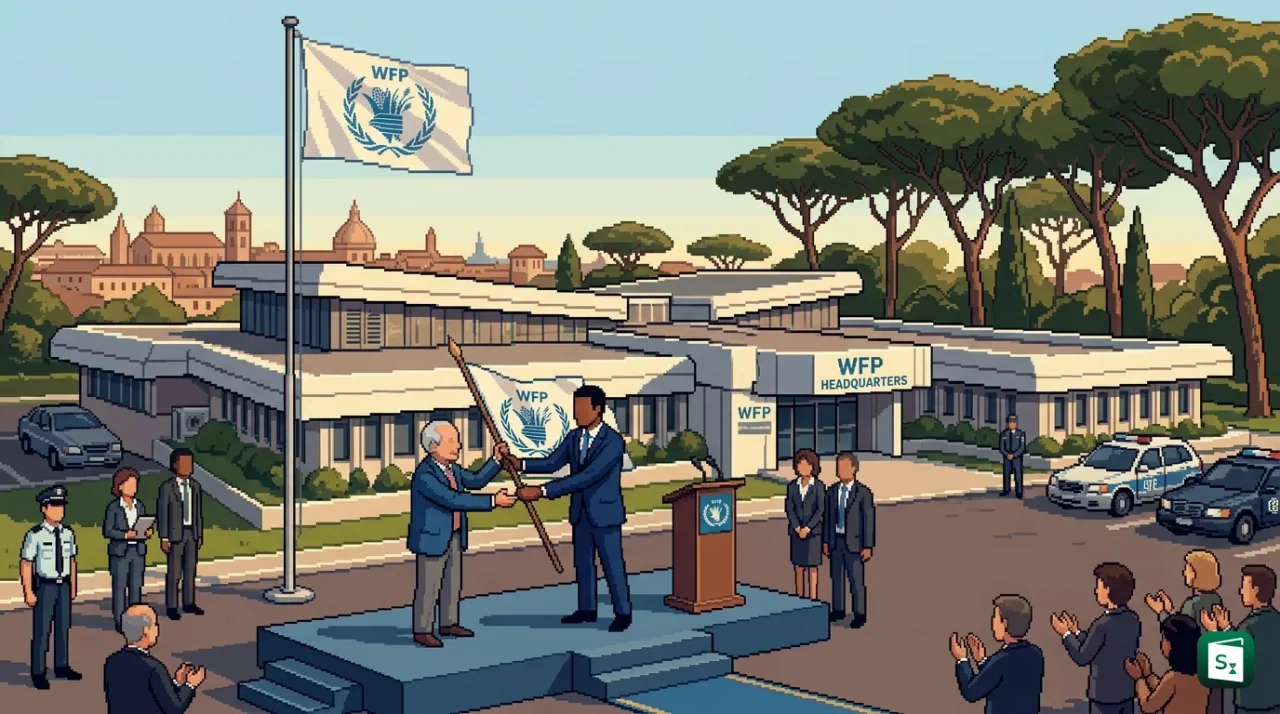
United Nations Secretary-General Antonio Guterres and Food and Agriculture Organization Director-General Qu Dongyu appointed Luke J Lindberg of the United States as Executive Director of the World Food Programme on 18 September 2026. The appointment, made for a fixed five-year term after concurrence of the WFP Executive Board in Rome, places the 37-year-old farm trade diplomat at the head of the world’s largest humanitarian agency. He succeeds Cindy McCain, who led the Programme from April 2023 to May 2026.
Who Is the New Head of the World Food Programme?
The new head of the World Food Programme is Luke J Lindberg of the United States, appointed on 18 September 2026 for a five-year term. The 37-year-old farm trade diplomat currently serves as Under Secretary for Trade and Foreign Agricultural Affairs in the United States Department of Agriculture.
Lindberg took charge as Under Secretary at the United States Department of Agriculture (USDA) on 4 August 2025 after the United States Senate confirmed him by 78 votes to 17. In this role, he serves as the principal diplomat for American agriculture. He oversees the Foreign Agricultural Service and the United States Codex Office, and handles food assistance programmes such as McGovern-Dole Food for Education and Food for Progress. The United States had put forward his candidature for the World Food Programme post on 8 April 2026.
Before joining the USDA, Lindberg founded and led South Dakota Trade as its President and Chief Executive Officer. The body is a public private partnership that helps exporters from South Dakota find markets abroad. During the first term of President Donald Trump, he served as Chief of Staff and Chief Strategy Officer at the Export-Import Bank of the United States (EXIM), where he managed day to day operations and handled a portfolio of about 50 billion dollars. He had earlier worked as a management consultant with IBM in Washington, and led global health operations at Sanford World Clinic across seven countries, including a network of nearly 300 staff in about 30 clinics in Ghana.
Lindberg earned a Bachelor of Arts in Government and Politics, a Master of Public Policy and a Master of Business Administration, all from the University of Maryland. He lives in South Dakota with his wife and two children.
How Is the WFP Executive Director Appointed?
The Executive Director of the World Food Programme is appointed jointly by the United Nations Secretary-General and the Director-General of the Food and Agriculture Organization (FAO) after consultation with the WFP Executive Board. The Executive Director holds office for a fixed five-year term, which can be renewed only once. The Executive Director is answerable to the Board for running the Programme and for carrying out its projects and activities.
In the present case, the WFP Executive Board confirmed its concurrence with the choice of Lindberg at Rome on 18 September 2026. The Board President is the Ambassador of Brazil to the United Nations agencies in Rome, Carla Barroso Carneiro. Lindberg will take charge after Deputy Executive Director Carl Skau completes his period as Acting Executive Director. Skau has held the interim charge since 1 June 2026.
Lindberg succeeds Cindy McCain, who took office on 5 April 2023 after serving as the United States Ambassador to the United Nations food agencies in Rome. McCain announced on 26 February 2026 that she would step down within three months for health reasons. She had suffered a mild stroke in October 2025 and had returned to duty in January 2026. Her active service ended in May 2026, before the completion of her five-year term. Before McCain, the post was held by former South Carolina Governor David Beasley, who led the agency from 2017 to April 2023.
What Is the World Food Programme?
The World Food Programme, with full form World Food Programme and short name WFP, is the food assistance branch of the United Nations and the world’s largest humanitarian organisation. Jointly set up by the United Nations and the Food and Agriculture Organization in 1961, it is headquartered in Rome, Italy.
The idea for a multilateral food aid body came from George McGovern, the then Director of the United States Food for Peace Programme, at the 1960 Conference of the Food and Agriculture Organization. The Programme was created on an experimental basis for three years through two matching resolutions. These were FAO Conference Resolution 1/61 of 24 November 1961 and United Nations General Assembly Resolution 1714 of 19 December 1961. The experiment was made permanent in 1965 through fresh resolutions of the two parent bodies.
The World Food Programme started work quickly. Its first emergency operation supplied wheat, sugar and tea after the earthquake in Iran in 1962, which killed more than 12,000 people. Its first development project was launched in Sudan in 1963. The Programme is therefore jointly owned by the United Nations and the FAO. This dual parentage explains why its chief is chosen jointly by the United Nations Secretary-General and the FAO Director-General. The United States, which helped create the body, has remained its largest donor since 1961.
What Does the World Food Programme Do?
The World Food Programme saves lives in emergencies and builds long term food security through food distribution, cash support, school meals, nutrition care and supply services. It works in more than 120 countries, with two thirds of its help going to conflict zones where hunger is deepest.
The Programme has two clear tasks. The first is to meet urgent needs of refugees and others hit by war, disaster and extreme weather. The second is to support economic and social growth and to promote world food security. In practice, this means direct food delivery, cash and market support where local shops function, treatment of malnutrition among women and small children, daily school meals, help to small farmers, and work on climate strength and stronger food systems.
The scale of work is very large. The Programme has more than 22,300 staff and field offices in 87 countries. It is the world’s leading provider of school meals, a role that began with food for 5,000 children in Togo and now covers millions of learners. It leads the Logistics Cluster of the humanitarian system and jointly leads the Food Security Cluster, which means it moves relief goods and coordinates food action for the whole aid community. Its public tools include the Hunger Map, which tracks hunger live, and the ShareTheMeal app, which lets ordinary people donate meals through a phone.
The challenge before the new chief is sharp. As many as 266 million people face acute hunger, but funding cuts have forced the Programme to aim at reaching only about 110 million people in 2026. In 2023, it faced a funding gap of more than 60 percent, the highest in its history, and had to cut rations in most operations. Emergency demands continue in places such as Gaza, Sudan, South Sudan, Somalia, Yemen, Ukraine and Haiti. The WFP Strategic Plan 2026 to 2029 and the Global Outlook 2026 set the frame for tighter focus on the core task, better operations and closer ties with donors.
Where Is the WFP Headquarters and How Is It Governed?
The headquarters of the World Food Programme is at Via Cesare Giulio Viola 68 in Rome, Italy, inside the FAO complex. It is run by a 36 member Executive Board of states, with daily work led by the Executive Director, one Deputy Executive Director and three Assistant Executive Directors.
The WFP Executive Board is the supreme governing body of the Programme. It gives intergovernmental support, direction and supervision to all activities. Its 36 member states are elected for three-year terms from five electoral lists and meet in Rome. The Board approves plans, budgets and operations, and its concurrence is needed when a new Executive Director is chosen.
The Secretariat, which manages work in more than 120 countries and territories, is headed by the Executive Director. The present senior team includes Deputy Executive Director Carl Skau, who also serves as Chief Operating Officer, and Assistant Executive Directors for Programme Operations, Partnerships and Innovation, and Workplace and Management. The Programme works closely with the Food and Agriculture Organization (FAO) and the International Fund for Agricultural Development (IFAD), the other two Rome based food agencies. While the FAO focuses on food production and farm policy, the Programme focuses on direct food help in crises and on building strength against future shocks.
WFP India Presence and Country Office
The World Food Programme has worked in India since 1963 and its country office is at 2 Poorvi Marg, Vasant Vihar, New Delhi. The present work in India runs under the India Country Strategic Plan 2023 to 2027, which focuses on expert help rather than direct food handouts.
The shift reflects India’s own progress. After India became self sufficient in cereal production in the late 1980s, the Programme moved from food distribution to technical support. The Government of India now handles food delivery, while the Programme helps make the systems stronger and better targeted.
Three areas explain the work clearly. First, the Programme helps improve the Targeted Public Distribution System, which supplies wheat, rice, sugar and kerosene to about 800 million poor people and ranks among the largest food safety nets in the world. Second, it supports fortification of food given through schools and child care centres. In one pilot, rice mixed with iron cut anaemia and the model is linked to the PM Poshan school meal scheme and efforts in states such as Kerala. Third, it helps map hunger through Vulnerability Analysis and Mapping and supports state food security analysis units so that policy and relief reach the most food insecure districts. This technical role matters because high levels of anaemia, stunting and wasting still persist among women and children under five, as recorded in National Family Health Survey 5 (2019 to 2021).
Nobel Peace Prize 2020 Legacy
The Norwegian Nobel Committee awarded the Nobel Peace Prize for 2020 to the World Food Programme for its efforts to fight hunger, for improving the chance of peace in conflict areas, and for stopping the use of hunger as a weapon of war. The prize was announced on 9 October 2020 when David Beasley was Executive Director.
In 2019, the year cited for the prize, the Programme had helped close to 100 million people in 88 countries facing acute food insecurity. The Committee noted that 135 million people suffered acute hunger that year, the highest count in many years, mainly due to war and armed conflict. It also warned that the COVID-19 pandemic was pushing many more to the edge of starvation in places such as Yemen, the Democratic Republic of Congo, Nigeria, South Sudan and Burkina Faso.
The award placed the Programme alongside other United Nations winners such as the UN High Commissioner for Refugees, the UN Children’s Fund (UNICEF), UN Peacekeeping and the United Nations itself. It also linked food work to Sustainable Development Goal 2, which calls for ending hunger by 2030. For the new leadership, the Nobel legacy is both a shield and a test. It confirms the body’s moral standing, but it also raises the bar for reaching the hungry when money is short and conflicts block access.
Why This Appointment Matters
The change of chief comes at a hard moment for global food help. Needs are rising due to conflict, climate shocks and high prices, while donor budgets are shrinking. The United States has said Lindberg is the right leader to bring reform, keep the focus on the core task, improve field results, and rebuild trust with fund providers. His record in trade promotion, export finance and large dispersed teams is presented as proof that he can manage a multibillion dollar relief body with staff in more than 90 countries.
The recent leadership line shows why a smooth handover counts. The table below places the new appointment in sequence.
| Head of the World Food Programme | Period |
|---|---|
| David Beasley | 2017 to 4 April 2023 |
| Cindy McCain | 5 April 2023 to May 2026 |
| Carl Skau (Acting) | 1 June 2026 till new chief takes charge |
| Luke J Lindberg | Appointed 18 September 2026 for five years |
For India, steady leadership in Rome supports steady expert help in New Delhi. Work on supply chain strength, rice fortification, school meals and hunger mapping depends on stable funding and clear policy from headquarters. A chief with a background in farm trade and food aid programmes can shape how American food assistance, including the Food for Peace model now handled through the USDA, links with multilateral feeding work in the years ahead.
Key Takeaways
- Luke J Lindberg was appointed Executive Director of the World Food Programme on 18 September 2026 for a fixed five-year term.
- Lindberg succeeds Cindy McCain, who served from 5 April 2023 to May 2026, with Carl Skau holding interim charge from 1 June 2026.
- The WFP Executive Director is chosen jointly by the UN Secretary-General and the FAO Director-General after consultation with the 36-member WFP Executive Board.
- The World Food Programme, set up in 1961 and headquartered in Rome, is the world’s largest humanitarian organisation and won the Nobel Peace Prize in 2020.
- The WFP India office in New Delhi has worked since 1963 and now supports the Country Strategic Plan 2023 to 2027 on distribution reform, food fortification and hunger mapping.