

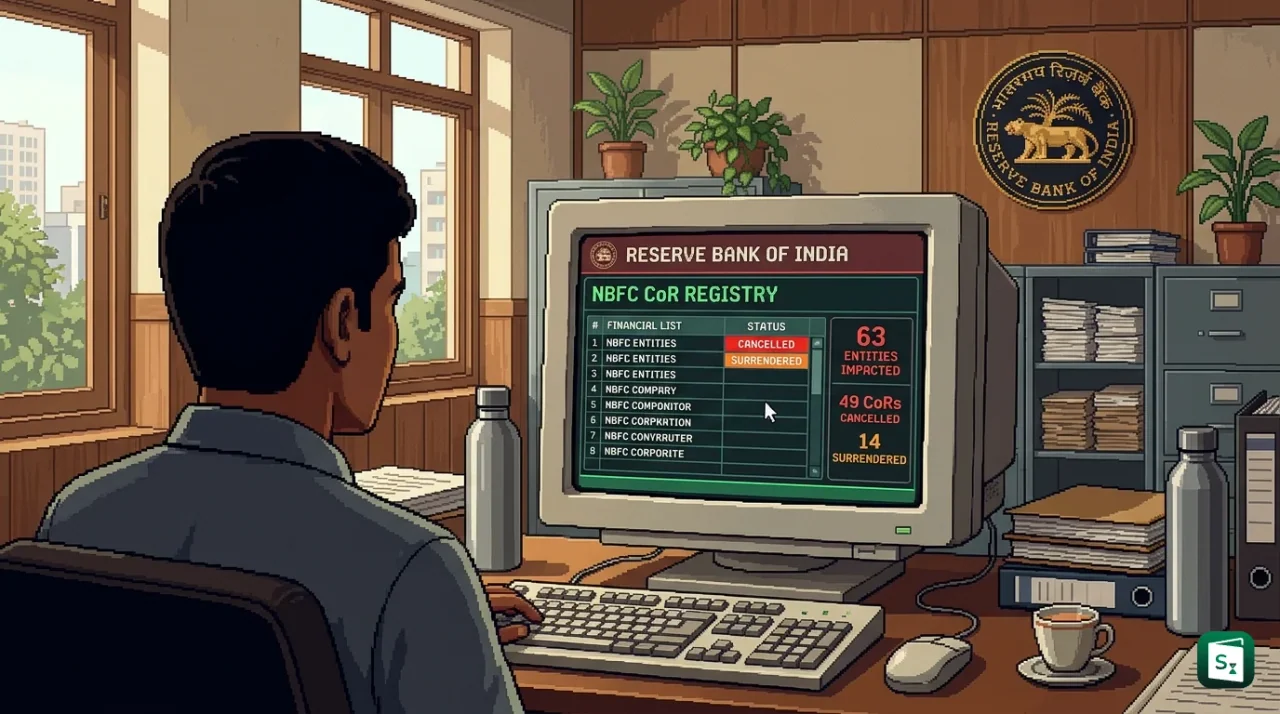
The Reserve Bank of India cancelled the Certificates of Registration (CoRs) of 49 Non-Banking Financial Companies (NBFCs) and accepted the surrender of licences from 13 NBFCs and 1 Housing Finance Company (HFC) in November 2026. The action was notified on 16 November 2026 and affects 63 entities in total. The cancellations were ordered under Section 45-IA(6) of the Reserve Bank of India Act, 1934 and Section 29A of the National Housing Bank Act, 1987.
What Is a Non-Banking Financial Company?
A Non-Banking Financial Company (NBFC) is a company registered under the Companies Act, 1956 or 2013 that provides loans, advances, investments in shares and securities, leasing and hire purchase as its main business. The Reserve Bank of India (RBI), the central bank set up on 1 April 1935 under the RBI Act, 1934 and headquartered in Mumbai, registers and regulates NBFCs that meet the principal business test.
The RBI uses the 50-50 test to decide if a company is an NBFC. Financial assets must be more than 50 percent of total assets, after reducing intangible assets. Income from those financial assets must also be more than 50 percent of gross income. A company that meets both conditions must obtain a Certificate of Registration (CoR) from the RBI before it starts lending or investing as its main business.
An NBFC works like a lender or investor, but it is not a bank. It can give loans and buy securities using its own funds and borrowings. Most NBFCs cannot accept demand deposits such as savings or current account deposits. They also cannot issue cheques drawn on themselves and their depositors do not get cover from the Deposit Insurance and Credit Guarantee Corporation (DICGC).
What Did the RBI Announce on 16 November 2026?
The RBI issued two separate press releases on 16 November 2026 on NBFC licences. In the first release, the RBI said it had cancelled the CoRs of 49 NBFCs in exercise of powers under Section 45-IA(6). The cancellation orders were passed between 1 October and 29 October 2026. In the second release, the RBI said 13 NBFCs and 1 HFC had surrendered their CoRs, and the RBI had cancelled those certificates as a result.
| Action by the RBI | Number of entities | Legal basis |
|---|---|---|
| Cancellation of CoR | 49 NBFCs | Section 45-IA(6) of the RBI Act, 1934 |
| Surrender accepted, CoR cancelled | 13 NBFCs | Section 45-IA(6) of the RBI Act, 1934 |
| Surrender accepted, CoR cancelled | 1 HFC | Section 29A of the NHB Act, 1987 |
| Total affected | 63 entities | RBI Act and NHB Act |
The RBI clarified that the 49 companies whose registrations were cancelled shall not transact the business of a Non-Banking Financial Institution (NBFI) as defined in Section 45-I(a) of the RBI Act. In simple terms, they can no longer act as RBI registered NBFCs. The cancellations were concentrated in Kolkata in West Bengal, with other cases in Tamil Nadu, Maharashtra, Delhi and Gujarat.
Under Which Law Did the RBI Cancel the Registrations?
The RBI cancelled the 49 CoRs under Section 45-IA(6) of the RBI Act, 1934. This section allows the RBI to cancel the registration of an NBFC on five main grounds. The company has stopped doing NBFI business in India. It has broken a condition on which the CoR was given. It no longer meets the approval conditions listed in Section 45-IA(4)(a) to (g), such as ability to pay depositors, honest management and adequate capital.
The remaining grounds relate to disobedience and poor records. The RBI can act if the company ignores directions issued under Chapter IIIB of the RBI Act. It can also act if the company fails to keep accounts as required by law or RBI orders, or refuses to show books and documents to RBI inspectors. A company that has been barred from accepting deposits, and that bar has lasted for at least three months, can also lose its CoR.
Cancellation is not instant without safeguards. The law requires the RBI to give the company a reasonable chance to be heard before passing the order. In practice, the RBI issues a show cause notice based on inspection or return failures, considers the written reply, and then passes a reasoned order. The only exceptions are where the company itself seeks cancellation, or where delay would harm public interest or depositor interest.
The HFC surrender was dealt with under Section 29A of the National Housing Bank Act, 1987. No housing finance company can start or carry on housing finance business without a CoR under this section. The National Housing Bank (NHB), set up on 9 July 1988 and headquartered in New Delhi, was the original regulator. Since 9 August 2019, regulation of HFCs rests with the RBI after changes made by the Finance (No. 2) Act, 2019. HFCs are now treated as a category of NBFC for regulation, while NHB continues supervision and grievance work.
Why Did 13 NBFCs and 1 HFC Surrender Their Certificates?
The RBI grouped the 14 surrenders into three clear reasons. Six entities exited NBFI business. Five entities qualified as Unregistered Type I NBFCs that no longer need registration. Three entities stopped existing as legal persons because of merger, amalgamation, dissolution or strike off.
| Reason for surrender | Number | Examples named by the RBI |
|---|---|---|
| Exit from NBFI business | 6 NBFCs | Manish Synthetics, Amar Plaza and Holdings, Viconic Vyapaar, Right Treasure Finance and Leasing, Bravo Capital Services, CGR Mercantile Finance |
| Meeting Type I exemption conditions | 5 NBFCs | Astrex Enterprise, Capital Finvest, Merlin Homes, Mastermind (India), Klug Investments |
| Ceased to exist legally | 2 NBFCs and 1 HFC | Sun Source Leafin, Lianer Distributors, Manibhavnam Home Finance India (HFC) |
The second group needs explanation. The RBI introduced Unregistered Type I NBFCs through amendment directions dated 29 April 2026, effective from 1 July 2026. These are companies that meet the 50-50 principal business test but operate with no public funds and no customer interface, and hold assets below ₹1,000 crore. Public funds include public deposits, bank loans, debentures and commercial paper, including money taken through group companies. Customer interface means any lending, guarantee or service link with customers, including group firms and directors.
Such companies pose very low systemic risk because they invest mainly their own funds. The RBI therefore exempted them from registration under Section 45IA using powers under Section 45NC of the RBI Act. Existing registered NBFCs that follow this model with assets below ₹1,000 crore could seek deregistration. Companies that cross ₹1,000 crore, or plan to take public funds or serve customers, must register as Type I or Type II NBFCs before doing so.
How Is an NBFC Different From a Bank?
An NBFC lends and invests like a bank but it is not a bank under the law. The RBI states that NBFCs cannot accept demand deposits, cannot join the payment and settlement system, cannot issue cheques drawn on themselves, and do not offer DICGC insurance to depositors. Banks accept savings and current deposits, clear cheques and provide insured deposits.
| Feature | Bank | NBFC |
|---|---|---|
| Demand deposits | Can accept savings and current deposits | Cannot accept demand deposits |
| Payment system and cheques | Part of payment system, can issue cheques | Not part of payment system, cannot issue cheques drawn on itself |
| Deposit insurance | Deposits covered by DICGC up to the legal limit | No DICGC cover for deposit taking NBFCs |
| Registration | Banking licence under the Banking Regulation Act | CoR from the RBI under Section 45-IA of the RBI Act |
Only a small set of NBFCs can accept deposits. An NBFC needs a specific deposit accepting CoR to take public deposits, and only within the limits the RBI allows. As a matter of policy since 1997, the RBI favours banks for public deposits. Most NBFCs today are non deposit taking and raise money through equity, bank loans, debentures and commercial paper instead of public savings.
How Does NBFC Registration and Scale Based Regulation Work?
The RBI grants a CoR only if the company is incorporated under company law and holds the minimum Net Owned Fund (NOF). New NBFCs seeking registration as Investment and Credit Companies (NBFC-ICC), Micro Finance Institutions (NBFC-MFI) or Factors need ₹10 crore from the start. Existing companies in these groups must reach ₹5 crore to ₹7 crore by 31 March 2025 and ₹10 crore by 31 March 2027. Failure to meet the level can lead to loss of the CoR.
NOF levels differ by activity. NBFC Peer to Peer (P2P), Account Aggregator (AA) and Type I NBFCs need ₹2 crore. Infrastructure Finance Companies (IFC) and Infrastructure Debt Funds (IDF-NBFC) need ₹300 crore. Housing Finance Companies need ₹20 crore, Mortgage Guarantee Companies need ₹100 crore, and Standalone Primary Dealers need ₹150 crore to ₹250 crore. Applications are filed on the RBI PRAVAAH portal with company, capital and management documents.
The RBI organises registered NBFCs into four layers under Scale Based Regulation. Lower layer rules apply to higher layers as well.
| Layer | Who is included |
|---|---|
| Base Layer (NBFC-BL) | Non deposit taking NBFCs below ₹1,000 crore assets, plus P2P, AA, Non Operative Financial Holding Companies and Type I NBFCs which always stay in this layer |
| Middle Layer (NBFC-ML) | All deposit taking NBFCs, non deposit taking NBFCs of ₹1,000 crore and above, Standalone Primary Dealers, IDF-NBFCs, Core Investment Companies, HFCs and IFCs |
| Upper Layer (NBFC-UL) | Large NBFCs identified each year by the RBI, now those with assets of ₹1,00,000 crore and above, subject to stronger rules for at least five years |
| Top Layer (NBFC-TL) | Ideally empty, used only if an Upper Layer NBFC creates very high systemic risk |
An HFC has its own principal business test. At least 60 percent of its total assets must be housing finance, and at least 50 percent must be individual housing loans as defined in the RBI Housing Finance Companies Directions, 2025. The RBI published the 2026-27 Upper Layer list on 6 August 2026 with names such as REC, Power Finance Corporation, Bajaj Finance, Shriram Finance and LIC Housing Finance, showing how large NBFCs face bank like scrutiny.
Key Takeaways
- The RBI cancelled CoRs of 49 NBFCs and accepted surrender from 13 NBFCs and 1 HFC on 16 November 2026, affecting 63 entities.
- Cancellations were made under Section 45-IA(6) of the RBI Act, 1934 and Section 29A of the NHB Act, 1987 for the HFC case.
- An NBFC must meet the 50-50 principal business test and hold a CoR with minimum NOF of ₹10 crore by 31 March 2027 for ICC, MFI and Factor types.
- Unregistered Type I NBFCs with assets below ₹1,000 crore, no public funds and no customer interface are exempt from registration since 1 July 2026.
- Unlike banks, NBFCs cannot accept demand deposits, cannot issue cheques and do not provide DICGC insurance cover.