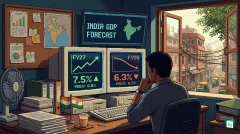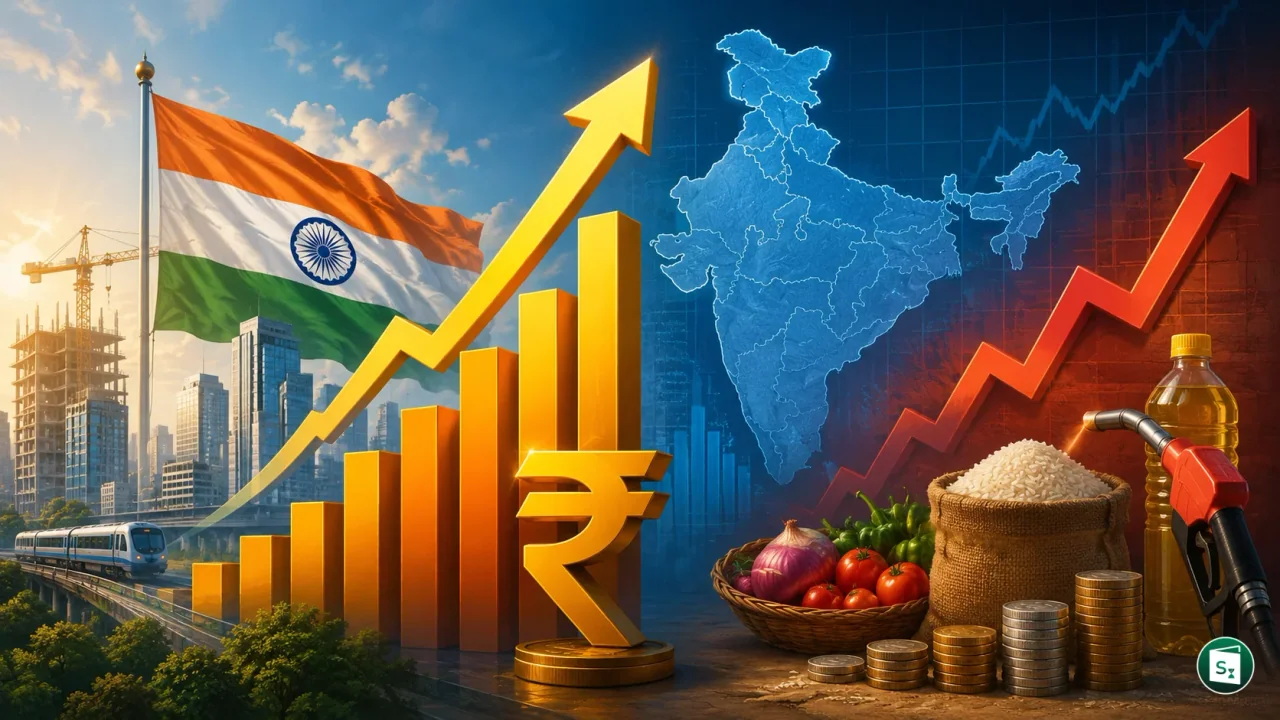
India is projected to grow at a robust 7.6% in the 2025-26 fiscal year, maintaining its status as the fastest-growing major economy according to the OECD Economic Outlook June 2026 report. However, the projections suggest a moderation to 6.3% in FY2026-27 as the economy faces a significant spike in inflation driven by global energy shocks. This report highlights the dual challenge of sustaining domestic investment momentum while navigating a volatile international landscape.
India’s Growth Trajectory: Key GDP Forecasts
The report, titled OECD Economic Outlook Under Pressure, underscores India’s position as a standout performer in the global economy. For the current fiscal year (FY2025-26), the organisation has projected a growth rate of 7.6%, supported by strong domestic demand and significant infrastructure spending. However, the outlook for the subsequent years indicates a cooling period as external headwinds begin to impact domestic activity.
The OECD has revised its projection for FY2026-27 to 6.3%, an increase from its earlier estimate of 6.1%. This revision reflects a slightly better than expected resilience in urban consumption and public investment. By FY2027-28, the growth is expected to stabilise at 6.4%, as the economy adjusts to new price levels and external trade conditions.
| Fiscal Year | GDP Growth Projection |
|---|---|
| FY 2025-26 | 7.6% |
| FY 2026-27 | 6.3% |
| FY 2027-28 | 6.4% |
The Challenge of Rising Inflation in FY27
One of the most concerning aspects of the report is the projected spike in Consumer Price Index (CPI) inflation. While inflation is expected to remain low at 2.1% in FY2025-26, it is projected to jump to 4.8% in FY2026-27. This increase is primarily attributed to higher costs for essential imports, including energy and fertilizers, which are being pushed up by global supply chain disruptions.
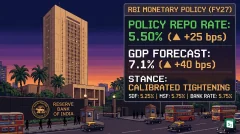
The sharp rise in inflation is expected to impact real household income, potentially slowing down the recovery in rural demand. To counter these pressures, the OECD suggests that monetary policy may need to tighten, potentially involving a 25 basis point hike in the repo rate by the Reserve Bank of India (RBI) during the early months of the next fiscal year. This move would aim to anchor inflation expectations and prevent the secondary effects of imported inflation from spreading domestic economy.
Global Headwinds and Domestic Resilience
The moderation in growth projections is largely a result of external factors, specifically the geopolitical tensions in West Asia. These tensions have led to higher imported energy costs, as India relies heavily on this region for nearly 46% of its crude oil and 57% of its natural gas requirements. The resulting increase in import bills is expected to widen India’s Current Account Deficit (CAD) to 2.1% of GDP in FY2026-27, up from just 0.7% in the previous year.
Despite these challenges, the OECD notes that India’s domestic foundations remain strong. Several factors contribute to this resilience:
- Public Investment: Continued government focus on infrastructure projects, such as the Gati Shakti initiative, provides a steady floor for growth.
- Urban Consumption: Demand in urban centers remains robust, supported by rising employment and wage growth in the services sector.
- Fiscal Support: The government is expected to adopt an expansionary fiscal stance in the short term to mitigate the impact of energy price shocks on consumers and industries.
The report estimates that India’s Public Debt will continue its downward trajectory, reaching approximately 54.7% of GDP by FY2027-28, provided that structural reforms continue to enhance revenue collection and expenditure efficiency.
About the Organisation for Economic Co-operation and Development (OECD)
The Organisation for Economic Co-operation and Development (OECD) is an international intergovernmental organisation that works to build better policies for better lives. It provides a platform for its member countries to compare policy experiences, seek answers to common problems, and coordinate domestic and international policies.
| Detail | Information |
|---|---|
| Headquarters | Paris, France |
| Established | 30 September 1961 (Successor to the OEEC) |
| Members | 38 countries (India is a Key Partner, not a member) |
| Secretary-General | Mathias Cormann |
| Official Languages | English and French |
The OECD operates as a think tank and a monitoring agency, publishing regular economic outlooks, surveys, and statistical databases that are widely used by governments and international organisations to track global economic trends.
Key Takeaways
- India is projected to be the fastest-growing major economy with a GDP growth rate of 7.6% in FY2025-26.
- The growth forecast for FY2026-27 has been revised upwards to 6.3% from an earlier estimate of 6.1%.
- CPI inflation in India is expected to spike significantly from 2.1% in FY26 to 4.8% in FY2026-27.
- India’s Current Account Deficit (CAD) is estimated to widen to 2.1% of GDP in FY27 due to higher energy import costs from West Asia.
- The Organisation for Economic Co-operation and Development (OECD) is headquartered in Paris and was established in 1961.
- India is classified as a Key Partner of the OECD, alongside countries like China, Brazil, and South Africa.
- Mathias Cormann currently serves as the Secretary-General of the organisation.