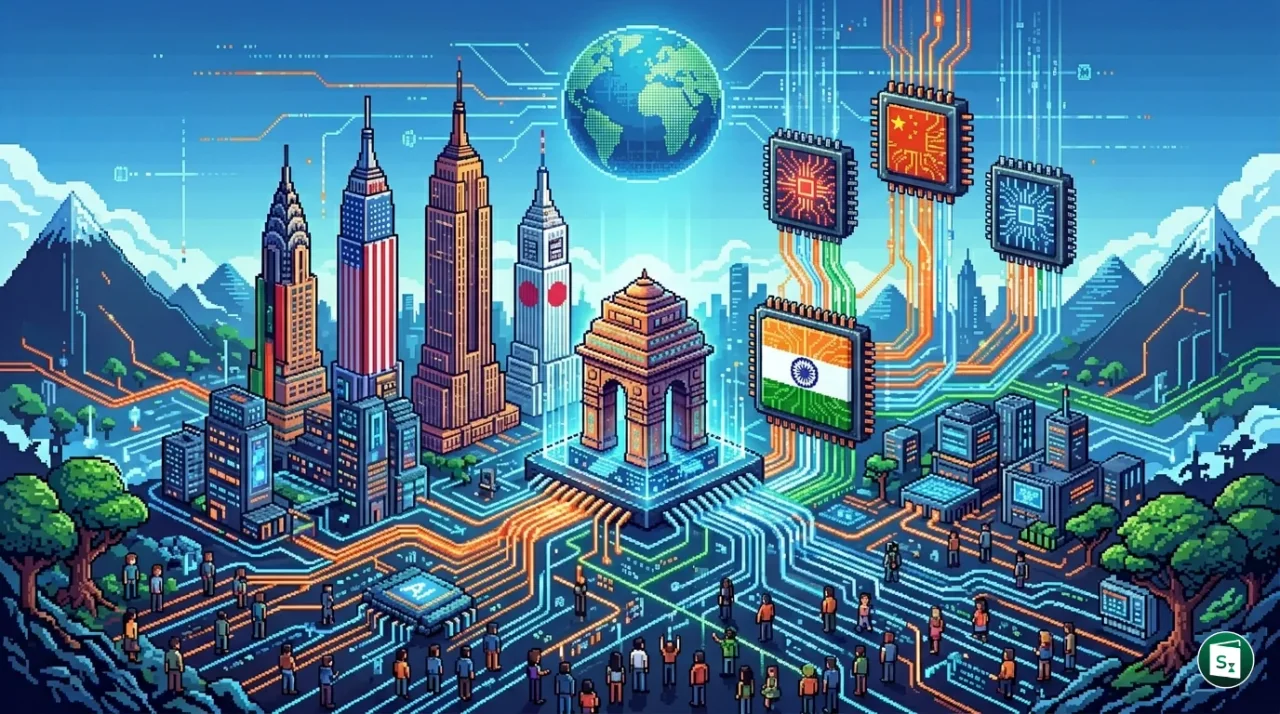
India has secured its position as the world’s fifth most digitalised economy according to the State of India’s Digital Economy (SIDE) 2026 report released by ICRIER. The findings highlight India’s rapid climb from the eighth position in 2025, driven by a surge in artificial intelligence adoption and internet connectivity. This transformation places India as a leading force in the emerging tripolar digital order, alongside the traditional North Atlantic powers and China.
The SIDE 2026 Report and the CHIPS Framework
The State of India’s Digital Economy (SIDE) 2026 report is the third edition of the annual study published by the ICRIER-Prosus Centre for Internet and Digital Economy (IPCIDE). The Indian Council for Research on International Economic Relations (ICRIER), established in 1981 and headquartered in New Delhi, is one of India’s premier economic policy think tanks. The 2026 report benchmarks 71 economies that together represent nearly 96% of the global Gross Domestic Product (GDP).
The report uses the CHIPS framework to evaluate the digital maturity of nations. This framework is built on five key pillars:
- Connect: Focuses on internet accessibility, broadband penetration, and 5G network coverage.
- Harness: Measures the actual usage of digital tools, specifically focusing on Digital Public Infrastructure (DPI) like Aadhaar and UPI.
- Innovate: Evaluates research and development (R&D) efforts, the startup ecosystem, and technological patents.
- Protect: Assesses data privacy, cybersecurity measures, and digital trust.
- Sustain: Examines the environmental and social impact of the digital economy.
The 2026 edition of the index has specifically integrated AI-related indicators across these pillars to reflect the transformative impact of artificial intelligence on global markets.
India’s Rise as a Global Digital Powerhouse
India has achieved a significant milestone by becoming the world’s fifth most digitalised economy, jumping three spots from its eighth-place finish in 2025. This rapid ascent has allowed India to surpass major developed nations including Germany, France, Japan, and Canada. The top four spots in the index are held by the United States, China, Singapore, and the United Kingdom.
The report identifies a structural shift in global digital leadership, moving away from traditional North Atlantic dominance. It introduces the concept of a tripolar digital order, where three major poles now drive global technological growth:
- North Atlantic Pole: Led by the United States and the United Kingdom.
- China Pole: Operating as a standalone digital superpower.
- Indo-Pacific Pole: Led by India and Singapore.
India’s economic strength in the digital domain is reflected in its digitally delivered trade, which reached nearly $328 billion. This figure accounts for approximately 50% of the total digitally delivered services exported by the BRICS nations, showcasing India’s role as a global IT and services hub.
Dominance in Artificial Intelligence and Talent
Artificial Intelligence (AI) has emerged as a cornerstone of India’s digital strategy. On the CHIPS-AI Index, which specifically measures AI capability, India is positioned fourth globally. It trails only the United States, China, and Singapore, while outperforming many other technologically advanced nations.
India’s leadership in AI is supported by its massive user base and specialized human capital:
- Global AI Users: India accounts for 19.9% of all AI users worldwide. The report notes that AI adoption is increasingly a developing-country phenomenon, with 72% of global AI users residing in developing nations.
- AI Talent Pool: India possesses the second-largest concentration of AI talent in the world. This provides the country with a significant competitive advantage in developing and scaling AI-driven solutions.
To support this growth, the government has established the National AI Portal, known as INDIAai, which serves as a central hub for AI-related developments and resources in the country. However, despite high adoption and a deep talent pool, the report highlights a critical gap: India currently commands only 1% of global private AI investment. Addressing this funding shortfall is seen as essential for India to transition from a primary user of AI to a global leader in AI innovation.
Connecting the Dots: Digital Public Infrastructure and Internet Growth
The report attributes India’s rapid digitalisation to a combination of high-speed internet expansion and the widespread adoption of Digital Public Infrastructure (DPI). India recorded an 8.8% growth in internet users, which is significantly higher than the 2.1% average growth observed among the other top 10 digital economies.
India performs exceptionally well in the Connect and Harness pillars of the CHIPS framework. This success is driven by several factors:
- Connectivity: The aggressive rollout of 5G services and the implementation of the BharatNet project have expanded high-speed broadband access to rural areas.
- Harnessing Digital Tools: India’s DPI ecosystem, including Aadhaar (biometric identity), UPI (Unified Payments Interface), and DigiLocker, has facilitated the seamless delivery of public and private services at scale.
The table below summarizes India’s performance across the five pillars of the CHIPS framework:
| CHIPS Pillar | Primary Focus Areas | India’s Performance Drivers |
|---|---|---|
| Connect | Internet and 5G access | Lowest data tariffs globally, BharatNet |
| Harness | Usage of digital tools | UPI, Aadhaar, DigiLocker, ABDM |
| Innovate | R&D and Startups | 3rd largest startup ecosystem worldwide |
| Protect | Security and Trust | Need for stronger data privacy laws |
| Sustain | Social and Green impact | Focus on green data centres and digital inclusion |
India’s model of digitalisation is unique because it leverages government-backed infrastructure to enable private sector innovation. This approach has allowed the country to achieve levels of digital penetration that typically take much longer for lower-middle-income economies to reach.
Key Takeaways
- India is ranked as the 5th most digitalised economy globally in the SIDE 2026 report, climbing from the 8th position in 2025.
- The report was released by the ICRIER-Prosus Centre for Internet and Digital Economy (IPCIDE) and evaluates 71 economies using the CHIPS framework.
- India ranks 4th globally on the CHIPS-AI Index, trailing only the United States, China, and Singapore in AI capability.
- The country possesses the world’s second-largest AI talent pool and accounts for 19.9% of all AI users worldwide.
- India’s internet user base grew by 8.8%, a rate nearly four times higher than the average growth of the other top 10 digital economies.
- The report highlights India as a key pillar of the emerging tripolar digital order, alongside the North Atlantic powers and China.