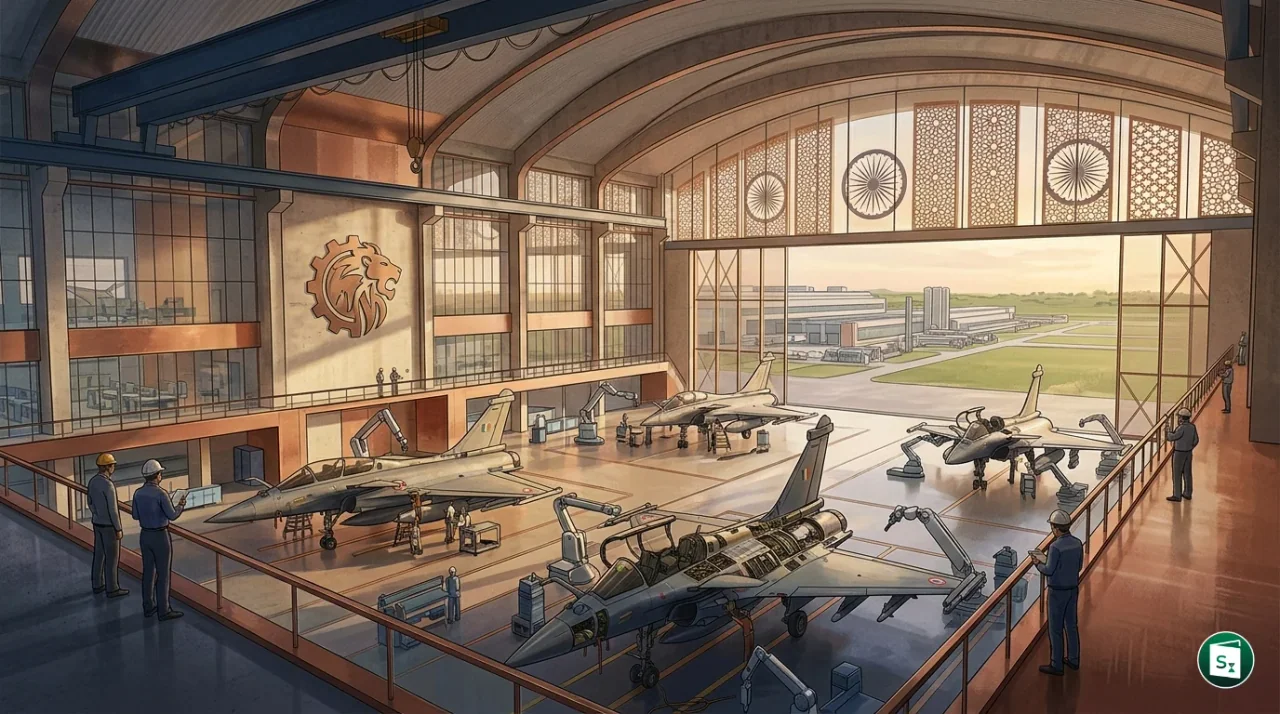
India has formally issued a Letter of Request (LoR) to the French government for the procurement of 114 Rafale multi-role fighter jets in a deal valued at approximately ₹3.25 lakh crore. This massive acquisition, part of the Multi-Role Fighter Aircraft (MRFA) program, marks a significant shift toward a government-to-government (G2G) framework to address the Indian Air Force (IAF) dwindling squadron strength. The move solidifies India’s strategic defense partnership with France while emphasizing domestic manufacturing through a primary collaboration with Tata Advanced Systems.
Addressing the IAF Squadron Shortfall
The Indian Air Force (IAF) is currently facing a critical shortage of fighter squadrons, operating with approximately 30 squadrons against a sanctioned strength of 42.5. This deficit has been exacerbated by the phased retirement of older Soviet-era MiG-21 and MiG-29 fleets. The procurement of 114 jets under the Multi-Role Fighter Aircraft (MRFA) program is intended to bridge this gap until India’s indigenous fifth-generation fighter, the Advanced Medium Combat Aircraft (AMCA), enters production.
Initially envisioned as an open global tender, the MRFA program has pivoted toward the Rafale to ensure fleet commonality. By selecting the Rafale, the IAF can leverage existing maintenance infrastructure, training protocols, and logistics developed for the 36 Rafale jets ordered in 2016. This commonality is expected to save billions of dollars in long-term operational costs and significantly reduce induction timelines.
The “Make in India” Roadmap and Industrial Partnership
A defining feature of this ₹3.25 lakh crore agreement is the extensive focus on domestic production. Under the proposed terms, 18 to 20 aircraft will be delivered in “fly-away” condition directly from France, while the remaining 94 to 96 jets will be manufactured in India. Dassault Aviation has finalized a partnership with Tata Advanced Systems Limited (TASL) to establish a massive manufacturing ecosystem.
The centerpiece of this collaboration is a state-of-the-art facility in Hyderabad, which is set to become the first site outside of France to produce the complete Rafale fuselage. This facility will not only cater to the Indian order but is also expected to be integrated into Dassault’s global supply chain. Furthermore, the program aims for nearly 50% indigenous content, incorporating Indian-made avionics, mission computers, and advanced weaponry like the Astra Beyond Visual Range (BVR) missile.
Role of Other Industrial Hubs
The Rafale ecosystem in India extends beyond Hyderabad. The Dassault Reliance Aerospace Limited (DRAL) facility in Nagpur continues to function as a center of excellence for components and Falcon business jet parts. Additionally, Hindustan Aeronautics Limited (HAL) is expected to play a crucial role in the Maintenance, Repair, and Overhaul (MRO) operations and the final integration of indigenous systems onto the platform.
Strategic Significance and Technical Edge
The Rafale is a 4.5-generation multi-role fighter known for its “omni-role” capabilities, meaning it can perform multiple missions, such as air supremacy, interdiction, aerial reconnaissance, and nuclear deterrence, during the same flight. The aircraft being procured under this deal will follow the F4 standard, which features enhanced connectivity, upgraded radar capabilities, and improved electronic warfare systems. There are also provisions to eventually upgrade the fleet to the future F5 standard, ensuring the IAF remains technologically superior in the region.
The government-to-government (G2G) nature of the deal underscores the deep strategic trust between India and France. This partnership has evolved into a “Special Global Strategic Partnership,” focusing on technological sovereignty and co-development. Beyond the IAF, this collaboration extends to the Indian Navy, which finalized a separate contract for 26 Rafale Marine (M) jets in 2025.
Strengthening the Naval Wing: The Rafale-M Connection
The Indian Navy is also set to benefit from the Rafale ecosystem. Following the 2025 agreement, the first Rafale-M jets are expected to be delivered by 2028. These carrier-based aircraft will operate from INS Vikrant and INS Vikramaditya, replacing the aging MiG-29K fleet. The high level of commonality (nearly 80%) between the Air Force and Navy variants will streamline training and maintenance for both services, marking a major step toward jointness in India’s defense forces.
Key Takeaways
- India has issued a formal Letter of Request (LoR) to France for the procurement of 114 Rafale fighter jets for the IAF.
- The deal is valued at approximately ₹3.25 lakh crore and will be executed through a Government-to-Government (G2G) framework.
- Out of 114 aircraft, 94 jets are planned to be manufactured in India by Dassault Aviation in collaboration with Tata Advanced Systems.
- A primary manufacturing hub for Rafale fuselages will be established in Hyderabad, marking the first such facility outside of France.
- The new fleet will follow the advanced F4 standard, with future upgrade paths to the F5 standard for long-term technological edge.
- The Indian Navy is also procuring 26 Rafale-M jets, with the first deliveries expected to arrive by 2028.