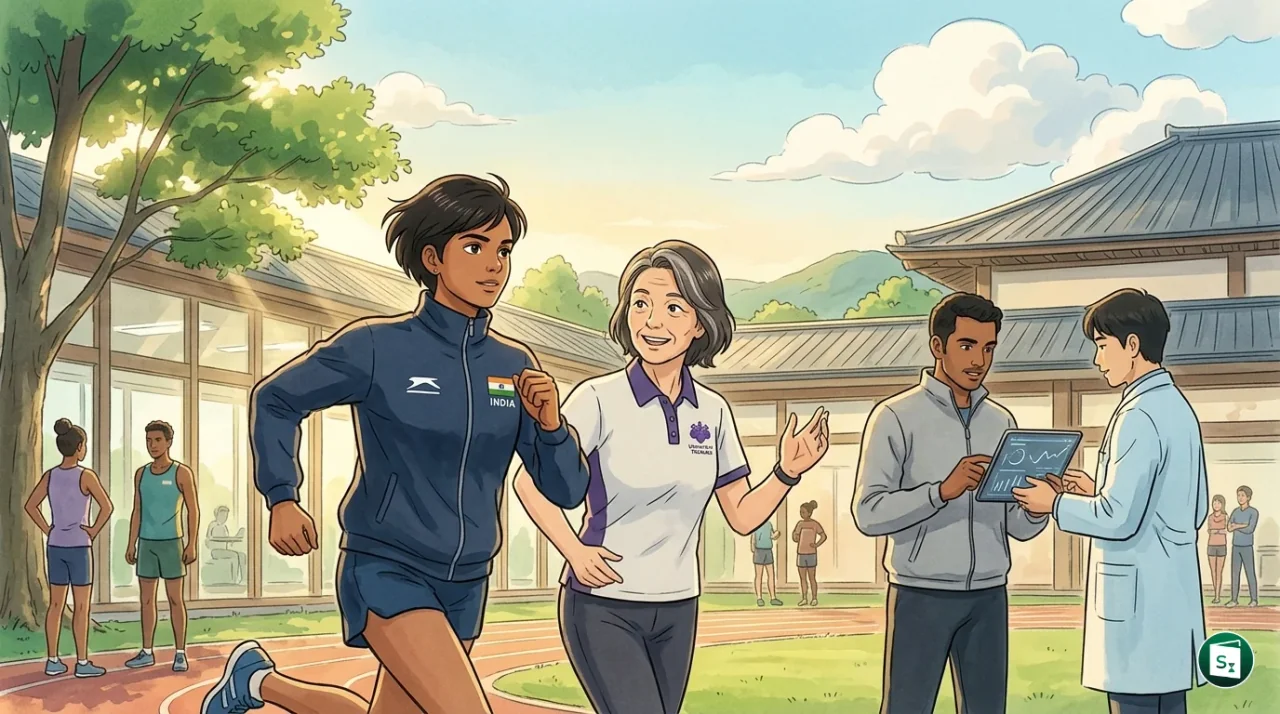
The Sports Authority of India (SAI) signed a fresh Memorandum of Understanding (MoU) with the University of Tsukuba, Japan, on June 5, 2026, to modernize the nation’s high-performance sports framework. This three-year agreement aims to provide world-class training and exchange opportunities for Indian athletes, coaches, and sports scientists at one of Asia’s premier sports institutions. The partnership is a critical step in India’s preparation for upcoming global events, including the 2030 Commonwealth Games and the bid for the 2036 Olympics.
Details of the Strategic Partnership
The agreement was signed in New Delhi by Manjushree Dayanand, Deputy Director General of the Sports Authority of India, and Prof. Kyosuke Nagata, President of the University of Tsukuba. This collaboration builds on the India-Japan Sports Cooperation Framework initiated in 2016 and subsequent institutional agreements signed in 2018. The new tenure extends for three consecutive years, focusing on deep institutional integration to share knowledge in coaching methodology and athlete management.
The Sports Authority of India (SAI), established in 1984 to manage the legacy of the 1982 Asian Games, is an autonomous body under the Ministry of Youth Affairs and Sports. Headquartered at the Jawaharlal Nehru Stadium Complex in New Delhi, SAI operates major academic wings like the Netaji Subhas National Institute of Sports (NSNIS) in Patiala. This MoU aligns with SAI’s mission to professionalize Indian sports by leveraging Japan’s expertise in “Human High Performance” research.
Focus on Five Priority Sporting Disciplines
The partnership specifically targets five key disciplines where India aims to enhance its international competitiveness. These include Athletics, Archery, Table Tennis, Swimming, and Judo. Athletes and coaches from these sports will participate in attachment programs and specialized training sessions at the University of Tsukuba’s world-class facilities in Japan.
This focused approach complements the Target Olympic Podium Scheme (TOPS), which was launched in September 2014 to provide customized support to India’s top medal prospects. By integrating Tsukuba’s advanced training protocols into the TOPS framework, the government intends to improve podium finishes in marquee events. Judo holds a special place in this agreement because the University of Tsukuba was founded by Kano Jigoro, the creator of Judo and the first Asian member of the International Olympic Committee.
Advancing Sports Science through TIAS 2.0
A significant component of the MoU is the academic and technical exchange through the Tsukuba International Academy for Sport Studies (TIAS 2.0). This academy is a center of excellence established by the Japanese government to train future global sports leaders. Under the new agreement, Indian sports administrators, researchers, and coaches will have access to specialized internships and higher education opportunities in Japan.
The technical cooperation covers several critical domains of modern athletics:
- Sports Medicine and Physiotherapy: Sharing best practices in injury prevention and rehabilitation.
- Strength and Conditioning: Implementing data-driven physical training modules.
- Performance Analysis: Using high-tech tools to monitor and improve athlete output.
- Facility Development: Technical consultation on building world-class sports infrastructure in India.
Supporting India’s 2036 Olympic Ambitions
The renewal of this partnership is timed strategically as India ramps up its efforts to host major international multi-sport events. The country is currently preparing to host the 2030 Commonwealth Games and has officially expressed interest in bidding for the 2036 Olympic and Paralympic Games. Access to Japan’s mature sports economy and training systems is expected to provide India with the operational learning required to manage such large-scale events.
By collaborating with the University of Tsukuba, which has produced over 60 Olympians and won more than 135 medals collectively, India seeks to replicate Japan’s success in building a sustainable medal-winning culture. This MoU is part of a broader “Next 10 Years” vision for India-Japan relations, where sports serves as a vital bridge for people-to-people exchange and institutional growth.
Key Takeaways
- The Sports Authority of India (SAI) signed a three-year MoU with Japan’s University of Tsukuba in June 2026.
- The agreement prioritizes training and sports science exchange for five disciplines: Athletics, Archery, Table Tennis, Swimming, and Judo.
- Manjushree Dayanand (DDG, SAI) and Prof. Kyosuke Nagata (President, University of Tsukuba) were the primary signatories.
- The collaboration leverages the Tsukuba International Academy for Sport Studies (TIAS 2.0) for academic and technical internships.
- The Sports Authority of India was established in 1984 and operates under the Ministry of Youth Affairs and Sports.
- The partnership supports India’s strategic goals for the 2030 Commonwealth Games and the 2036 Olympic bid.