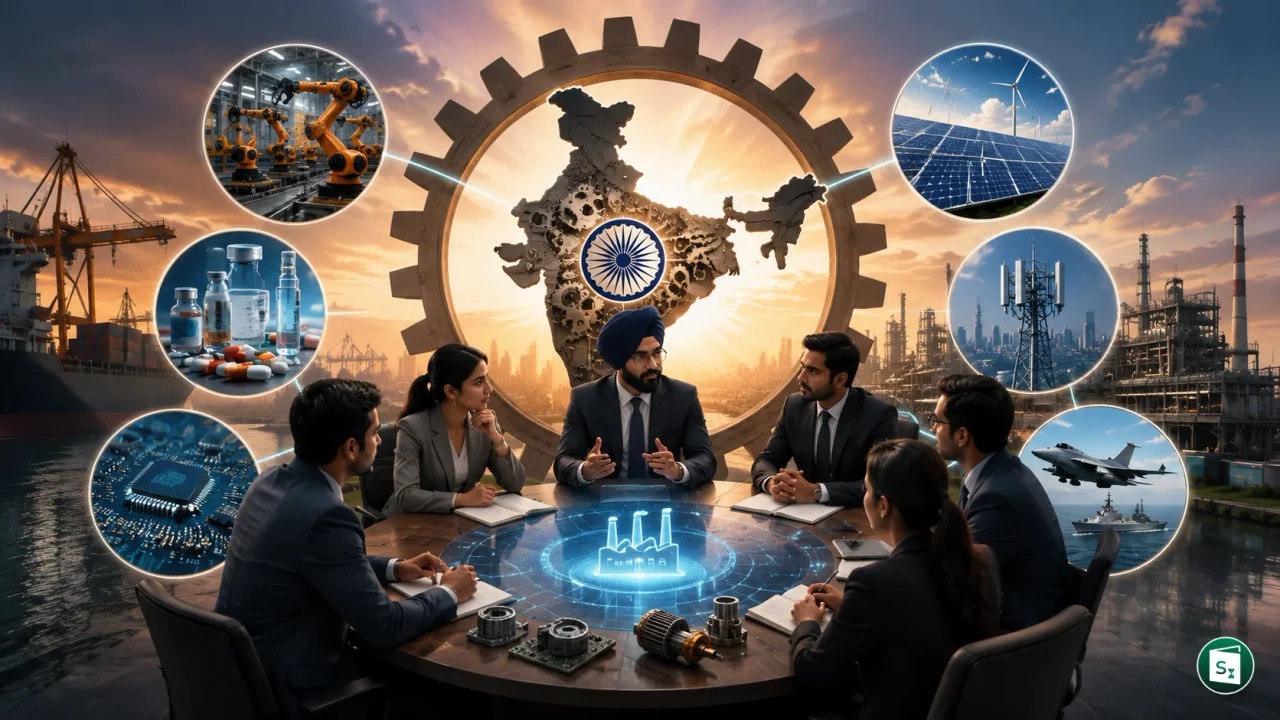
The Government of India has established six sector-specific working groups to identify 100 key products for domestic manufacturing to reduce the country’s reliance on imports. These groups, chaired by the Secretary of the Department for Promotion of Industry and Internal Trade (DPIIT), will provide a roadmap to strengthen India’s industrial self-reliance. The initiative is a critical part of the broader Atmanirbhar Bharat and Make in India frameworks aimed at balancing the national trade deficit.
What Are the Six Focus Sectors?
The working groups are divided by industrial clusters to ensure a specialized approach toward indigenisation. Each group consists of experts from the NITI Aayog (National Institution for Transforming India) and various nodal ministries, including Heavy Industries, Electronics and Information Technology, and New and Renewable Energy.
| Working Group | Focus Areas and Sectors |
|---|---|
| Group 1 | Pharmaceuticals, Biotechnology, and Medical Devices |
| Group 2 | Chemicals, Petrochemicals, Textiles, and Footwear |
| Group 3 | Capital Goods, Automotive, and Electric Vehicles |
| Group 4 | Energy and Renewable Power Equipment |
| Group 5 | Construction Equipment and Infrastructure |
| Group 6 | Defence, Aerospace (Civilian), and Electronics |
These sectors have been chosen based on their high import value and their potential for rapid domestic scaling. The primary goal is to identify items that are either not manufactured in India at all or are produced in quantities that do not meet domestic demand.
Strategic Goals: Beyond Import Substitution
The initiative, led by Amardeep Singh Bhatia, a 1993-batch IAS officer of the Nagaland cadre who took charge as DPIIT Secretary in 2024, focuses on more than just replacing foreign goods. It aims to bridge critical technology gaps that currently force Indian industries to depend on international suppliers for intermediate components.
By focusing on the “missing middle” of the manufacturing value chain, the government intends to help Micro, Small and Medium Enterprises (MSMEs) integrate more effectively into global supply chains. The working groups have been given a tight deadline of three weeks to submit their final list of 100 products to the Cabinet Secretariat. This swift timeline reflects the urgency of addressing the rising cost of imports.
Addressing the Rising National Import Bill
India’s total import bill reached a significant $775 billion during the 2025 to 2026 fiscal year. This surge has put pressure on the country’s foreign exchange reserves and highlighted vulnerabilities in the domestic supply chain. By localizing the production of high-value items, the government hopes to retain more value within the Indian economy.
According to recent trade data, the major contributors to the import bill include:
- Electronic Goods: $116.2 billion
- Machinery and Equipment: $61.73 billion
- Transport Equipment: $34.7 billion
The Department for Promotion of Industry and Internal Trade (DPIIT), which was established in 1995 and renamed in 2019 to include internal trade, is the nodal agency for this mission. It operates under the Ministry of Commerce and Industry, currently led by the Union Minister. The department is headquartered in New Delhi and is the primary body responsible for formulating and implementing industrial policy in India.
Bridging the Technology Gap in Indian Industry
One of the key mandates for the working groups is to identify specific technology gaps. For instance, in the automotive sector, India still imports specialized axles and motorcycle components despite having a robust domestic vehicle manufacturing industry. The new strategy involves providing focused policy support to companies that can bring or develop these missing technologies within India.
This move is expected to enhance the global competitiveness of Indian products. By achieving manufacturing scale, India can transition from being a net importer to a significant exporter of these 100 identified products. This transition is essential for India to reach its goal of becoming a $5 trillion economy and a global manufacturing hub.
Key Takeaways
- The Government of India has formed 6 working groups to identify 100 products for domestic manufacturing and import substitution.
- All six working groups are chaired by Amardeep Singh Bhatia, the Secretary of the Department for Promotion of Industry and Internal Trade (DPIIT).
- The initiative targets high-import sectors such as Electronics, Pharmaceuticals, Automotive, and Aerospace.
- The working groups have a three-week deadline to submit their recommendations to the Cabinet Secretariat.
- This strategic move aims to reduce India’s import bill, which stood at $775 billion in the 2025 to 2026 fiscal year.
- The DPIIT, headquartered in New Delhi, is the nodal agency for this initiative under the Ministry of Commerce and Industry.