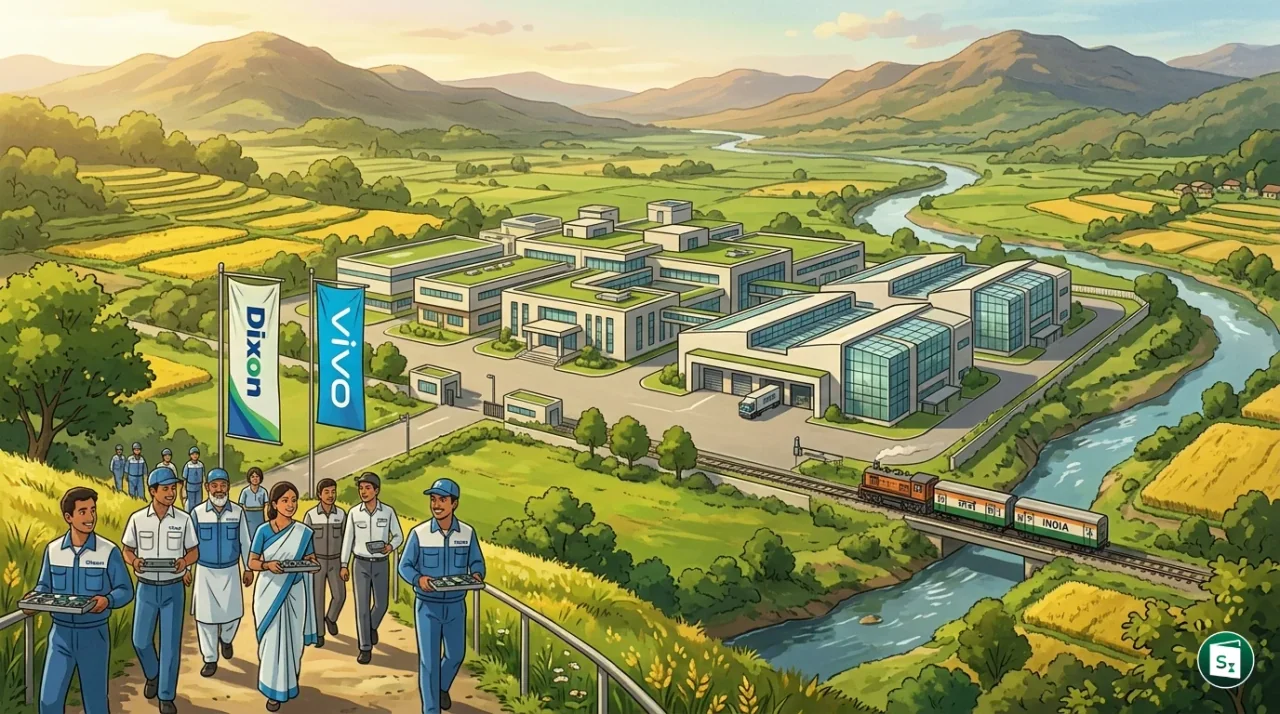
The Indian government has approved a joint venture between Dixon Technologies (India) Limited and Vivo Mobile India Private Limited to manufacture smartphones and electronic devices in India. Dixon will hold a 51% controlling stake in the venture, while Vivo will own the remaining 49%, making the new entity a subsidiary of Dixon. The clearance, granted under the government’s Press Note 3 regulations, marks a significant step in deepening domestic smartphone manufacturing through partnerships between Indian and Chinese firms.
What Is the Dixon-Vivo Joint Venture?
The joint venture agreement was signed between Dixon Technologies and Vivo Mobile India (VMI) following a binding term sheet announced in December 2024. The new entity will be incorporated with an initial paid-up share capital of ₹5 crore, contributed by both partners in the ratio of their shareholding.
The venture will operate as an Original Equipment Manufacturer (OEM) of electronic devices, with smartphones as its primary focus. It will take over a portion of Vivo’s smartphone production orders in India and is also permitted to manufacture electronic products for other brands in the Android ecosystem. At the closing of the transaction, the JV will purchase certain manufacturing assets from Vivo and enter into a manufacturing and packaging agreement to execute Vivo’s OEM orders.
The board of the joint venture will comprise four directors, with both Dixon and Vivo having the right to nominate two directors each. The transaction is expected to be completed within one year, subject to customary conditions precedent and applicable statutory approvals. Dixon clarified that neither company will hold any direct stake in each other outside of this joint venture.
Managing Director Atul Lall stated that the partnership could add 20 to 22 million smartphones annually to Dixon’s manufacturing volume, generating incremental revenue of approximately ₹30,000 crore per annum.
Why Government Approval Was Required
The JV required government clearance because of Press Note 3 (2020 Series), a regulation issued by the Department for Promotion of Industry and Internal Trade (DPIIT) in April 2020. Press Note 3 was introduced in the backdrop of the COVID-19 pandemic and the Galwan Valley clash in June 2020, which led to a sharp deterioration in India-China relations.
Under Press Note 3, any investment from a country that shares a land border with India requires prior government approval. This applies to seven neighbouring jurisdictions: China, Bangladesh, Pakistan, Bhutan, Nepal, Myanmar, and Afghanistan. The rule also covers investments routed through third countries if the ultimate beneficial owner belongs to any of these nations. Before PN3, most sectors allowed FDI through the automatic route without requiring prior clearance.
For Chinese companies like Vivo, which is a subsidiary of China-based BBK Electronics, this regulation meant that any new investment or joint venture in India required clearance from the central government. The approval was granted on July 8, 2026, after a thorough review process.
In March 2026, the government amended Press Note 3 to ease some restrictions. The revised framework allows investors with non-controlling beneficial ownership of up to 10% to invest through the automatic route and introduced a 60-day timeline for processing investment proposals. However, larger investments such as the Dixon-Vivo JV continued to require case-by-case government approval.
Dixon Technologies: India’s Largest Electronics Manufacturer
Dixon Technologies (India) Limited is the country’s largest electronics manufacturing services (EMS) company. It was founded in 1993 by Sunil Vachani and is headquartered in Noida, Uttar Pradesh. The company started with a single factory manufacturing CRT televisions and has since expanded into a multinational with 30 manufacturing facilities across India.
Dixon’s product portfolio spans consumer electronics (LED TVs, smart TVs, interactive flat panels), home appliances (washing machines, refrigerators), lighting solutions (LED bulbs, battens, downlighters), mobile phones (4G and 5G smartphones, feature phones), IT hardware (laptops, desktops, notebooks), wearables and hearables, and security systems (CCTV cameras, DVRs). The company also provides reverse logistics services for repair and refurbishment.
The company’s clients include global and Indian brands such as Samsung, Xiaomi, Panasonic, Nokia, Motorola, HP, Philips, Bajaj, Wipro, and Crompton. Dixon went public in 2017 and is listed on both the BSE and NSE. It reported a revenue of ₹48,873 crore in FY 2025-26, reflecting rapid growth driven by the government’s Production Linked Incentive (PLI) scheme.
Dixon has been actively forming joint ventures to expand its capabilities. In 2025, it entered JVs with Signify Innovations India for lighting OEM business and with Longcheer Intelligence (Singapore) for manufacturing smartphones, tablets, wearables, and AI PCs. In Q2 2025, Dixon became India’s largest smartphone manufacturer by shipments, surpassing Samsung, with a 22% market share.
Vivo’s Journey in India
Vivo is a Chinese smartphone brand owned by BBK Electronics Corporation, which was founded in 2009 in Dongguan, China, by Shen Wei. The company entered the Indian market in 2014 and quickly established itself as one of the country’s leading smartphone brands alongside other BBK-owned brands such as Oppo, OnePlus, and Realme.
Vivo was among the first smartphone companies to set up its own manufacturing operations in India. Its manufacturing facility in Greater Noida, Uttar Pradesh, has an annual production capacity of approximately 60 million units. Over 150 million smartphones have been manufactured at this facility, and every Vivo smartphone sold in India is now made locally. The company has invested more than ₹3,500 crore in its Indian operations and directly employs around 8,000 people.
The company has also built a network of over 30 local suppliers in India, contributing to the development of a domestic component ecosystem. Vivo began exporting smartphones from India in 2022, with cumulative exports exceeding ₹400 crore. The brand has been a prominent sponsor of major sporting events, including the Indian Premier League (IPL) and the FIFA World Cup.
In recent years, Chinese smartphone brands in India have faced increased regulatory scrutiny, including tax investigations and compliance requirements. The Dixon partnership represents a strategic shift for Vivo towards a model where a majority Indian-owned entity handles its manufacturing operations, aligning with the government’s push for greater domestic control in the electronics sector.
India’s Expanding Smartphone Manufacturing Ecosystem
India has emerged as the world’s second-largest mobile phone manufacturer, driven by the government’s Make in India initiative and the Production Linked Incentive (PLI) scheme for large-scale electronics manufacturing. The PLI scheme, launched in 2020 with an outlay of ₹40,951 crore, attracted global players such as Apple (through Foxconn, Wistron, and Pegatron), Samsung, and domestic manufacturers like Lava and Micromax.
The results have been significant. Mobile phone production in India grew from ₹18,900 crore in FY2014 to ₹4.22 lakh crore in FY2024. Mobile phone exports surged from ₹1,566 crore in FY2014-15 to ₹1.2 lakh crore in FY2023-24, making smartphones India’s single largest export category. In 2014, India had just two mobile phone manufacturing units; today, it has over 300. The share of locally manufactured handsets in domestic sales rose from 26% in 2014 to over 99% by 2024.
The first PLI scheme concluded on March 31, 2026. To sustain momentum, the Union Cabinet on July 15, 2026 approved the Mobile Phone Manufacturing Scheme (MPMS) with an outlay of ₹62,500 crore for five years (FY2026-27 to FY2030-31). The new scheme offers incentives of 2.25% to 5% on eligible sales, with additional incentives for domestic component sourcing and Indian brand R&D. It targets cumulative production of ₹39 lakh crore and the creation of 60,000 direct jobs.
The government also approved Semicon 2.0 with a ₹1.27 lakh crore outlay to strengthen semiconductor design and manufacturing. India’s electronics industry aims for $500 billion in production by 2030, with smartphone production projected to reach $110 to $130 billion annually.
Strategic Significance of the Deal
The Dixon-Vivo joint venture carries significance on multiple fronts.
For Dixon Technologies, the partnership adds a major global smartphone brand to its client list and strengthens its position as India’s leading contract manufacturer. The estimated addition of 20 to 22 million units annually represents a substantial scaling of its smartphone manufacturing capacity. The deal also allows Dixon to serve other brands through the JV, expanding its addressable market within the Android ecosystem.
For Vivo, the JV provides a path to navigate India’s regulatory environment for Chinese companies. By ceding majority control to an Indian partner while retaining a significant 49% stake, Vivo can continue manufacturing in India while aligning with the government’s preference for Indian-owned manufacturing entities. This model may serve as a template for other Chinese smartphone brands operating in India.
For India’s manufacturing ecosystem, the deal demonstrates that the China Plus One strategy is working. Global and Chinese companies are increasingly willing to partner with Indian manufacturers to diversify their supply chains beyond China. The venture is expected to boost local value addition, create employment, and contribute to India’s electronics export targets.
The partnership also signals a pragmatic approach by the government: while maintaining regulatory oversight of Chinese investments through Press Note 3, New Delhi is willing to approve proposals where Indian entities hold majority control and strategic benefits for domestic manufacturing are clear.
Key Takeaways
- The government approved a joint venture between Dixon Technologies (51% stake) and Vivo Mobile India (49% stake) for manufacturing smartphones and electronic devices in India.
- The JV has an initial paid-up capital of ₹5 crore and will operate as an Original Equipment Manufacturer (OEM), undertaking Vivo’s smartphone production orders and manufacturing for other brands.
- Government clearance was required under Press Note 3 (2020), which mandates prior approval for investments from countries sharing a land border with India, including China.
- Dixon Technologies, founded in 1993 and headquartered in Noida, is India’s largest electronics manufacturing services company with 30 manufacturing facilities and revenue of ₹48,873 crore in FY26.
- Vivo, a subsidiary of China’s BBK Electronics (founded 2009), entered India in 2014, has invested over ₹3,500 crore, and manufactured more than 150 million smartphones at its Greater Noida facility.
- The partnership could add 20 to 22 million smartphones annually to Dixon’s output, generating incremental revenue of about ₹30,000 crore per year.