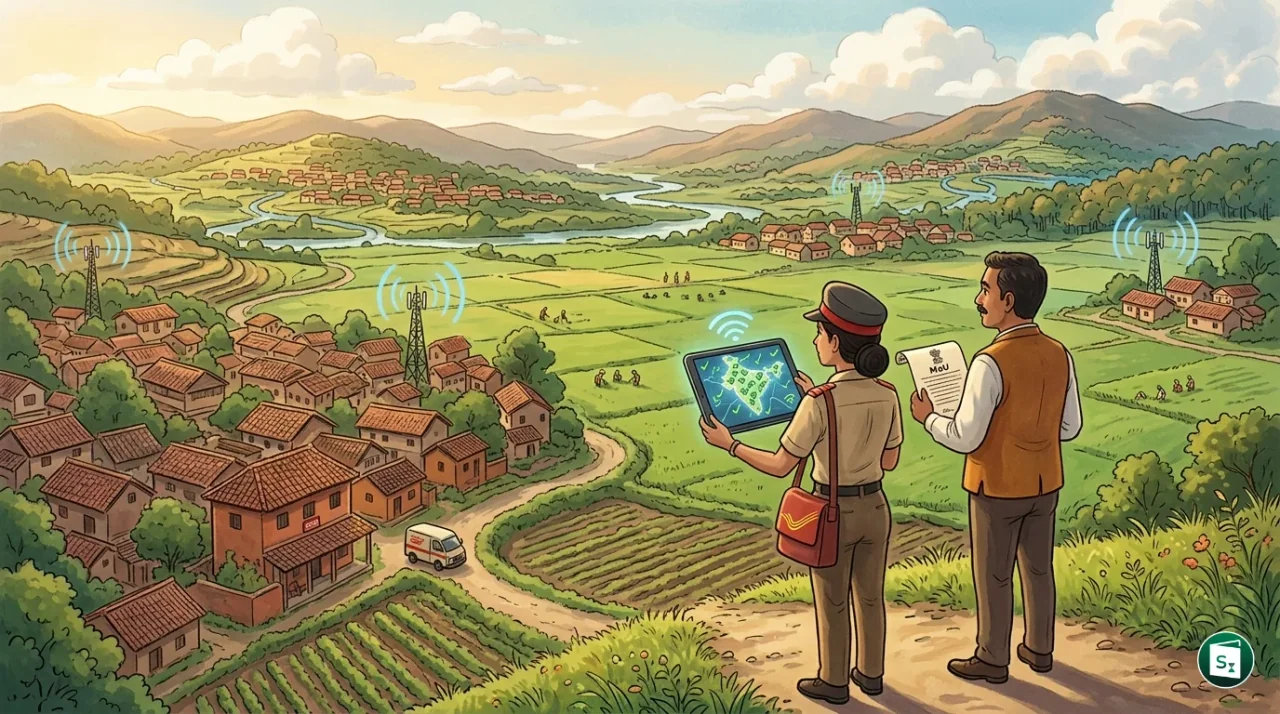
The Department of Posts (DoP) and the Telecom Regulatory Authority of India (TRAI) signed a Memorandum of Understanding on 10 July 2026 in New Delhi to conduct the largest ever village-level telecom network performance survey in India. The one-year initiative will assess the mobile network quality of all four major Telecom Service Providers (TSPs) namely Bharti Airtel, Reliance Jio, Vodafone Idea (Vi), and BSNL across more than 5.68 lakh villages nationwide. By deploying over 1.4 lakh Gramin Dak Sevaks (GDSs) equipped with a TRAI-developed Android app, the survey aims to produce granular field-level data that can guide policy decisions and infrastructure investments to close India’s persistent rural-urban digital divide.
The MoU: Scope and Signatories
The MoU was signed by Ms. Manisha Bansal Badal, General Manager (Citizen Centric Services and Rural Business) at the Department of Posts, and Shri S. M. K. Chandra, Joint Advisor (Broadband and Policy Analysis) at TRAI. Senior officials from both organisations attended the signing ceremony in New Delhi. The initiative was undertaken under the leadership of the Union Minister of Communications and Development of North Eastern Region, Shri Jyotiraditya M. Scindia.
Under the terms of the MoU, the Department of Posts will carry out the field survey operations using its vast rural postal infrastructure. TRAI will serve as the technical partner, providing the custom-built Android application, training for field personnel, ongoing technical support, and centralised monitoring of the entire exercise. The partnership is structured for a duration of one year.
Why the Postal Network? Leveraging the GDS Workforce
The Department of Posts operates the world’s largest postal network with 1,64,999 post offices as of March 2025, of which nearly 1,49,385 (90.54%) are located in rural areas. Among these, more than 1.40 lakh are Branch Post Offices (BOs) that serve as the government’s last-mile outpost in India’s most remote hamlets.
These rural Branch Post Offices are staffed by Gramin Dak Sevaks (GDSs) , local residents who handle mail delivery, savings bank transactions, life insurance services, and disbursement of government benefits under schemes such as MGNREGS and old age pensions. Because GDSs live within the communities they serve and make daily door-to-door rounds, they are uniquely positioned to collect authentic, on-ground network performance data without requiring separate field visits or additional travel costs.
The survey will be integrated into their routine delivery operations. As GDSs move through their assigned villages delivering mail, they will use the TRAI-developed app on their smartphones to capture real-time mobile network metrics. This approach makes the data collection process both cost-effective and seamlessly embedded into existing workflows, eliminating the need for dedicated survey teams or expensive drive-test equipment.
The Android App: How the Survey Will Work
The Android-based mobile application has been specially developed by TRAI for this survey. During their daily rounds, GDSs will use the app to capture key network performance indicators for each of the four telecom operators. The app is designed to record objective measurements such as signal strength, data speed, call drop rates, and network availability along with the precise geo-location of each measurement.
TRAI already operates consumer-facing crowd-sourcing apps such as MyCall (for voice call quality feedback), MySpeed (for data speed testing), and DND (for spam reporting). The new survey app builds on the same technical framework but is tailored for systematic village-level data collection by trained postal workers rather than voluntary consumer submissions.
Covering villages across all States and Union Territories, the survey will generate a vast repository of standardised, geo-tagged data. TRAI will use this data to identify connectivity black spots, compare the relative performance of TSPs in different regions, and produce evidence-based recommendations for infrastructure deployment. The results will also help the government evaluate the effectiveness of existing rural connectivity programmes under the Digital Bharat Nidhi (DBN) , the fund established to finance telecom expansion in underserved areas.
Rural Connectivity: The Challenge and the Context
Despite India being the world’s second-largest telecommunications market with over 117 crore wireless subscribers as of June 2025, a significant urban-rural divide persists. Rural mobile penetration stands at 58.8% compared to 125.3% in urban areas. As of September 2024, out of 6,44,131 villages in the country (as per the Registrar General of India), around 6,22,840 villages had mobile coverage, of which 6,14,564 were covered by 4G. This means roughly 21,000 villages still lack any mobile connectivity, and many more face poor quality of service.
| Metric | Rural | Urban |
|---|---|---|
| Mobile penetration (June 2025) | 58.8% | 125.3% |
| 4G coverage (villages, Sep 2024) | 95.4% | Near universal |
| 5G coverage (villages, 1H 2025) | 77.8% | Near universal |
The government has launched multiple initiatives to address this gap. The BharatNet project aims to connect over 2.5 lakh Gram Panchayats with high-speed broadband through optical fibre, with around 2.15 lakh already service-ready. The 4G Saturation Project targets complete mobile coverage for all uncovered villages. The Digital Bharat Nidhi (DBN) , which replaced the Universal Service Obligation Fund (USOF) under the Telecommunications Act, 2023 , funds telecom infrastructure in commercially unviable rural and remote areas. A total of ₹1.62 lakh crore has been collected under the Universal Access Levy as of March 2024.
The DoP-TRAI survey adds a critical missing piece to these efforts: reliable, ground-level performance data. While infrastructure rollout is tracked through administrative data, there has been no systematic, national-scale mechanism to measure whether the installed networks actually deliver acceptable quality of service to end-users in remote villages. This survey aims to fill that gap.
Key Takeaways
- The Department of Posts (DoP) and TRAI signed an MoU on 10 July 2026 in New Delhi to conduct India’s largest village-level telecom network performance survey.
- The survey will cover over 5.68 lakh villages across all States and Union Territories, assessing the networks of Bharti Airtel, Reliance Jio, Vodafone Idea, and BSNL.
- Field data will be collected by Gramin Dak Sevaks (GDSs) from more than 1.40 lakh rural Branch Post Offices during their routine delivery rounds.
- TRAI has developed a dedicated Android-based mobile application for the survey, and the partnership is for a duration of one year.
- The MoU was signed by Ms. Manisha Bansal Badal (DoP) and Shri S. M. K. Chandra (TRAI) under the leadership of Union Minister Jyotiraditya M. Scindia.
- The Department of Posts, established in 1854, operates the world’s largest postal network, while TRAI was established on 20 February 1997 under the TRAI Act, 1997.
- India’s rural mobile penetration stands at 58.8% against 125.3% in urban areas, and the survey aims to generate evidence for bridging this digital divide.