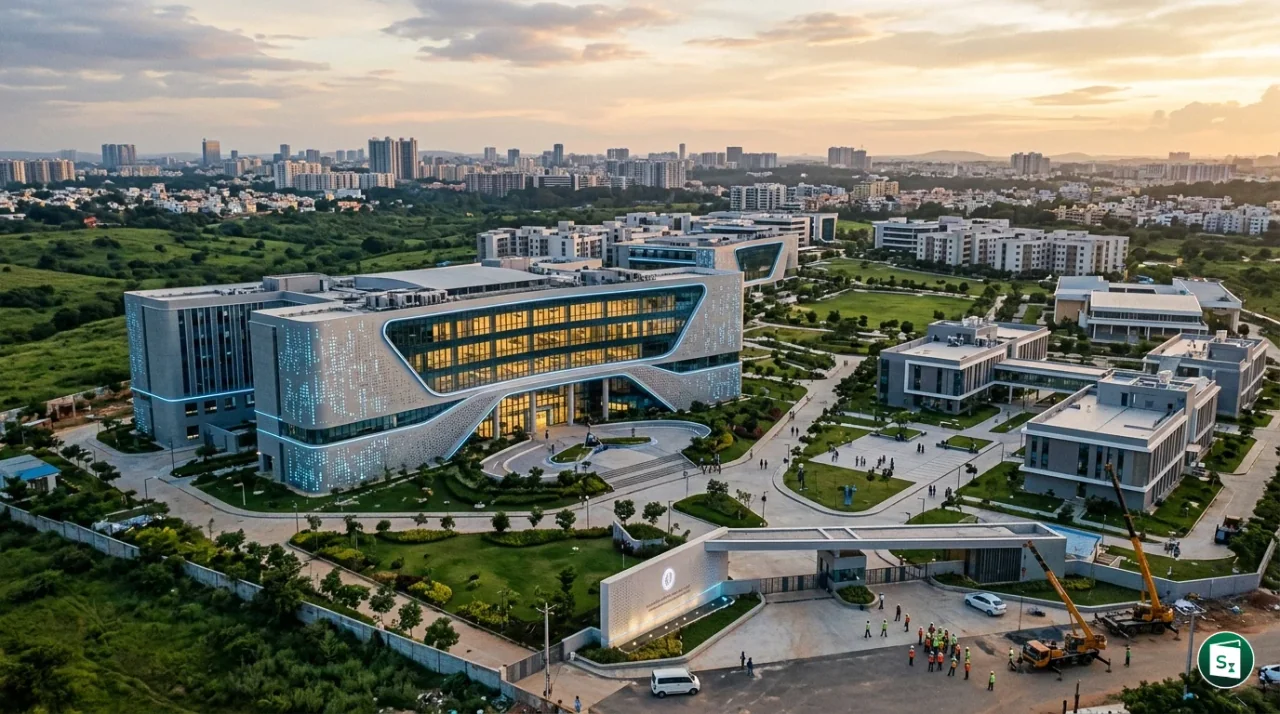
Karnataka Chief Minister DK Shivakumar announced the establishment of India’s first government-driven Artificial Intelligence (AI) University at the Google I/O Connect India 2026 event in Bengaluru on July 14, 2026. The university will be built on a 100-acre world-class campus in Bengaluru, with regional satellite campuses planned across five other cities in the state. Alongside the university, the government unveiled plans for an AI Innovation Hub, green data centres, and the introduction of AI education from Class VI as part of a broader vision to make Karnataka an “AI-native state”.
What Was Announced
The announcement came during the inaugural session of Google I/O Connect India 2026, held at the Bangalore International Exhibition Centre (BIEC) . The event brought together over 2,000 developers, technology leaders, entrepreneurs, researchers, and policymakers from India and around the world.
In his address, CM Shivakumar outlined a multi-pronged strategy to position Karnataka as a global hub for responsible AI innovation. The centrepiece was the AI University, but the plan also included several other components. The government will establish a dedicated AI Innovation Hub that will function as an incubation centre, bringing together startups, researchers, academic institutions, and companies to develop AI solutions. AI education will be introduced from Class VI onwards in schools to build foundational computational skills among students from an early age. The state also announced plans for two next-generation green data centres near Bengaluru and in the coastal region to support the computing demands of the AI economy.
Shivakumar invited Google to deepen its partnership with Karnataka, calling for collaboration in developing AI solutions for education, healthcare, agriculture, climate resilience, urban mobility, and governance. He noted that Google employs more than 18,000 people in India, with around 12,000 based in Bengaluru.
The AI University: Campus and Curriculum
The proposed AI University will be India’s first and largest government-run institution dedicated entirely to artificial intelligence. The main campus, spread over 100 acres, will be located in Bengaluru’s innovation corridor, with potential sites including the proposed KWIN City near Kempegowda International Airport or the upcoming AI City being planned around 30 km from Bengaluru.
In a move designed to ensure that AI talent development reaches beyond the capital, the state will establish regional satellite campuses in five cities:
| City | Region |
|---|---|
| Kalaburagi | North Karnataka |
| Belagavi | North Karnataka |
| Hubballi-Dharwad | North Karnataka |
| Mangaluru | Coastal Karnataka |
| Mysuru | South Karnataka |
These regional campuses will help democratise access to advanced AI education and training, particularly for students in tier-2 and tier-3 cities who may not have the means to relocate to Bengaluru.
The university is expected to offer specialised undergraduate, postgraduate, doctoral, and executive programmes focused on deep tech domains, including generative AI, data science, robotics, high-performance computing, cybersecurity, and critically, AI ethics and governance. The academic framework is being designed in collaboration with industry partners, including Google, as well as premier institutions such as the Indian Institute of Science (IISc) and NASSCOM. An expert committee has already been constituted to design the university’s academic framework, governance model, and industry integration blueprint.
AI Innovation Hub and Digital Infrastructure
The AI Innovation Hub will be housed within the university campus and will serve as a physical crucible for translating research into market-ready solutions. It will bring together startups, venture capitalists, researchers, and industry leaders to work on India-specific challenges in sectors such as agriculture, healthcare, education, and governance.
The hub is expected to function as a full-stack incubation centre, offering mentorship, funding access, compute infrastructure, and regulatory facilitation. It builds on existing state initiatives such as ELEVATE, Karnataka’s flagship startup support programme, which has disbursed ₹287.85 crore to over 1,230 startups since 2017. The state’s Startup Policy 2025-30, with an outlay of ₹570.68 crore, targets the creation of 25,000 new startups by 2030, with at least 10,000 from beyond Bengaluru.
To power this AI ecosystem, Karnataka will establish two green data centres, one near Bengaluru and another along the coast in the Mangaluru region. These facilities will rely on renewable energy sources, including the 2,000 MW Pavagada Solar Park, and use treated water for cooling, making them more sustainable than conventional data centres. This infrastructure is critical because training and running large AI models requires massive computing power, and India’s AI computing capacity has been a major focus of national policy under the IndiaAI Mission.
Why Karnataka: A Legacy of Tech Leadership
Karnataka’s decision to establish the country’s first government-driven AI University is rooted in the state’s established position as India’s technology capital. Karnataka contributes nearly 40% of India’s software exports, and Bengaluru is home to more than 17,000 startups, thousands of Global Capability Centres (GCCs) , and nearly 40% of India’s unicorn startups.
According to the Global Startup Ecosystem Report (GSER) 2026, Bengaluru-Karnataka was ranked the 15th best startup ecosystem globally and the second-best AI-native cluster in Asia after Beijing. The ecosystem is valued at approximately $153 billion, and Bengaluru attracts 58% of India’s AI-focused venture funding. The city also received $39 billion in venture capital funding between 2021 and 2025, with a growth rate of 190%, significantly outpacing the global average of 149%.
The state has been steadily building its AI infrastructure over the past year. In June 2026, Karnataka approved 50 AI labs in government colleges across the state, implemented in partnership with the IndiaAI Mission. The Centre for Applied AI for Tech Solutions (CATS) , with an investment of ₹50 crore, was approved earlier to drive AI adoption in governance and public services. These initiatives, combined with the new AI University, position Karnataka to move beyond being India’s IT capital toward becoming its AI capital.
India’s AI Ecosystem: The Broader Context
Karnataka’s AI University announcement comes at a time when both the central government and other states are making strong pushes in artificial intelligence. The IndiaAI Mission, approved by the Union Cabinet in March 2024 with an outlay of ₹10,372 crore over five years, is the flagship national programme for building indigenous AI capacity. Implemented by the Ministry of Electronics and Information Technology (MeitY) , the mission is built on seven pillars, including compute infrastructure, foundational models, datasets, startup financing, and ethical AI.
Under the mission, India has already onboarded over 38,000 GPUs (Graphics Processing Units), the powerful chips needed to train AI models, available at subsidised rates. Four Indian startups, including Sarvam AI and Soket AI, have been selected to build indigenous foundational AI models trained on Indian datasets. The AIKosha platform has been launched as a repository of over 3,000 datasets and 243 AI models across 20 sectors. In the Union Budget 2026, the government allocated ₹1,000 crore to the IndiaAI Mission.
At the same event, Google itself announced several India-focused AI initiatives, including on-premises access to Gemini models for regulated sectors, a free 56-hour AI research curriculum by Google DeepMind, and expanded support for 25 Indian languages in Gemini Live. These developments reflect the growing convergence of central government policy, state-level initiatives, and private sector investment in building India’s AI ecosystem.
Key Takeaways
- Karnataka will establish India’s first government-driven AI University on a 100-acre campus in Bengaluru, with satellite campuses in Kalaburagi, Belagavi, Hubballi-Dharwad, Mangaluru, and Mysuru.
- The announcement was made by CM DK Shivakumar at Google I/O Connect India 2026 on July 14, 2026 at the Bangalore International Exhibition Centre.
- Karnataka contributes nearly 40% of India’s software exports and is home to over 17,000 startups; Bengaluru ranked 15th globally in the GSER 2026.
- The IndiaAI Mission, approved in March 2024 with a ₹10,372 crore outlay, is the central government’s flagship programme for building indigenous AI capacity.
- Karnataka’s Startup Policy 2025-30, with a ₹570.68 crore outlay, targets 25,000 new startups by 2030.
- The state will introduce AI education from Class VI and build two green data centres powered by renewable energy to support the AI ecosystem.