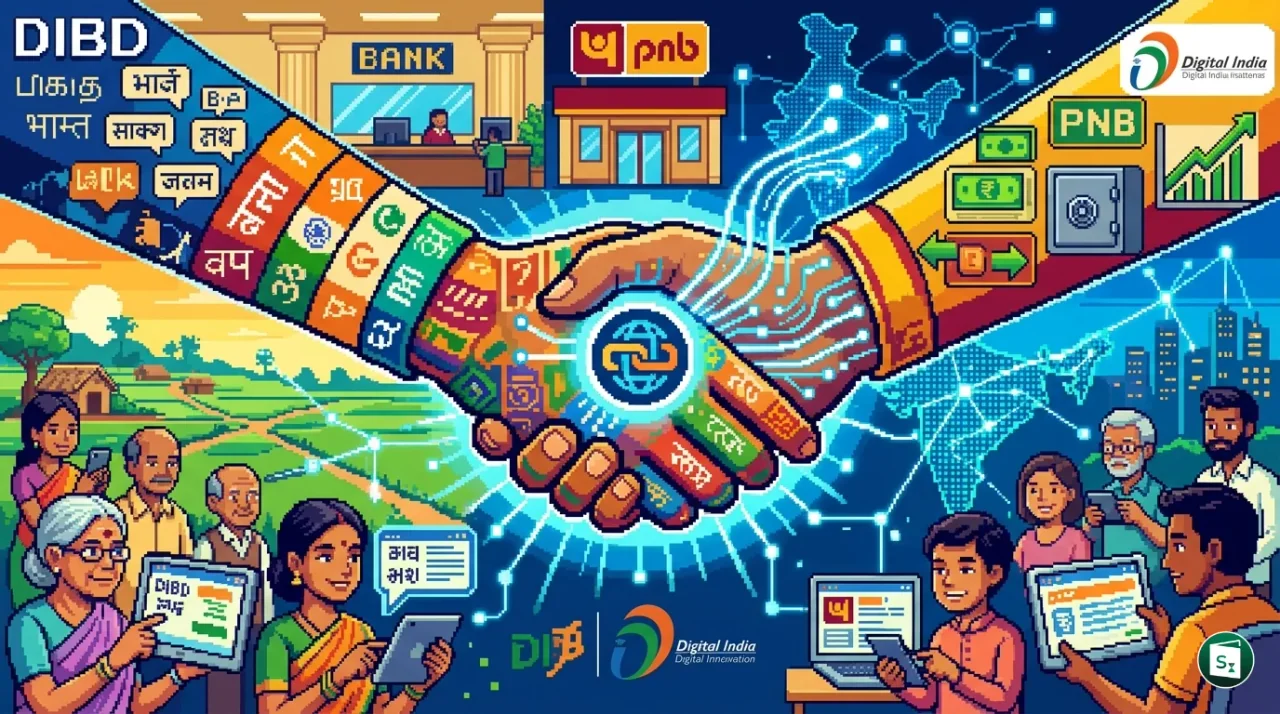
Punjab National Bank (PNB) has signed a Memorandum of Understanding with the Digital India BHASHINI Division (DIBD) under the Ministry of Electronics and Information Technology (MeitY) to bring multilingual AI capabilities to its digital banking platforms. The agreement was formalised at PNB’s Corporate Office in Dwarka, New Delhi, in the presence of senior officials from both organisations. The partnership will allow PNB customers to access banking services through voice and text in their preferred Indian languages, marking a significant step toward inclusive digital banking.
What Is Digital India BHASHINI?
Digital India BHASHINI (BHASa INterface for India) is India’s national language translation platform, designed as an AI-led digital public infrastructure to break language barriers across digital services. It was launched by Prime Minister Narendra Modi on 4 July 2022 during the Digital India Week in Gandhinagar, Gujarat, as part of the National Language Translation Mission (NLTM) under MeitY.
The platform is managed by the Digital India BHASHINI Division (DIBD), an independent division under the Digital India Corporation (DIC), a not-for-profit company under MeitY. Amitabh Nag serves as the CEO of DIBD. BHASHINI operates on India’s first sovereign AI cloud, ensuring complete data sovereignty and independence from foreign hyperscalers.
BHASHINI currently powers more than 500 government websites and processes over 15 million inferences daily, surpassing 6 billion total inferences. It supports 22 officially recognised languages under the Eighth Schedule of the Constitution, along with additional Indian and international languages. The platform offers over 20 niche Natural Language Processing (NLP) services, including automatic language detection, speech recognition, and text-to-speech, across 36 text and 23 voice languages.
BHASHINI for Seva/Sanchalan: Expanding Multilingual Governance
The MoU with PNB was signed under the “BHASHINI for Seva/Sanchalan: A BHASHINI Sahayogi Program”, a dedicated framework through which DIBD partners with central government ministries, departments, and public sector institutions to integrate multilingual AI into governance and public service delivery.
The programme has two core components. Sanchalan focuses on strengthening multilingual governance within government operations, while Seva targets citizen-facing service delivery. Through this programme, DIBD has already engaged more than 50 central ministries and departments, translated over 80 government websites, and enabled multilingual access across sectors ranging from pension services to public procurement.
Earlier this year, DIBD signed similar MoUs with the Reserve Bank of India (RBI) in February 2026, the Pension Fund Regulatory and Development Authority (PFRDA) in March 2026, the Ministry of Ayush in May 2026, and the Government e Marketplace (GeM) in June 2026, all under the same programme.
Punjab National Bank and Its Digital Push
Punjab National Bank (PNB) is one of India’s largest public sector banks, with its headquarters in Dwarka, New Delhi. It was founded on 19 May 1894 in Lahore as India’s first Swadeshi bank, started entirely with Indian capital. Today, the Government of India holds a 70.08% stake in the bank. PNB operates a vast network of 10,189 branches and 11,822 ATMs across the country as of March 2025. Ashok Chandra serves as the Managing Director and CEO.
PNB has been aggressively pursuing digital transformation in recent years. The bank’s flagship PNB One mobile app offers over 350 features, and digital transactions now account for more than 95% of all transactions. The bank has also deployed an AI-based chatbot called RAHI for employee training and customer support. In Q4 of FY26 alone, PNB sanctioned and disbursed over ₹20,873 crore through digital lending channels, serving nearly 4.8 lakh customers.
What the MoU Covers
The MoU was signed at PNB’s Corporate Office in Dwarka, New Delhi, in the presence of M. Paramasivam, Executive Director of PNB; Amitabh Nag, CEO of DIBD; and Atish Kumar Rout, Chief General Manager (Digital Banking Transformation Division), PNB.
Under the agreement, BHASHINI’s AI-powered language technologies will be integrated into PNB’s digital platforms, including the PNB One mobile app, internet banking portal, and WhatsApp banking services. The integration will enable voice-based banking, where customers can speak their banking requests in their native language and the system will process them using BHASHINI’s Automatic Speech Recognition (ASR) and Natural Language Understanding (NLU) engines.
It will also enable text-based multilingual access, where all digital banking interfaces, transaction confirmations, account statements, and customer communications will be rendered in the user’s preferred Indian language selected from the 22 Eighth Schedule languages.
The collaboration also includes co-creation of banking-specific language models, multilingual glossary development for financial terminology, and the deployment of voice bots and reference applications tailored to banking workflows.
Significance of the Partnership
This partnership addresses a critical gap in India’s banking landscape. Despite the rapid growth of digital banking, most platforms operate primarily in English and Hindi, excluding the large section of customers who are more comfortable transacting in their mother tongue. According to the Internet and Mobile Association of India (IAMAI), only about 12% of Indians are English-speaking, while the rest communicate in regional languages.
For a bank like PNB with a strong presence in semi-urban and rural areas, this initiative can significantly improve financial inclusion. Customers in smaller towns and villages who currently depend on branch visits or assisted digital banking will be able to independently perform transactions using voice commands in languages such as Tamil, Telugu, Bengali, Marathi, Punjabi, Kannada, Odia, Assamese, Gujarati, Malayalam, and others.
The partnership also supports the government’s broader vision of Digital Public Infrastructure (DPI) as a public good. By integrating BHASHINI into banking, the model demonstrates how India’s sovereign language AI infrastructure can be leveraged by the private and public sectors alike to create inclusive digital services without each entity having to build language capabilities from scratch.
Key Takeaways
- Punjab National Bank signed an MoU with the Digital India BHASHINI Division (DIBD) to integrate multilingual AI into its digital banking platforms.
- The agreement was signed under the “BHASHINI for Seva/Sanchalan: A BHASHINI Sahayogi Program”, which focuses on multilingual governance and citizen service delivery.
- BHASHINI (BHASa INterface for India) is India’s National Language Translation Mission, launched on 4 July 2022, operating under MeitY through the Digital India Corporation (DIC).
- BHASHINI powers over 500 government websites, processes 15 million inferences daily, and supports 22 Eighth Schedule languages.
- PNB was founded in 1894 in Lahore as India’s first Swadeshi bank and is headquartered in Dwarka, New Delhi, with Ashok Chandra as MD and CEO.
- The partnership will enable voice and text-based banking in Indian languages, improving financial inclusion in rural and semi-urban areas.