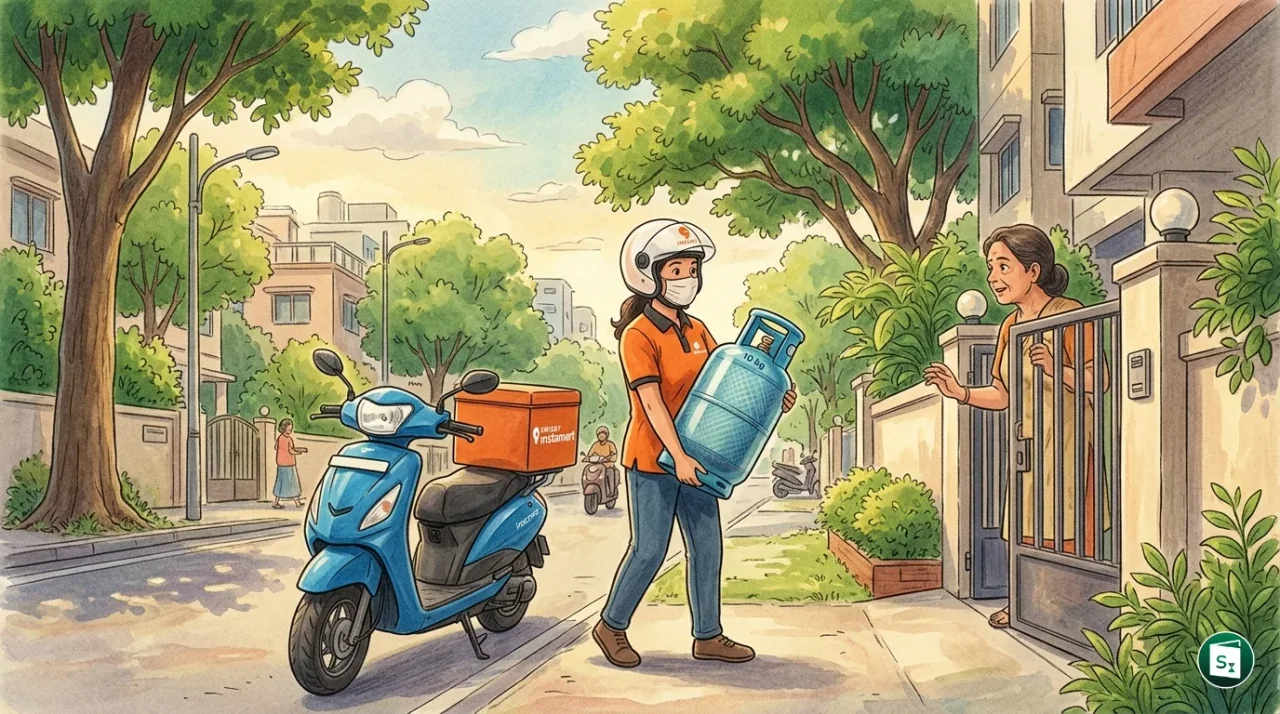
Quick commerce platform Instamart has partnered with Hindustan Petroleum Corporation Ltd (HPCL) to launch India’s first on-demand LPG cylinder delivery service on a quick commerce platform. The service, which debuted in Bengaluru, introduces HP Navya, HPCL’s next-generation 10 kg composite LPG cylinder, alongside its existing 5 kg metal cylinder. For the first time, consumers can order an LPG cylinder without holding an existing domestic gas connection, with delivery expected within 30 to 45 minutes.
What Is the HP Navya Composite LPG Cylinder?
HP Navya is HPCL’s next-generation 10 kg composite LPG cylinder designed as a modern alternative to traditional steel cylinders. Unlike conventional steel cylinders that weigh around 15 to 16 kg when empty, the HP Navya is built using advanced composite materials and weighs roughly half as much, making it significantly easier to handle and transport.
The cylinder uses a three-layer construction. The innermost layer is a blow-moulded High-Density Polyethylene (HDPE) liner that forms a seamless gas-tight chamber. This is wrapped with a composite layer of filament-wound fibreglass and epoxy resin that provides the structural strength to withstand high pressure. An outer HDPE jacket protects the inner layers from physical damage and environmental exposure.
One of the most user-friendly features of the HP Navya is its translucent body, which allows users to see the remaining LPG level by simply looking at the cylinder. This eliminates the need for guesswork or manual weighing. The composite material is also completely corrosion-resistant, meaning the cylinder will not rust, leave stains on floors, or deteriorate over time like steel cylinders. Its compact and contemporary design makes it suitable for apartments, small families, working professionals, students living in rented accommodation, and households looking for a convenient secondary LPG cylinder.
How the On-Demand Delivery Service Works
The Instamart-HPCL partnership creates a new digital channel for ordering LPG cylinders that differs from the traditional model in several important ways. Unlike the conventional system where a household must be registered with a specific LPG distributor and hold a formal connection, this service allows anyone to place an order through the Instamart app without an existing domestic LPG connection.
When a customer places a first-time order, it is treated as a new cylinder purchase. The buyer must complete identity verification and proof-of-delivery documentation during the transaction. For all subsequent orders, the process becomes a refill transaction, where the delivery personnel collect the empty HPCL cylinder at the time of delivering the filled one. This exchange model is similar to the existing LPG refill system but is now available through a quick commerce interface.
The actual fulfilment is handled entirely by HPCL’s existing network of authorised distributors. Trained personnel from the distributor carry out the delivery following all applicable safety and regulatory protocols. This means that regular Instamart delivery partners do not handle the cylinders. The separation ensures that the specialised knowledge and safety equipment required for LPG handling remain with qualified professionals.
The cylinders are sold at government-regulated prices, making the cost comparable to what consumers would pay through traditional offline channels. The service is currently available only in Bengaluru, and the companies have not announced a timeline for expansion to other cities.
Why This Partnership Matters
For HPCL
Hindustan Petroleum Corporation Ltd is a Maharatna Central Public Sector Enterprise under the Ministry of Petroleum and Natural Gas. Incorporated in 1952 and headquartered in Mumbai, HPCL is a subsidiary of ONGC and ranks among India’s largest oil and gas companies. The partnership with Instamart represents a strategic push by HPCL to extend its LPG distribution network into a technology-enabled channel and reach consumers who have traditionally remained outside the formal LPG ecosystem.
By launching HP Navya through a quick commerce platform, HPCL is targeting a new segment of urban consumers. Students, working professionals, tenants, and smaller households often do not hold a domestic LPG connection due to the paperwork, security deposit requirements, or the commitment involved. The Instamart channel allows HPCL to sell to these customers without the friction of the traditional registration process. At the same time, the translucent, lightweight HP Navya cylinder positions HPCL as an innovator in a market long dominated by the standard red steel cylinder.
The partnership marks the commercial rollout of the HP Navya brand, which HPCL has positioned as a product for “Naya Bharat”. It follows similar composite cylinder offerings from other public sector oil marketing companies, such as Indian Oil’s Indane XtraLite and BPCL’s Bharatgas Lite.
For Instamart
Instamart is the quick commerce arm of Swiggy Limited, launched in August 2020. It currently operates in over 131 cities across India, delivering more than 50,000 stock-keeping units (SKUs), and has built a network of over 1,000 dark stores. The LPG delivery service represents Instamart’s entry into what the company describes as “high-trust categories”, which require rigorous safety compliance and customer verification.
Quick commerce in India has grown rapidly from a grocery delivery model to a platform that now handles electronics, medicines, beauty products, and home essentials. Industry estimates put India’s quick commerce market at around $3.65 billion in 2026, with projections of reaching $6.64 billion by 2031. LPG delivery is a natural extension of this expansion into higher-frequency, essential household services. By adding LPG to its catalogue, Instamart deepens its role in daily household consumption and increases platform stickiness, making it harder for customers to switch to competing platforms such as Blinkit or Zepto.
The partnership also positions Instamart as a platform that can handle regulated, safety-sensitive categories. If the Bengaluru pilot succeeds, it could open the door for similar tie-ups with other public sector undertakings or regulated commodity suppliers.
India’s LPG Sector and the Shift to Composite Cylinders
India has one of the largest LPG markets in the world, with over 32.68 crore active domestic LPG consumers served by public sector oil marketing companies. The three state-owned OMCs Indian Oil Corporation (IOCL), Bharat Petroleum Corporation Ltd (BPCL), and HPCL together maintain a stock of over 50 crore cylinders across the country, predominantly made of steel.
The transition from steel to composite cylinders has been a policy focus of the Ministry of Petroleum and Natural Gas. Composite cylinders were introduced as a recent innovation by PSU OMCs and are still in limited circulation. The government has indicated that OMCs are gradually expanding the availability of composite cylinders through competitive bidding processes with manufacturers, though no manufacturing facilities are being set up by the OMCs themselves.
| Feature | Steel Cylinder | Composite Cylinder |
|---|---|---|
| Weight (empty, 10 kg capacity) | Approx. 15-16 kg | Approx. 7.5 kg (50% lighter) |
| Corrosion | Prone to rust | Corrosion-resistant |
| Gas level visibility | Not visible | Translucent body |
| Safety | Can fragment on impact | Engineered for controlled failure |
| Aesthetic | Standard industrial design | Modern, compact design |
The advantages of composite cylinders extend beyond consumer convenience. Their lighter weight reduces transportation costs for distributors, making logistics more efficient. The absence of corrosion extends the usable life of the cylinder and eliminates the scrap metal losses associated with corroded steel cylinders. These factors make composite cylinders a viable long-term investment for the LPG supply chain, though the higher upfront cost compared to steel cylinders remains a barrier to mass adoption.
The government’s flagship Pradhan Mantri Ujjwala Yojana (PMUY), launched in 2016, has been instrumental in expanding LPG coverage to rural and below-poverty-line households. As of 2024, India’s LPG coverage stands at approximately 99.8%. While PMUY focused on access through traditional distributor networks, the Instamart-HPCL partnership represents a different kind of access expansion, one aimed at urban, digitally active consumers who may not fit the traditional household connection model.
The Way Forward
The Instamart-HPCL partnership is still a pilot project confined to Bengaluru. A successful pilot could pave the way for expansion to other cities, giving HPCL a broader digital distribution footprint and Instamart a differentiated offering in the competitive quick commerce market.
However, several challenges remain. LPG is a regulated commodity in India, and any digital distribution model must address concerns around customer verification, purchase limits, traceability, and prevention of diversion or black marketing. Industry observers expect the model to incorporate robust KYC protocols similar to systems used for other government-regulated transactions. The companies will need to demonstrate that convenience can coexist with the regulatory framework that governs LPG distribution.
The broader quick commerce industry in India is watching this experiment closely. If LPG delivery succeeds as a category, it could encourage other quick commerce platforms to forge similar partnerships with public sector enterprises or regulated industries. For the consumer, the service offers a genuine choice: order a lightweight composite cylinder in under an hour without the paperwork of a traditional connection, or continue with the established distributor-based system. In either case, the entry of quick commerce into the LPG market marks a notable shift in how an essential household commodity reaches Indian homes.
Key Takeaways
- Instamart partnered with HPCL to launch India’s first on-demand LPG cylinder delivery service on a quick commerce platform.
- HPCL’s new HP Navya is a 10 kg composite LPG cylinder that is 50% lighter than conventional steel cylinders, corrosion-resistant, and features a translucent body for gas level visibility.
- The service is available in Bengaluru and does not require an existing domestic LPG connection; first-time purchases involve identity verification, while subsequent orders are refill exchanges.
- HPCL, a Maharatna CPSE established in 1952 and headquartered in Mumbai, operates under the Ministry of Petroleum and Natural Gas and is a subsidiary of ONGC.
- Deliveries are fulfilled by HPCL’s authorised distributor network using trained personnel, not regular quick commerce delivery partners, and cylinders are sold at government-regulated prices.
- India has over 32.68 crore active domestic LPG consumers and more than 50 crore cylinders in circulation, with composite cylinders gradually being introduced as a lighter, safer alternative to steel.