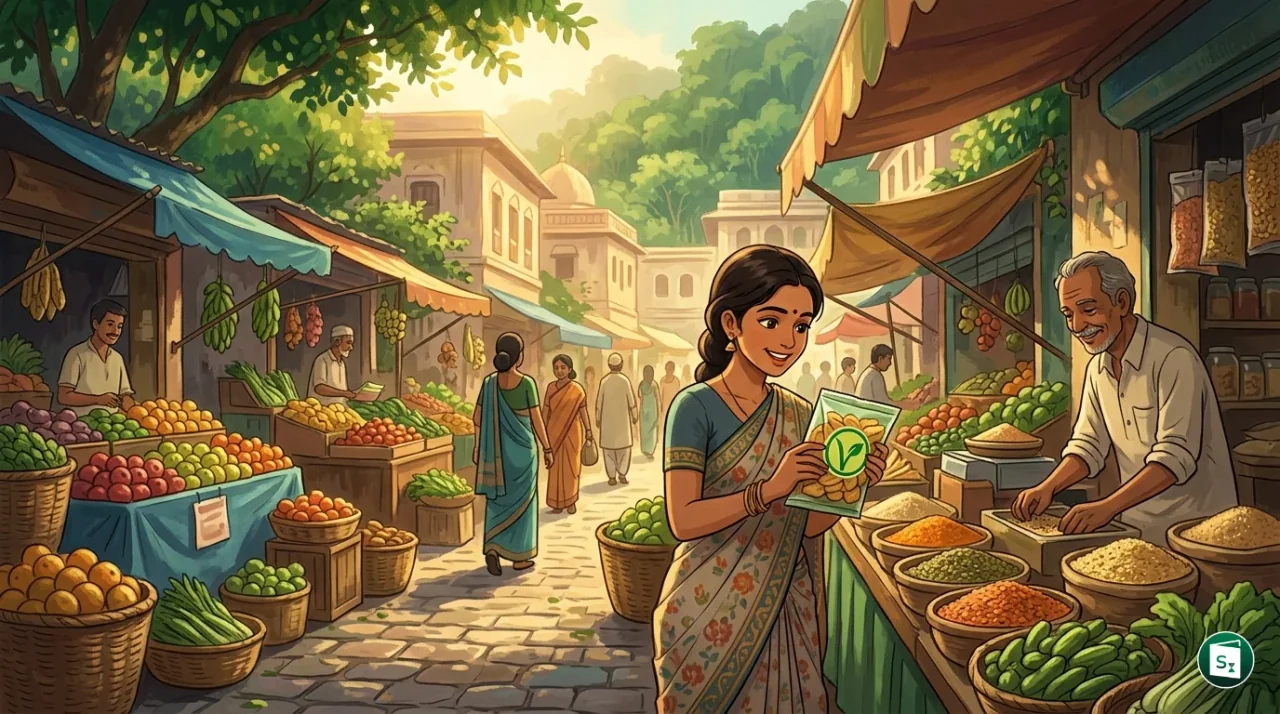
The Food Safety and Standards Authority of India (FSSAI) has officially notified the Food Safety and Standards (Vegan Foods) Amendment Regulations, 2026, making a standardized Vegan logo mandatory for all approved products starting July 1, 2027. This move establishes a uniform national identity for plant-based foods, helping consumers easily distinguish them from vegetarian and non-vegetarian items. By standardizing these labeling norms, the government aims to prevent misleading claims and boost consumer confidence in India’s rapidly growing vegan market.
What are the New FSSAI Vegan Food Regulations?
The Food Safety and Standards (Vegan Foods) Regulations were first introduced in June 2022 to provide a structured framework for the production and sale of vegan products. The latest 2026 Amendment builds upon this foundation by mandating a specific logo design and tightening certification norms. Under these rules, Vegan Food is defined as any food, ingredient, or additive that is not a product of animal origin.
The regulations strictly prohibit the use of any animal-derived substances, including dairy, honey, eggs, meat, and gelatin, at any stage of production or processing. Furthermore, these products must not have undergone animal testing for any purpose, including safety evaluations, unless explicitly required by a regulatory authority. The July 1, 2027 deadline provides food business operators (FBOs) a transition period to align their packaging with the new standardized requirements.
Mandatory Logo Specifications and Design
The standardized logo is designed to be visually consistent with the existing Green Dot (Vegetarian) and Brown Triangle (Non-Vegetarian) symbols used in India. It consists of a green square-framed symbol with a stylized “V” and a sprouting leaf on top, with the word “VEGAN” clearly printed at the base.
| Feature | Technical Specification |
|---|---|
| Symbol Design | A stylized “V” with a plant leaf on top |
| Color Code | Bright Green (CMYK: C-60, M-0, Y-89, K-0) |
| Minimum Size | 15 mm x 15 mm for the square frame |
| V-Symbol Size | 10 mm in length and 7 mm in width |
| Leaf Symbol | 3.25 mm in length, centered at the top |
| Text Placement | ”VEGAN” text placed 1 mm below the “V” |
This specific design helps consumers instantly identify genuine vegan products without having to read lengthy ingredient lists. FBOs must obtain prior approval from the FSSAI and pay a prescribed endorsement fee before using the logo on their product packaging.
Key Requirements for Vegan Food Business Operators
To ensure the integrity of vegan products, the FSSAI has laid down strict operational guidelines for all manufacturers and importers. These requirements focus on maintaining a clear distinction between vegan and non-vegan food items throughout the supply chain.
Production and Sanitation Standards
Manufacturers are encouraged to maintain separate production lines for vegan foods. In cases where shared equipment is used, the facility must implement rigorous cleaning and sanitation protocols to ensure that no traces of animal-derived ingredients remain. Food business operators must follow Good Manufacturing Practices (GMP) and be able to demonstrate traceability for all ingredients up to the primary manufacturer level.
Rules for Imported Vegan Products
All imported vegan food products intended for sale in India must also carry the prescribed FSSAI logo. Additionally, these products must be accompanied by a certificate of conformity issued by a recognized authority in the exporting country. This certificate must confirm that the product meets the vegan standards defined by the Indian regulator.
Storage and Display
Retailers and distributors are required to store and display vegan products in a manner that makes them clearly distinguishable from non-vegan items. This ensures that the final consumer can make an informed choice at the point of purchase without any ambiguity.
Significance of a Standardized Vegan Identity
The introduction of a mandatory, government-backed logo is a significant milestone for India’s evolving food landscape. It addresses the growing demand for ethical and sustainable food options while providing a clear regulatory definition of what constitutes a “vegan” product.
Empowering Conscious Consumers
For many years, consumers had to rely on varied private certifications or scrutinize complex labels to ensure a product was truly vegan. The standardized logo provides instant identification and a government-certified guarantee. This is particularly important for individuals who follow vegan diets for ethical, religious, or environmental reasons, as well as for those with severe allergies to dairy or eggs.
Benefits for the Plant-Based Industry
The move provides a level playing field for startups and established companies alike by replacing multiple third-party certifications with a single national standard. This market differentiation helps brands build long-term credibility and loyalty. Furthermore, by aligning Indian standards with international practices, the FSSAI is making it easier for domestic manufacturers to export their vegan products to global markets, where such certifications are highly valued.
About the Food Safety and Standards Authority of India (FSSAI)
The Food Safety and Standards Authority of India (FSSAI) is an autonomous statutory body established under the Food Safety and Standards Act, 2006. It operates under the administrative control of the Ministry of Health and Family Welfare, Government of India. The authority was formally established on September 5, 2008, and is headquartered in New Delhi.
The primary mandate of the FSSAI is to lay down science-based standards for articles of food and to regulate their manufacture, storage, distribution, sale, and import to ensure the availability of safe and wholesome food for human consumption. It consolidated eight older laws into a single regulatory framework to streamline food safety governance in the country. The authority is led by a Chairperson and has six regional offices across India.
Key Takeaways
- The standardized Vegan logo becomes mandatory for all approved plant-based food products in India starting from July 1, 2027.
- The Food Safety and Standards (Vegan Foods) Amendment Regulations, 2026, defines vegan food as being entirely free from animal-derived ingredients and animal testing.
- The new logo features a green stylized “V” with a sprouting leaf inside a square frame, accompanied by the word “VEGAN” at the bottom.
- Imported vegan food products must carry a certificate of conformity from the exporting country and display the FSSAI prescribed logo for sale in India.
- The FSSAI was established as a statutory body under the Food Safety and Standards Act, 2006, and is headquartered in New Delhi.
- Manufacturers using shared equipment for vegan and non-vegan foods must adhere to strict Good Manufacturing Practices (GMP) and thorough sanitation protocols.