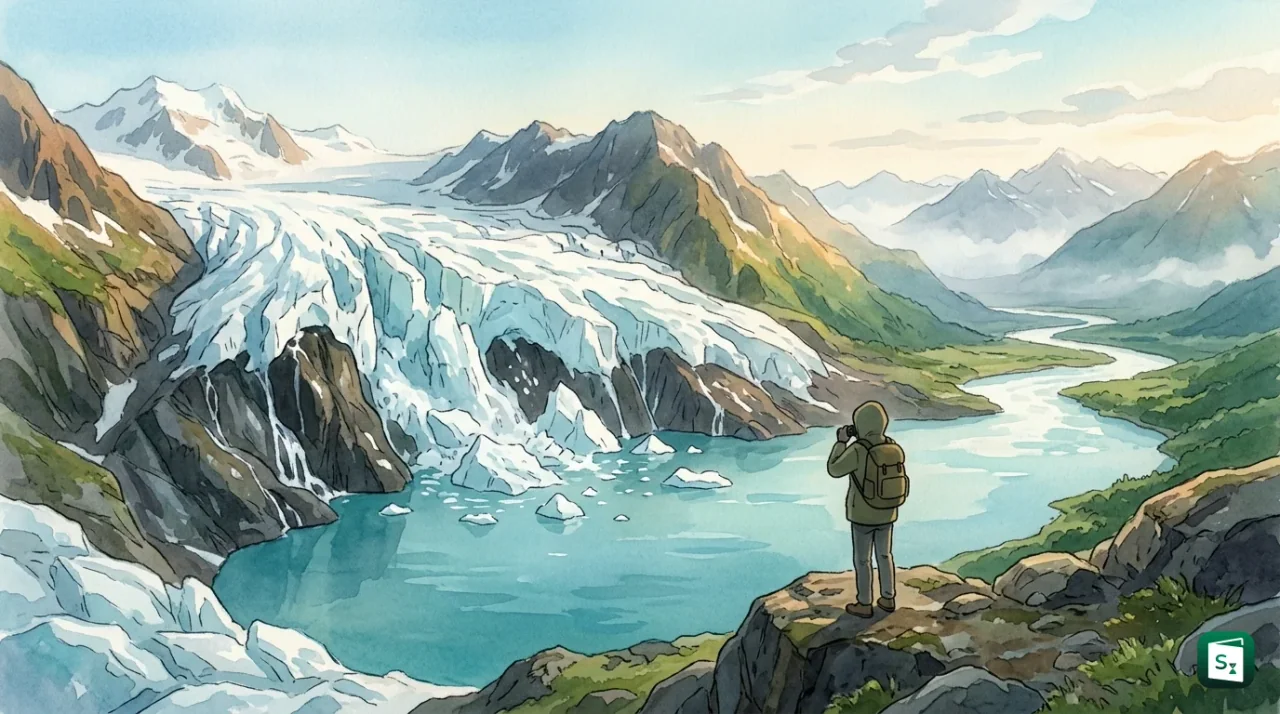
The World Meteorological Organization released its State of Global Water Resources 2025 report on 17 September 2026 in Geneva. The report records 408 gigatonnes of global glacier loss in the hydrological year 2025, the fourth straight year every major glacier region lost ice. Mountain glaciers have now lost 6.2 percent of their ice since 2000, a decline that directly threatens river flows, groundwater recharge and water security from the Himalayas to the Alps.
What Is the World Meteorological Organization and Its Water Report?
WMO is the full form of the World Meteorological Organization. The World Meteorological Organization is the United Nations agency for weather, climate and water. It coordinates global observation, data exchange and hydrological services among 193 members, which include 187 member states and 6 territories. The World Meteorological Organization is headquartered in Geneva, Switzerland and is headed by Secretary-General Celeste Saulo (as of September 2026).
The roots of the World Meteorological Organization lie in the International Meteorological Organization, set up in 1873 to share weather data across borders. The World Meteorological Organization itself was created through a Convention signed in Washington in 1947, which came into force on 23 March 1950. The World Meteorological Organization became a specialized agency of the United Nations in 1951 and is governed by the World Meteorological Congress, which meets once in four years.
The State of Global Water Resources is the flagship annual water assessment of the World Meteorological Organization. The World Meteorological Organization started the series in 2022 for the year 2021, and the 2025 edition released on 17 September 2026 is the fifth edition. The 2025 edition gives a full assessment of the water cycle, covering river discharge, groundwater, terrestrial water storage, evapotranspiration, snow cover, glaciers, lake ice extent and water quality. The assessment blends field observations from national hydrological services, satellite data and hydrological models, with glacier estimates drawn from the World Glacier Monitoring Service (WGMS) based in Zurich and global glacier models.
Global Glacier Loss Findings in 2025
The World Meteorological Organization reports that glaciers lost 408 plus or minus 132 gigatonnes (Gt) of ice in the hydrological year 2025, which ran from October 2024 to September 2025. This single year loss added 1.1 plus or minus 0.4 millimetres to global sea level. The year 2025 was the fourth consecutive year in which all 19 major glacier regions recorded a net loss, and the sixth most negative glacier year on record since 1976.
The pace of loss has quickened sharply. Six of the seven largest annual glacier losses on record have occurred in the past seven years. Between 2023 and 2025 alone, glaciers lost a cumulative 1,400 Gt of water. That three year loss equals about 560 million Olympic size swimming pools and about one third of the freshwater the world withdraws in a year. Since 1975, total glacier loss has reached 9,583 plus or minus 1,211 Gt, equal to 26.4 plus or minus 3.3 millimetres of sea level rise. Mountain glaciers, which exclude the giant ice sheets of Greenland and Antarctica, have lost 6.2 percent of their total ice mass between 2000 and 2025.
Loss in 2025 was widespread but not uniform. The largest total contributions came from High Mountain Asia, Alaska and the Russian Arctic, which hold large ice areas. The sharpest losses per unit area were in Western Canada and the United States, Iceland and Central Europe. The table below summarises the standout regional signals reported for 2025.
| Glacier Region | 2025 Signal Reported by WMO and WGMS |
|---|---|
| Central Asia, South Asia West, Russian Arctic, Iceland, Western Canada and USA | Annual mass balance among three most negative years on record for each region |
| Iceland | Average loss of 1.55 metres water equivalent, the second largest loss since 1976 |
| Western Canada and USA, South Asia West, Svalbard | Largest departure from 1991 to 2020 climate average |
| High Mountain Asia, Alaska, Russian Arctic | Largest share of total global 408 Gt loss in 2025 |
| Caucasus, Western Canada and USA, Central Europe | Small glacier regions showing signs of having passed peak water |
What Is Glacier Melting and How Is Mass Balance Measured?
Glacier melting is the loss of snow and ice from a glacier when summer melt and sublimation exceed winter snowfall. Scientists track it through glacier mass balance, the yearly difference between accumulation and ablation expressed in millimetre water equivalent, with negative values showing net ice loss.
Glacier mass balance is the accounting system for a glacier. Accumulation is the income, mainly snowfall that compacts into ice. Ablation is the expense, mainly surface melting, sublimation (direct change from ice to vapour) and calving of ice chunks. When ablation is larger than accumulation over a balance year, the mass balance is negative and the glacier shrinks. Mass balance is reported in millimetre water equivalent (mm w.e.), which means the thickness of water that the gained or lost ice would make if spread evenly over one square metre.
Glacier retreat means something slightly different. Retreat is the backward movement of the glacier snout or terminus, the lowest end of the glacier. A glacier can have a negative mass balance for years before the snout visibly retreats, and debris cover or lake contact can make retreat faster or slower. Field teams measure mass balance with stakes drilled into the ice tongue and snow pits in the upper zone, correct for ice and snow density, and extend the point values across the whole glacier. These field series are compiled by the World Glacier Monitoring Service and cross checked with satellite and model based estimates to produce global totals such as the 408 Gt figure for 2025.
Why Are Glaciers Melting So Fast?
Glaciers are melting because greenhouse gases from burning fossil fuels have warmed air and oceans, so summer melt now exceeds winter snow gain every year. Dark soot on snow, drier winters in many ranges and warmer ocean water at glacier fronts further speed the loss.
The World Meteorological Organization traces the acceleration to a simple gap. Since the 1990s, summer melting has regularly beaten winter snow build up, and the gap has grown wider since 2000. When snow cover melts early, darker ice is left exposed. Dark surfaces absorb more sunlight and melt faster, a feedback linked to reflectivity or albedo. In the Himalayas, black carbon or soot from brick kilns and other combustion settles on snow and cuts reflectivity, with one recent assessment estimating that about one third of Himalayan melt is linked to such particles.
Warmer water adds a second push from below. Tidewater and lake terminating glaciers are undercut by warm ocean or lake water, which thins the front and triggers calving. Meltwater from the surface also drills down through the ice and lubricates the bed, so the glacier slides faster and thins further. Melting of land ice raises sea level because it adds new water to the ocean. Melting of already floating ice does not raise sea level in the same way, just as a melting ice cube in a glass does not make the glass overflow.
How Fast Are Glaciers Melting and What Is Peak Water?
Glaciers lost about 273 billion tonnes of ice per year between 2000 and 2023, rising to about 314 billion tonnes per year after 2012. In 2025 the loss was 408 gigatonnes, equal to 1.1 millimetres of sea level rise in one year.
The long view shows clear acceleration. The global loss rate rose from modest levels in the 1990s to around 390 Gt per year in 2016 to 2020, and annual loss jumped by 36 percent in 2012 to 2023 compared with 2000 to 2011. Over 2000 to 2023 glaciers together lost 6,542 billion tonnes, adding 18 millimetres to sea level at an average of 0.75 millimetres per year from glaciers alone.
Peak water is the turning point after which a shrinking glacier gives less meltwater each year simply because less ice is left. The World Meteorological Organization warns that small glacier regions such as the Caucasus, Western Canada and the United States and Central Europe may already have passed this point. Before peak water, extra melt can swell summer river flows and raise flood and glacial lake outburst flood risks. After peak water, summer flows fall even in hot years, which creates long term water insecurity for downstream farms, towns and hydropower plants that depend on steady melt in dry months.
Mountain Glaciers and Himalayan Impact With Water Resources in India
The Himalayan findings matter most for India because the Hindu Kush Himalaya, often called the Third Pole, holds the largest snow and ice reserve outside the polar regions. The Hindu Kush Himalaya stretches from Afghanistan to Myanmar and feeds 10 major Asian rivers, including the Indus, Ganga and Brahmaputra. The Indian Himalayan Region spans 13 states and Union Territories, hosts more than 9,575 glaciers across the three basins and supports about 50 million people directly.
Indian monitoring by the Geological Survey of India, the Wadia Institute of Himalayan Geology, the National Centre for Polar and Ocean Research, the National Institute of Hydrology and the Space Applications Centre shows steady retreat. The mean retreat rate for the region is 14.9 metres per year, with about 12.7 metres in the Indus, 15.5 metres in the Ganga and 20.2 metres in the Brahmaputra basins. Reported rates include 19.9 metres per year for the Gangotri glacier and about 15 to 16 metres per year for East Rathong, Samudra Tapu and Dokriani glaciers. One recent assessment found Himalayan glaciers are now losing mass 65 percent faster than a decade ago.
The stakes are high because nearly 800 million people in the Indus, Ganga and Brahmaputra basins depend on Himalayan melt during the lean summer season when rain is scarce. Together the three rivers provide close to 50 percent of the usable surface water of India. Snow and ice melt contribute about 60 percent of annual flow in the Indus, about 21 percent in the Brahmaputra and about 9 percent in the Ganga, with a far larger share in dry months because monsoon rain falls in only 30 to 40 days. About 33 percent of thermal power capacity and 52 percent of hydropower capacity in the country depend on Himalayan rivers, so changes in timing and volume directly affect energy security.
Faster retreat also raises hazard risks. Retreating glaciers leave behind growing lakes held by loose rock and ice. Bursts from such lakes, called Glacial Lake Outburst Floods (GLOFs), have caused major damage in Sikkim in 2023 and in the Rishiganga and Dhauliganga valleys of Uttarakhand in 2021. A 2025 assessment listed 189 high risk lakes in the Indian Himalayan region, of which 56 were classed as very high risk, while the Central Water Commission tracks 2,485 glacial lakes larger than 10 hectares. Research groups project that most Hindu Kush Himalayan basins will reach peak water around mid century, after which melt contribution will fall even as demand rises.
Wider Water Crisis: Rivers, Storage and Groundwater in 2025
The glacier story sits inside a wider drying signal. The World Meteorological Organization finds that 2025 was one of the driest years for river discharge in 35 years, based on the 1991 to 2025 record. About 36 percent of the global catchment area had drier than normal flows, 36 percent was normal and 21 percent was wetter than normal. For the seventh year in a row, the share of basin area with normal flows stayed below the historical average. Below normal flows hit much of North America, the La Plata and Sao Francisco basins in South America, Eastern Europe, the Middle East and Central Asia, along with the Nile, Congo and Zambezi basins in Africa. Above normal flows were seen across South, East and South East Asia, parts of northern South America and selected basins in Africa and Australia.
Total land water storage has also fallen. Terrestrial water storage, which means all water held in groundwater, lakes, rivers, soil moisture, vegetation, snow and ice, has shown a falling trend since 2014 to 2016. Groundwater confirms the stress. In 2025, 65 percent of monitored wells recorded levels outside the normal range, with 34 percent below to much below normal compared with 25 percent in 2024. Persistent deficits appeared across Central and Eastern Europe, the central United States, parts of Mexico, Chile and Brazil, northern South Africa, northwestern India, the Middle East and parts of southern Australia. Over the past five years, Asia and Africa reported the most water related disasters by number of events and lives lost, yet Africa and Asia together supplied only about 7 percent of river stations used in the report, which underlines the data gap in the hardest hit areas.
Global Water Agenda and the Way Forward
The World Meteorological Organization presents the report as a tool for planning, not panic. The first edition in 2021 used data from 7 countries and 14 river stations. The 2025 edition draws on 52 countries and 3,115 field stations, plus 496 stations filled with space based observations, and covers 15 hydrological variables. New chapters add lake ice extent and water quality, with soil moisture inputs from the International Soil Moisture Network and quality data from the GEMStat freshwater base. The work is anchored in the Global Runoff Data Centre, the WMO Hydrological Observing System (WHOS) and the Global Hydrological Status and Outlook System (HydroSOS), which link observation to seasonal outlooks and early warnings under the Early Warnings for All effort and the WMO Unified Data Policy.
For policy, the report points to three clear tasks. First, close the observation gap through steady data sharing, especially in Asia, Africa and South America, so models and warnings rest on real river and well data. Second, cut the drivers of melt through lower greenhouse gas and black carbon emissions while expanding glacier, lake and slope monitoring and cross border early warning for floods and GLOFs. Third, reshape water management for less reliable melt through larger and smarter storage across groundwater, soil moisture, ponds and reservoirs, more efficient irrigation, groundwater recharge and basin level plans for drinking water, farming and hydropower. Annual themes such as World Water Day, observed on 22 March, and the International Year of Glaciers Preservation in 2025 keep this agenda in public focus.
Key Takeaways
- The State of Global Water Resources 2025 was released by the World Meteorological Organization on 17 September 2026 in Geneva.
- Global glaciers lost 408 plus or minus 132 gigatonnes in 2025, equal to 1.1 plus or minus 0.4 millimetres of sea level rise and the fourth straight year all 19 regions lost ice.
- Mountain glaciers have lost 6.2 percent of their ice mass between 2000 and 2025, with 1,400 Gt lost in 2023 to 2025 alone.
- WMO stands for the World Meteorological Organization, a UN specialized agency set up in 1950 with 193 members and headquarters in Geneva, Switzerland.
- The World Glacier Monitoring Service in Zurich tracks glacier mass balance in millimetre water equivalent, where negative values show net ice loss.
- In India, the Indus, Ganga and Brahmaputra provide about 50 percent of usable surface water for about 800 million people, with 56 glacial lakes classed as very high risk.