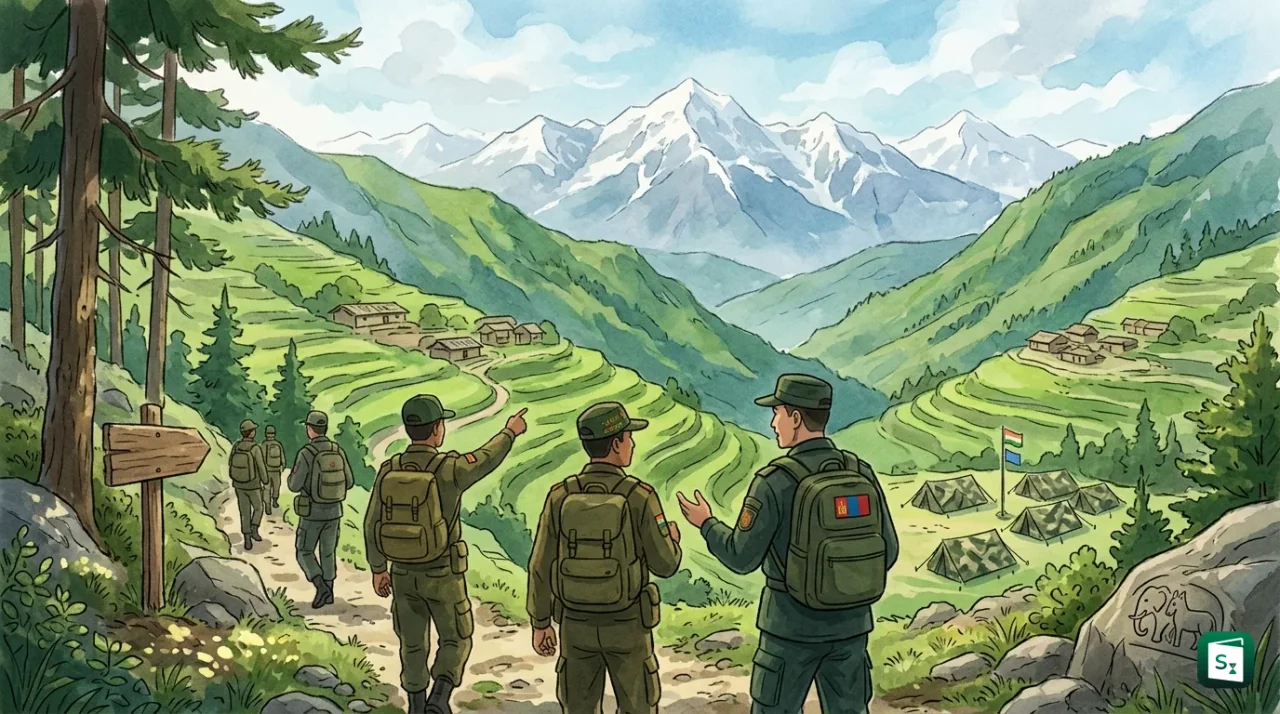
The 18th edition of the India-Mongolia joint military exercise Nomadic Elephant 2026 began on 21 September 2026 at the Foreign Training Node in Pithoragarh, Uttarakhand. The platoon level drill brings together 45 personnel each from the Indian Army and the Mongolian Armed Forces and will continue till 3 October 2026. The focus on drones, counter drone systems and cyber security makes this edition a sharp test of how both armies fight together in mountains and semi urban areas under a United Nations mandate.
What Is Nomadic Elephant and Which Countries Take Part?
Nomadic Elephant is an annual bilateral joint military exercise between India and Mongolia. It began in 2004 and is held alternately in the two countries at platoon level. The drill builds joint capability for counter insurgency operations in semi urban and mountainous terrain under a United Nations mandate.
The word bilateral means only two countries take part. In Nomadic Elephant, those two countries are always India and Mongolia. No other country joins this drill as a participant. This makes it different from multilateral drills where many countries train together.
The exercise is held at platoon level. A platoon is a small fighting unit of about 30 to 45 soldiers led by a junior officer. Training at this level focuses on small team skills such as patrolling, searching buildings and reacting fast in close combat. The aim is interoperability. Interoperability means the ability of two armies to understand each other, use similar drills and operate as one joint task force in the field.
The mandate for the drill comes from the United Nations. A United Nations mandate means the training is designed for peace support tasks approved by the United Nations. Most editions refer to Chapter VII of the UN Charter. Chapter VII allows the United Nations to approve action to keep or restore peace, including the use of force by peacekeepers when needed.
Where Is Nomadic Elephant 2026 Held and Who Is Participating?
Nomadic Elephant 2026 is held at the Foreign Training Node in Pithoragarh, Uttarakhand, from 21 September to 3 October 2026. India hosts the 18th edition. The Indian Army team comes from a battalion of the Arunachal Scouts, and Mongolia has sent 45 personnel from its Armed Forces.
The Foreign Training Node (FTN) at Pithoragarh is a dedicated training centre of the Indian Army for joint exercises with foreign armies. Pithoragarh sits at an altitude of about 1,627 metres in the Kumaon hills of Uttarakhand, close to the central Himalayan belt. The high mountains, narrow valleys and cold conditions give soldiers realistic practice for mountain warfare. The same station regularly hosts other bilateral drills, including exercises with Nepal.
The Indian side in 2026 is represented by troops from a battalion of the Arunachal Scouts. The Arunachal Scouts is an infantry regiment of the Indian Army raised specially for mountain and high altitude duties along the northern borders. Its 1st Battalion was raised in 2010 at Shillong and its 2nd Battalion was raised in 2013 at Umroi Cantonment in Meghalaya. Soldiers are largely recruited from Arunachal Pradesh and are trained in rock craft, survival and long patrols in difficult terrain.
The Mongolian side is represented by 45 personnel of the Mongolian Armed Forces. In recent editions, Mongolia has often fielded troops from its special forces units, including its 150 Special Forces unit. Both contingents train as a single combined platoon group during the exercise. This equal strength model helps both sides learn planning, command and field drills on equal terms.
What Training Is Covered in the 18th Edition?
The Nomadic Elephant 2026 training plan focuses on joint counter insurgency operations in semi urban and mountainous terrain. Counter insurgency means operations against armed groups that hide among civilians or in difficult ground and use surprise attacks. Semi urban terrain means small towns, villages and built up areas on the edge of cities. Mountainous terrain means steep slopes, forests and high altitude paths where movement and supply are hard.
The troops practise tactical level operations as a joint task force. A joint task force is a temporary combined team formed by both armies for one mission. The training starts with physical conditioning and small team tactics and then moves to complex field drills. Endurance training builds stamina for long marches with full loads. Reflex shooting trains soldiers to aim and fire fast and correctly at close targets. Rock craft training covers climbing, rappelling and safe movement on rocky slopes.
A large part of the curriculum deals with clearing hostile pockets in populated areas. Cordon and search means surrounding a suspect area so no one can escape and then checking houses and shelters in a planned way. Room intervention means entering a room or building held by armed persons and controlling it with minimum harm to civilians. Special heliborne operations means landing troops by helicopter in or near the target zone to gain speed and surprise in mountains where roads are few.
The 2026 edition also reflects new battlefield needs. The troops train in the use of drones for surveillance and targeting. Surveillance means watching enemy movement through cameras and sensors. They also train in counter drone systems, which are tools to detect, jam or bring down hostile drones. Cyber security training is included to protect military networks and communication from hacking and to understand how cyber warfare can affect ground operations.
| Training Module | What Soldiers Practise |
|---|---|
| Cordon and search operations | Sealing an area and conducting planned house to house checks |
| Room intervention drills | Safe entry, clearing and control of rooms held by armed persons |
| Special heliborne operations | Helicopter insertion and rapid action in mountainous zones |
| Drones and counter drone systems | Aerial watch, precision targeting and defence against enemy drones |
| Cyber security | Protection of networks, secure communication and response to hacking |
| Field skills | Endurance marching, reflex shooting, small team tactics and rock craft |
How Has the Exercise Grown Since Its Start in 2004?
Nomadic Elephant started in 2004 as an annual India Mongolia training event. It is now institutionalised as a platoon level exercise held alternately in India and Mongolia. The 16th edition was held at Umroi in 2024, the 17th at Ulaanbaatar in 2025, and the 18th at Pithoragarh in 2026.
The early editions focused on building basic contact between the two armies. Soldiers exchanged drills for counter terrorism operations in mountainous terrain under a United Nations mandate. Over time the scope widened to include semi urban combat, peacekeeping simulations and sharing of combat experience from real deployments.
The last three editions show how the content has become more modern. The 16th edition at Umroi in Meghalaya in July 2024 kept the focus on platoon field training in mountains and built up areas. The 17th edition at the Special Forces Training Centre in Ulaanbaatar from 31 May to 13 June 2025 added cyber warfare to the curriculum for the first time. That edition also used endurance training, reflex shooting, room intervention, small team tactics and rock craft training in a structured way.
The 18th edition at Pithoragarh carries that trend forward with drones, counter drone systems, heliborne drills and cyber security modules. The steady rise in technical content shows that Nomadic Elephant is no longer only a friendship drill. It is now a working laboratory where both armies test joint tactics for present day missions.
| Edition | Year and Venue | Main Focus |
|---|---|---|
| 14th edition | 2019, Bakloh in Himachal Pradesh | Platoon field training and counter terrorism drills |
| 15th edition | 17 to 31 July 2023, Ulaanbaatar in Mongolia | Mountain counter terrorism with Jammu and Kashmir Light Infantry and Mongolian Unit 084 |
| 16th edition | July 2024, Umroi in Meghalaya | Joint task force drills in semi urban and mountainous terrain |
| 17th edition | 31 May to 13 June 2025, Ulaanbaatar in Mongolia | Semi conventional operations with added cyber warfare component |
| 18th edition | 21 September to 3 October 2026, Pithoragarh in India | Counter insurgency with drones, counter drone systems, heliborne and cyber modules |
Why Is Nomadic Elephant Important for India and Mongolia?
The Nomadic Elephant exercise strengthens defence cooperation between India and Mongolia. Defence cooperation means regular training, exchange of skills and working together for regional security. For both countries, the drill builds trust between soldiers who may later serve together in United Nations peacekeeping missions.
India and Mongolia share a long history of cultural and spiritual links, including strong Buddhist ties. In recent years, this relationship has grown into a strategic partnership. A strategic partnership means a close long term understanding to work together in defence, trade, culture and global forums. The Joint Statement on Strengthening the Strategic Partnership of 14 October 2025 clearly named Nomadic Elephant and Khaan Quest as key tools for closer military ties. The same statement welcomed the decision to set up a Defence Wing with a resident Defence Attache at the Embassy of India in Ulaanbaatar. A Defence Attache is a military officer posted in an embassy to manage defence contacts.
The geography of Mongolia adds to the importance of the drill. Mongolia is a landlocked country in North East Asia, bordered by Russia on the north and China on the south, with its capital at Ulaanbaatar. For India, regular engagement with Mongolia supports wider outreach to East and Central Asia and adds balance in a region shaped by big power competition. For Mongolia, training with the Indian Army brings experience in mountain operations, counter insurgency methods and United Nations peacekeeping standards.
The exercise also improves real mission readiness. Both armies practise joint planning, shared communication and common drills for semi conventional operations. Semi conventional operations are missions that fall between normal policing and full war, such as controlling armed groups or stabilising disturbed towns. When soldiers from different languages and doctrines can plan and act together, future joint deployments become faster and safer.
How Does Nomadic Elephant Compare With Khaan Quest?
Mongolia hosts two major exercises that involve India, and readers often mix them up. Nomadic Elephant is a bilateral drill involving only India and Mongolia. Khaan Quest is a multilateral peacekeeping drill hosted by Mongolia with participation from many countries. Multilateral means more than two countries take part.
The Khaan Quest exercise began in 2003 as a bilateral drill between the United States and the Mongolian Armed Forces. From 2006 it became a multinational peacekeeping exercise. The aim is to prepare troops for peacekeeping missions in a multinational setting under Chapter VII of the UN Charter. Troops practise checkpoints, cordon and search, patrolling, evacuation of civilians, counter improvised explosive device drills, first aid and casualty evacuation.
The Khaan Quest 2026 edition, the 23rd iteration, was held from 20 June to 3 July 2026 at the Five Hills Training Area in Ulaanbaatar. More than 1,000 troops from 18 countries took part. The Indian contingent of 40 personnel came mainly from a battalion of the Jat Regiment. The previous edition in June 2025 had featured 40 personnel mainly from the Kumaon Regiment. This shows that India rotates different regiments to give wider exposure to peacekeeping methods.
Nomadic Elephant and Khaan Quest thus serve different needs in the same partnership. Nomadic Elephant builds deep bilateral comfort between two armies in mountain and semi urban combat. Khaan Quest builds wider ability to work with many armies in United Nations missions.
| Feature | Nomadic Elephant | Khaan Quest |
|---|---|---|
| Type | Bilateral, India and Mongolia only | Multilateral, many countries hosted by Mongolia |
| Started in | 2004 | 2003 as United States Mongolia drill, multilateral since 2006 |
| Level and strength in recent editions | Platoon level, 45 personnel each side | Company scale national contingents, Indian team of 40 personnel |
| Core focus | Counter insurgency in semi urban and mountainous terrain | Peacekeeping, peace support and humanitarian tasks under UN Chapter VII |
| Latest editions | 17th in Ulaanbaatar in 2025, 18th in Pithoragarh in 2026 | 22nd in June 2025, 23rd from 20 June to 3 July 2026 at Five Hills |
India runs a large calendar of such joint military exercises. Examples include Yudh Abhyas with the United States, Dharma Guardian with Japan and Surya Kiran with Nepal. Each drill has a fixed partner and a clear terrain focus. Nomadic Elephant holds a special place in this network because it links India to a key partner in North East Asia through yearly platoon training.
Key Takeaways
- The 18th edition of Nomadic Elephant 2026 began on 21 September 2026 at the Foreign Training Node in Pithoragarh and will continue till 3 October 2026.
- Nomadic Elephant is an annual bilateral platoon level exercise between India and Mongolia started in 2004 and held alternately in both countries.
- The 2026 drill involves 45 personnel each from a battalion of the Arunachal Scouts and the Mongolian Armed Forces.
- The exercise builds joint capability for counter insurgency in semi urban and mountainous terrain under a United Nations mandate, with focus on drones, heliborne drills and cyber security.
- The 17th edition was held in Ulaanbaatar from 31 May to 13 June 2025, while the 16th edition was held at Umroi in July 2024.
- Khaan Quest, started in 2003 and multilateral since 2006, is the other major Mongolia hosted drill, with its 23rd edition held at Five Hills, Ulaanbaatar in June 2026.