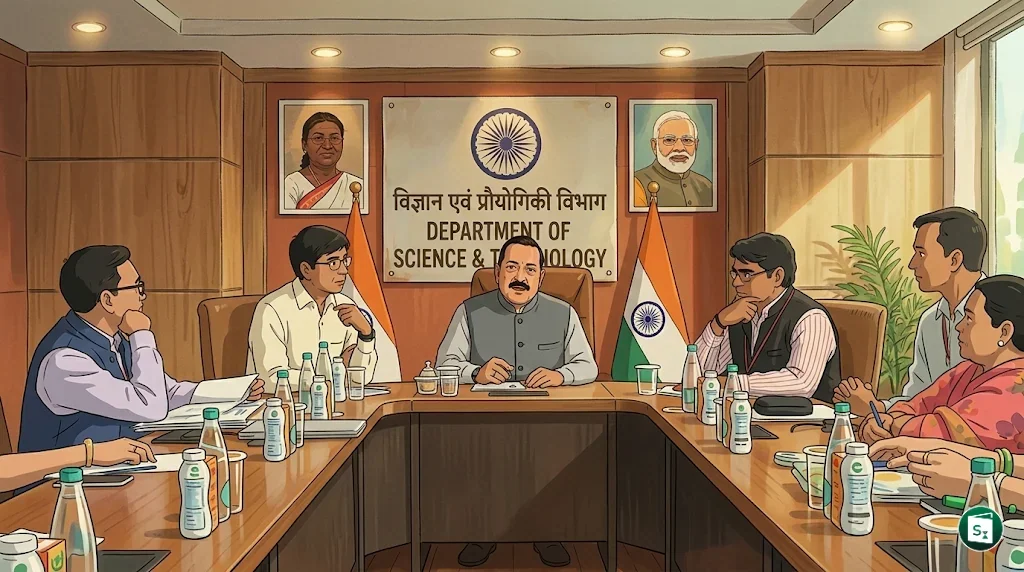
Union Minister Jitendra Singh reviewed the progress of the Anusandhan National Research Foundation (ANRF) during a high-level meeting in April 2026, unveiling major initiatives to reshape India’s scientific landscape. The foundation introduced SARAL AI, a platform to translate complex research into multiple Indian languages, alongside the MAHA Leapfrog Demonstrators program aimed at solving critical societal challenges. To cut through red tape, the foundation has also deployed dedicated nodal officers across 250 research institutions nationwide.
Restructuring the Research Ecosystem
The Anusandhan National Research Foundation (ANRF) was established under the ANRF Act, 2023, which officially came into force on February 5, 2024. Positioned as India’s apex science funding and policy-making body, it replaced the legacy Science and Engineering Research Board (SERB) that was established in 2008. The foundation was conceived to align with the vision of the National Education Policy (NEP) 2020, shifting the nation’s scientific focus from merely generating research output to creating tangible societal impact.
By prioritizing quality and relevance, the ANRF aims to bridge the historical gap between academic research, industrial application, and public utility. It extends financial support and strategic direction beyond pure sciences, integrating disciplines like environmental science, health, agriculture, and engineering to build a more robust and coordinated research ecosystem across Indian universities and laboratories.
Demystifying Science with SARAL AI
One of the most consequential announcements was the development of SARAL AI (Simplified and Automated Research Amplification and Learning). Built with the backing of the ANRF and researchers at IIIT Hyderabad, this artificial intelligence-driven platform addresses a fundamental barrier in Indian science communication: the language divide.
The platform automatically extracts insights from complex research papers, patents, and technical documents, converting them into simplified, non-technical formats. From these insights, it generates rich media such as short presentation videos, podcasts, posters, and social media posts. Crucially, the platform supports dissemination across multiple Indian languages. By translating dense scientific knowledge into mother tongues, SARAL AI democratizes access to research, enabling policymakers, industry professionals, and the general public to understand the real-world value of scientific advancements.
Scaling Innovations through MAHA Initiatives
During the review, the ANRF laid out the roadmap for the MAHA Leapfrog Demonstrators program. MAHA stands for Mission for Advancement in High Impact Areas, reflecting the foundation’s pivot toward goal-oriented, mission-mode programs.
Unlike traditional research grants that often end with academic publications, the Leapfrog Demonstrators focus on the accelerated deployment of scalable, technology-led solutions. The program targets multi-sectoral national priorities, including pollution control, climate resilience, disaster management, and sustainable agriculture. Structured to foster deep collaboration among academia, government bodies, and commercial industries, the initiative ensures that early-stage scientific research progresses rapidly into real-world applications that solve pressing challenges.
Enhancing the “Ease of Doing Science”
Beyond introducing new technological platforms and mission frameworks, the review highlighted administrative reforms aimed at improving the “Ease of Doing Science” in India. The ANRF has deployed dedicated Nodal Officers in approximately 250 institutions nationwide.
Stationed at grantee universities, research institutions, and laboratories, these officers are tasked with reducing the administrative burden on Principal Investigators. By acting as a direct bridge between the ANRF and researchers, they streamline project execution, manage financial communications, and accelerate the processing of essential documentation like Utilization Certificates and Statements of Expenditure. To complement this, new digital communication channels have been established to provide researchers with real-time updates, ensuring that administrative bottlenecks do not stifle scientific inquiry.
Key Takeaways
- The Anusandhan National Research Foundation (ANRF) was established under the ANRF Act, 2023, replacing the legacy Science and Engineering Research Board (SERB).
- The SARAL AI platform, developed alongside IIIT Hyderabad, translates complex research papers and technical documents into simplified content across multiple Indian languages.
- The MAHA Leapfrog Demonstrators program focuses on the accelerated deployment of scalable, technology-led solutions to address multi-sectoral national priorities.
- The acronym MAHA stands for Mission for Advancement in High Impact Areas.
- The ANRF has deployed Nodal Officers in 250 institutions to reduce the administrative burden on researchers and enhance the ease of doing science.