The Government of India has nominated Sanjay Lohiya as a Non-Executive Director on the Central Board of the RBI and the State Bank of India (SBI). He succeeds M Nagaraju.
The RBI has issued the “Third Amendment Directions, 2026” to govern bank lending to Real Estate Investment Trusts (REITs) and Infrastructure Investment Trusts (InvITs), while strengthening risk and exposure norms.
Banks are permitted to extend credit only to those REITs and InvITs that are registered with the SEBI and listed on recognized Stock Exchanges. Lending to REITs is restricted to listed trusts where at least 80% of assets consist of cash-generating properties that have been operational for more than 1 year.
Banks may lend to listed InvITs only if at least 80% of their assets are invested in completed and revenue-generating infrastructure projects that have demonstrated positive cash flows for a period exceeding 1 year.
The RBI has recognised the Sahamati Foundation as the Self-Regulatory Organisation (SRO) for the country’s Account Aggregator (AA) ecosystem.
The Government of India has re-appointed Swaminathan Janakiraman as the Deputy Governor of the RBI for a tenure of 2 years. This re-appointment will be effective from June 26, 2026.
The Monetary Policy Committee (MPC) of the RBI, chaired by Governor Sanjay Malhotra, held its second bi-monthly meeting for FY27. The committee unanimously voted to maintain the policy repo rate at 5.25% and retained a ‘neutral’ stance.
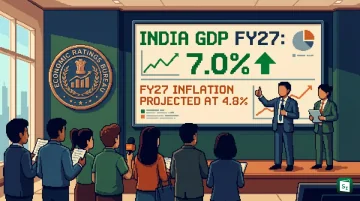
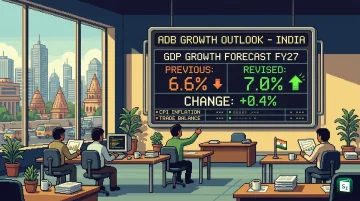
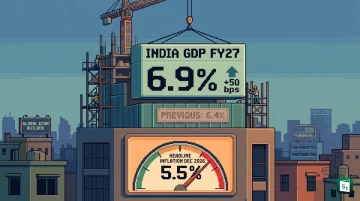
The RBI has maintained other key policy rates: Standing Deposit Facility (SDF) rate at 5%, Marginal Standing Facility (MSF) rate at 5.5%, Bank Rate at 5.5%, Cash Reserve Ratio (CRR) at 3%, and Statutory Liquidity Ratio (SLR) at 18%. The real GDP growth projection for India for FY27 is revised to 6.6% from 6.9%.
The quarterly real GDP growth is projected at 6.6% for Q1, 6.3% for Q2, 6.5% for Q3, and 6.8% for Q4. The Consumer Price Index (CPI) inflation projection is increased to 5.1% from 4.6%, and core inflation to 4.7% from 4.4%. Additionally, the baseline crude oil price projection is revised to $95 per barrel, up from $85 per barrel.
The RBI has imposed a monetary penalty of ₹41.8 lakh on Canara Bank for failing to comply with regulatory norms. The fine was imposed after a supervisory review revealed lapses in ‘Know Your Customer’ (KYC) norms and account classification.
The Ministry of Finance has introduced reforms to increase the participation of Foreign Portfolio Investors (FPIs) in Government Securities (G-Secs).
The measures include tax exemptions on interest income, Long Term Capital Gains (LTCG), and Short Term Capital Gains (STCG). Additionally, the reforms involve the expansion of specified securities under the Fully Accessible Route (FAR).
The Government of India (GoI) has extended the Credit Guarantee Scheme for Microfinance Institutions-2.0 (CGSMFI-2.0) until August 2026 or until guarantees amounting to ₹20,000 crore are issued, whichever is earlier.
The government has also increased the maximum loan amount cap for Large Sized Non-Banking Financial Company-Micro Finance Institutions (NBFC-MFIs)/Micro Finance Institutions (MFIs) from ₹300 crore to ₹1,000 crore, subject to an overall ceiling of 20% of Assets under Management (AUM).
The RBI has introduced two special USD-Rupee forex swap facilities to attract foreign currency inflows and support external financing.
The first facility is for fresh Foreign Currency Non-Resident Bank (FCNR (B)) deposits, allowing Authorised Dealer (AD) Category-I banks to access the RBI’s forex swap facility (available in USD only) for deposits raised in any freely convertible currency.
The second facility is for eligible External Commercial Borrowings (ECBs) with an average maturity of 3 years and above, and overseas Foreign Currency Borrowings (OFCBs) raised by AD Category-I banks with a minimum maturity of 3 years.
According to a report by Fitch Ratings, the GDP growth projection for India for FY27 has been lowered to 6.4% from the earlier estimate of 6.7%.
The RBI has released the ‘Annual Report 2025-26’. The Balance Sheet (BS) of the RBI expanded by 20.6% in FY26, increasing from ₹76.25 lakh crore to ₹91.97 lakh crore, registering a growth of ₹15.72 lakh crore. A provision of ₹1.09 lakh crore was transferred to the Contingency Fund (CF).
The expansion on the assets side was driven by a 44.9% increase in domestic investments to ₹22.59 lakh crore, a 63.8% rise in gold holdings to ₹10.94 lakh crore, and a 7.9% growth in foreign investments to ₹52.68 lakh crore. The number of reported fraud cases declined to 10,114 from 23,722 in the previous year.
The RBI has introduced a 6-point policy package to boost foreign capital inflows and stabilize the Indian rupee. Under the Fully Accessible Route (FAR), RBI has expanded the scope of 'specified securities' to include new central government securities (G-Secs) with tenors of 15, 30, and 40 years.
To optimize foreign portfolio capital flows, RBI has abolished historical entry bottlenecks under the General Route, including short-term investment lock-ins, concentration limits, and individual security caps for Foreign Portfolio Investors (FPIs).
Equity investment ceilings have been increased for Non-Resident Indians (NRIs) and Overseas Citizens of India (OCIs) without SEBI registration. A concessional forex swap facility is introduced for External Commercial Borrowings (ECBs) raised by Central Public Sector Enterprises (CPSEs) to insulate public infrastructure funding from currency volatility.
RBI will bear the full hedging costs for Authorized Dealer (AD) banks that raise fresh 3 to 5-year Foreign Currency Non-Resident (Bank) (FCNR(B)) deposits, valid until September 2026. The timeframe for exporters to repatriate and realize international sales revenue is reduced to 9 months from the previous 15 months.
One Mobikwik Systems Ltd, the parent company of Mobikwik, has received in-principle approval from the RBI for a Payment Aggregator-Physical (PA-P) licence. This licence will enable the firm to facilitate offline merchant payments across India.
RBI has issued final amendment directions for Urban Co-operative Banks (UCBs) and Rural Co-operative Banks (RCBs), mandating a 3-year cooling-off period for directors who have completed a continuous tenure of 10 years on the board.
RBI has also established an 8-member expert panel under the Quantum Secure and Adaptive Financial Ecosystem (Q-SAFE) initiative to evaluate the risks posed to the financial system by the adoption of quantum technology. The panel is led by Anil Prabhakar, a professor at the IIT Madras, who serves as the convener.
The RBI has approved leadership updates for two financial institutions. Sandeep Bakhshi has been re-appointed as the MD & CEO of ICICI Bank for a 2-year term, effective until October 3, 2028.
Additionally, Ketan Merchant has been granted a 3-month interim leadership extension at Fino Payments Bank.
The RBI has imposed a penalty of ₹10.1 lakh on City Union Bank for levying loan-related charges on priority sector agriculture advances up to ₹25,000 and for failing to report Self Help Group (SHG) member-level data to credit information companies.
Mintifi Finserve Pvt Ltd was fined ₹3.1 lakh for failure to upload certain Know Your Customer (KYC) records, and Newa Investments Pvt Ltd was fined ₹2.7 lakh for appointing directors without obtaining prior approval from the regulator.
The RBI has approved a record surplus transfer of ₹2.87 lakh crore to the Government of India (GoI) for FY26. This is higher than the previous year transfer of ₹2.69 lakh crore.
As of March 2026, the balance sheet of the RBI expanded by 20.61% to reach ₹91.97 lakh crore. It is to be noted that under the revised Economic Capital Framework (ECF), the RBI is required to maintain a Contingent Risk Buffer (CRB) within a range of 4.5% to 7.5% of the balance sheet size.
ZikZuk Technologies Pvt Ltd has received final authorization from the RBI to operate as a Prepaid Payment Instrument (PPI) issuer under the Payment and Settlement Systems Act (PSSA), 2007.
The RBI has imposed regulatory restrictions on the Uttar Pradesh-based Nagar Sahakari Bank Ltd due to deteriorating financial conditions and supervisory concerns. Under these restrictions, a withdrawal cap of ₹10,000 per depositor has been placed on all savings, current, and other accounts for 6 months.
The RBI has appointed Gunveer Singh as the Executive Director with immediate effect, assigning him the charge of the Department of Payment and Settlement Systems (DPSS).