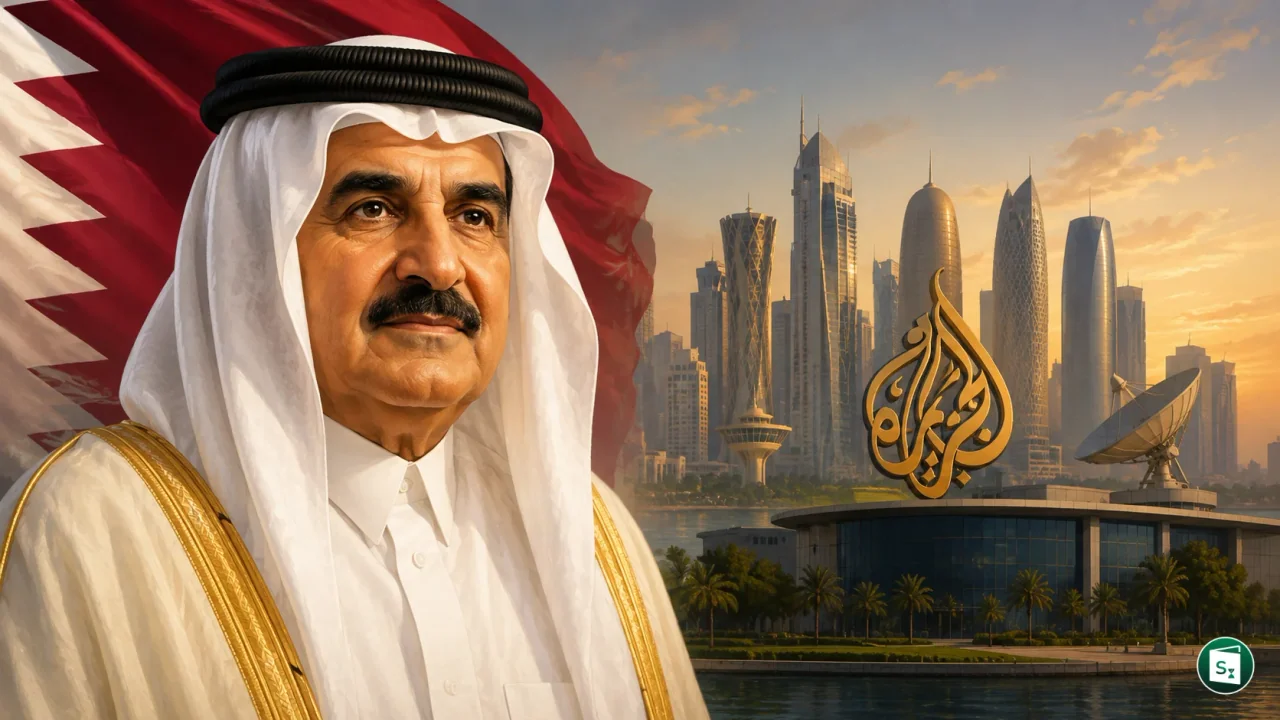
Sheikh Hamad bin Khalifa Al Thani, the Father Emir of Qatar who ruled the Gulf state from 1995 to 2013 and transformed it into one of the world’s wealthiest nations, passed away on July 12, 2026 at the age of 74. Known as the architect of modern Qatar, he built the country’s global influence on vast natural gas wealth, founded the Al Jazeera media network, and voluntarily stepped down in a rare act of abdication in the Arab world. India declared one day of national mourning on July 13, 2026, with flags flown at half-mast across the country as a mark of respect.
Early Life and Rise to Power
Sheikh Hamad was born in Doha in 1952 into the Al Thani family, which has ruled Qatar since the mid-19th century. After completing his early education in Qatar, he graduated from the Royal Military Academy Sandhurst in the United Kingdom in 1971 and was commissioned as a lieutenant colonel in the Qatari armed forces. He rose rapidly through the ranks, becoming commander in chief of the armed forces with the rank of major general in 1975 and was named heir apparent and minister of defence in 1977.
By the early 1990s, following the Persian Gulf War (1990-91), Sheikh Hamad was effectively running the country. On June 27, 1995, he deposed his father, Sheikh Khalifa bin Hamad Al Thani, in a bloodless palace coup while his father was travelling abroad. He took full control as the Emir of Qatar and later survived several coup attempts. He also recovered a significant portion of the estimated $3 billion to $7 billion in oil and gas revenues that his father had held in personal accounts abroad.
Economic Transformation and the LNG Revolution
The single most consequential aspect of Sheikh Hamad’s rule was his decision to aggressively develop Qatar’s natural gas reserves, particularly the North Field, the world’s largest non-associated natural gas field, which Qatar shares with Iran (where it is called South Pars). While his father had been reluctant to exploit this resource, Sheikh Hamad invested heavily in liquefied natural gas (LNG) infrastructure, turning Qatar into the world’s largest LNG exporter by 2006.
The results were staggering. During his 18-year reign, Qatar’s GDP grew more than 24-fold, while GDP per capita increased roughly six times. By the end of his rule, Qatar’s LNG production capacity reached 77 million tonnes per annum, making it the wealthiest country in the world in per capita terms, with average income exceeding $86,000 per person.
In 2005, he established the Qatar Investment Authority (QIA), the country’s sovereign wealth fund, to manage the surging hydrocarbon revenues and diversify the economy. By 2013, QIA had invested over $100 billion in global assets including London’s The Shard, Harrods, Barclays Bank, Heathrow Airport, Volkswagen, Siemens, and Paris Saint-Germain F.C. The fund has since grown to an estimated $600 billion in assets under management, securing Qatar’s financial future beyond the oil and gas era.
Al Jazeera and the Soft Power Revolution
In 1996, Sheikh Hamad founded Al Jazeera, the Arabic satellite news channel that reshaped media across the Arab world. The network was launched with journalists recruited from a shuttered BBC Arabic project, and it quickly became a phenomenon by offering live debates, investigative reporting, and uncensored commentary that was unprecedented in the region’s state-controlled media landscape.
Al Jazeera became the cornerstone of Qatar’s soft power strategy, giving the small state an outsized voice in regional affairs. Its coverage of the Second Intifada, the Iraq War (2003), and later the Arab Spring uprisings (2010-2012) made it a household name globally, though it also created tensions with neighbouring Gulf states. The network expanded into multiple languages and platforms and remains the most widely followed news source in the Arab world.
Foreign Policy and Global Mediation
Sheikh Hamad pursued an independent and activist foreign policy that was disproportionate to Qatar’s small size and population. He positioned Qatar as a mediator in regional conflicts, hosting talks between rival factions and engaging with diverse international partners including the United States, Iran, Hamas, and the Taliban.
Under his leadership, Qatar hosted two US military bases, including the sprawling Al Udeid Air Base, which became the forward headquarters of US Central Command (CENTCOM). At the same time, Qatar maintained working ties with Iran and supported various mediation efforts.
Notable diplomatic achievements during his reign included hosting the 2006 Asian Games, the 2012 UN Climate Change Conference (COP18) in Doha, the Doha Agreement between Palestinian factions Fatah and Hamas, and facilitating the opening of a Taliban political office in Doha at the request of the United States. This office later played a critical role in the negotiations that led to the US-Taliban agreement (2020) and the subsequent withdrawal of US and NATO forces from Afghanistan in 2021.
In October 2012, Sheikh Hamad became the first head of state to visit the Gaza Strip in over a decade, underscoring his commitment to the Palestinian cause. He announced $400 million in reconstruction aid during that visit.
India-Qatar Relations Under Sheikh Hamad
Sheikh Hamad played a significant role in deepening bilateral ties between India and Qatar. He visited India multiple times during his reign, including state visits in 1999, 2005, and 2012, besides several personal visits. These visits laid the foundation for a strong energy partnership, with Qatar becoming a key supplier of LNG to India.
Following his death, Prime Minister Narendra Modi described Sheikh Hamad as a “visionary leader” and a “true friend” of India, recalling their meeting during his visit to Qatar in February 2024. The Government of India declared one day of national mourning on July 13, 2026, with the national flag flown at half-mast across all government buildings and no official entertainment on the day. Parliamentary Affairs Minister Kiren Rijiju was deputed to travel to Doha to convey India’s condolences.
Abdication and Legacy
In a rare move for a Gulf ruler, Sheikh Hamad voluntarily abdicated the throne on June 25, 2013, handing power to his fourth son, Sheikh Tamim bin Hamad Al Thani, who was then 33 years old. In a televised address, he said: “The future lies ahead of you, the children of this homeland, as you usher into a new era where young leadership hoists the banner.” The peaceful transfer of power was widely praised as ensuring stability at a time of regional upheaval following the Arab Spring.
Sheikh Hamad’s domestic reforms were equally significant. Qatar held its first municipal elections in 1999, women were granted the right to vote and stand as candidates, and a permanent constitution was promulgated in 2004 following a public referendum. He established the Qatar Foundation for education, science, and community development, with his wife Sheikha Moza bint Nasser playing a prominent role. Under his patronage, several world-class universities including Carnegie Mellon, Georgetown, Northwestern, Texas A&M, and Weill Cornell Medicine opened campuses in Doha’s Education City.
Qatar also won the bid to host the 2022 FIFA World Cup, the first Arab country to do so, during his tenure. Qatar declared four days of public mourning following his death.
Key Takeaways
- Sheikh Hamad bin Khalifa Al Thani, the Father Emir of Qatar, passed away on July 12, 2026 at the age of 74.
- He ruled Qatar from 1995 to 2013, coming to power through a bloodless palace coup against his father and later voluntarily abdicating in favour of his son Sheikh Tamim bin Hamad Al Thani.
- He founded Al Jazeera in 1996, transforming Arab media, and made Qatar the world’s largest LNG exporter by 2006.
- He established the Qatar Investment Authority (QIA) in 2005, a sovereign wealth fund that grew to over $600 billion in assets.
- Qatar’s GDP grew 24-fold during his reign, making it the wealthiest country in the world in per capita terms.
- India declared one day of national mourning on July 13, 2026, with PM Modi calling him a “visionary leader” and a “true friend” of India.