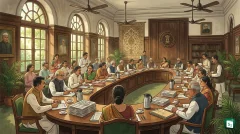
Every year on July 1, India observes GST Day to mark the anniversary of the Goods and Services Tax, the country’s most ambitious indirect tax reform since Independence. The day commemorates the historic midnight rollout of GST on July 1, 2017, when Parliament convened a special session in its Central Hall to usher in the One Nation, One Tax, One Market regime. First celebrated in 2018, GST Day is a reminder of how a complex web of central and state taxes was replaced by a single unified tax system.
What Is GST Day?
GST Day is observed annually on July 1 by the central government to commemorate the implementation of the Goods and Services Tax in India. The day was first celebrated on July 1, 2018, marking the first anniversary of the new tax regime. The government designated this date as GST Day to recognise the efforts of policymakers, tax officials, and taxpayers who contributed to the successful rollout of what is widely regarded as the biggest tax reform in independent India.
The day is used to promote awareness about GST compliance, highlight the achievements of the tax system, and encourage taxpayers to participate in the formal economy. Various outreach programs and events are organised by the Central Board of Indirect Taxes and Customs (CBIC) and state tax departments to mark the occasion.
The Journey to GST in India
The idea of a nationwide Goods and Services Tax was first proposed in 2000 by then Prime Minister Atal Bihari Vajpayee, who set up a committee to design a GST model. In 2003, the Kelkar Task Force on indirect taxes formally recommended the introduction of GST to replace the fragmented tax structure. The task force highlighted how a unified tax would eliminate the cascading effect of taxes and create a seamless national market.
The push gained momentum in 2006 when the Union Finance Minister announced in the Budget speech that GST would be introduced by April 1, 2010. A joint working group of central and state officials released the first discussion paper on GST in 2009, laying out the design of a dual GST model suitable for India’s federal structure.
The legislative journey, however, proved long and arduous. The Constitution (115th Amendment) Bill was introduced in 2011 but lapsed with the dissolution of the 15th Lok Sabha. The Constitution (122nd Amendment) Bill was reintroduced in 2014 under the leadership of Finance Minister Arun Jaitley. After extensive negotiations between the Centre and states, the bill was passed by the Lok Sabha in May 2015 and by the Rajya Sabha in August 2016. It became the Constitution (101st Amendment) Act, 2016 after receiving the President’s assent and ratification by more than half of the state legislatures.
On the midnight of June 30, 2017, Parliament convened a historic session in its Central Hall, reminiscent of the Independence midnight session of 1947. President Pranab Mukherjee and Prime Minister Narendra Modi pressed a button to formally launch GST, replacing 17 central and state taxes including excise duty, service tax, VAT, octroi, and entertainment tax with a single unified tax.
How GST Transformed India’s Indirect Tax System
India follows a dual GST model, where both the Centre and the states levy tax on the same base. Under this structure, intra-state supplies are taxed through CGST (Central GST) collected by the Centre and SGST (State GST) collected by the state. For inter-state supplies, IGST (Integrated GST) is levied and collected by the Centre, with the revenue shared between the Centre and the destination state. Union Territories levy UTGST in place of SGST.
GST Rate Structure
The GST regime originally operated with four primary tax slabs: 5%, 12%, 18%, and 28%, along with a nil rate for essential items and special rates for gold (3%) and rough diamonds (0.25%). Luxury and sin goods attracted a compensation cess on top of the 28% rate.
In a landmark reform in September 2025, the GST Council rationalised the rate structure under what is being called GST 2.0, merging the 12% and 28% slabs into a simplified framework:
| GST Rate | Category |
|---|---|
| 0% | Essential goods such as fresh food, medicines, healthcare, and educational services |
| 5% | Basic necessities including processed food, textiles, and daily-use items |
| 18% | Standard rate for most goods and services, including electronics, IT services, telecom, and financial services |
| 40% | Sin goods and luxury items such as tobacco, pan masala, aerated drinks, and high-end vehicles |
Key Features of GST
GST brought several transformative changes to India’s indirect tax system. The most important is the Input Tax Credit (ITC) mechanism, which allows businesses to claim credit for taxes paid on inputs, effectively eliminating the cascading effect of tax on tax. The e-way bill system replaced physical checkposts at state borders, enabling seamless inter-state movement of goods. Studies suggest this improved transport efficiency by over 30%. The GST Network (GSTN), a non-government company, provides the IT infrastructure for registration, return filing, and payments, bringing transparency and digital compliance to tax administration.
GST Council: The Decision Making Body
The GST Council is a constitutional body established under Article 279A of the Constitution by the 101st Constitutional Amendment Act, 2016. It is the apex decision-making forum for all GST-related matters and embodies the spirit of cooperative federalism.
The Council is chaired by the Union Finance Minister, with the Union Minister of State for Finance and the Finance or Taxation Ministers of all states and Union Territories as members. Decisions are taken through a consensus-based approach, but when voting is required, a three-fourths majority of weighted votes is needed. The Centre holds one-third of the total voting weight, while all states collectively hold two-thirds.
The Council’s recommendations cover tax rates, exemptions, threshold limits, model GST laws, place of supply rules, and special provisions for certain states. It has met over 55 times since its formation, playing a critical role in fine-tuning the tax system through rate rationalisation, compliance simplification, and policy reforms.
GST Revenue Performance
One of the most visible successes of GST has been the steady growth in revenue collections, reflecting expanding tax base, improved compliance, and economic formalisation.
| Fiscal Year | Gross GST Collection (₹ lakh crore) |
|---|---|
| 2017-18 | 7.41 |
| 2018-19 | 11.77 |
| 2019-20 | 12.22 |
| 2020-21 | 11.37 |
| 2021-22 | 14.88 |
| 2022-23 | 18.08 |
| 2023-24 | 20.18 |
| 2024-25 | 22.08 |
The average monthly collection rose from about ₹0.95 lakh crore in FY 2020-21 to ₹1.84 lakh crore in FY 2024-25. The highest ever single-month collection of over ₹2.36 lakh crore was recorded in April 2025. With over 1.4 crore registered taxpayers and growing digital compliance, GST now accounts for roughly 30-35% of India’s total indirect tax revenues. Notably, public limited companies, though just 0.6% of the taxpayer base, contribute over 34% of total GST revenue, while proprietorships making up over 80% of registered entities contribute about 13%.
Key Takeaways
- GST Day is observed on July 1 every year, first celebrated in 2018, to mark the implementation of GST in India on July 1, 2017.
- GST replaced 17 central and state taxes including excise duty, service tax, VAT, and octroi, unifying the country under a One Nation, One Tax, One Market framework.
- The Constitution (101st Amendment) Act, 2016 inserted Article 279A to create the GST Council, a constitutional body chaired by the Union Finance Minister with a weighted voting mechanism.
- India follows a dual GST model with CGST, SGST/UTGST for intra-state supplies and IGST for inter-state supplies.
- The GST rate structure was rationalised in September 2025 under GST 2.0 to four slabs: 0%, 5%, 18%, and 40%.
- Gross GST collections grew from ₹7.41 lakh crore in FY 2017-18 to ₹22.08 lakh crore in FY 2024-25, with over 1.4 crore registered taxpayers.
- France was the first country to introduce GST in 1954, and over 160 countries now have a GST or VAT system.