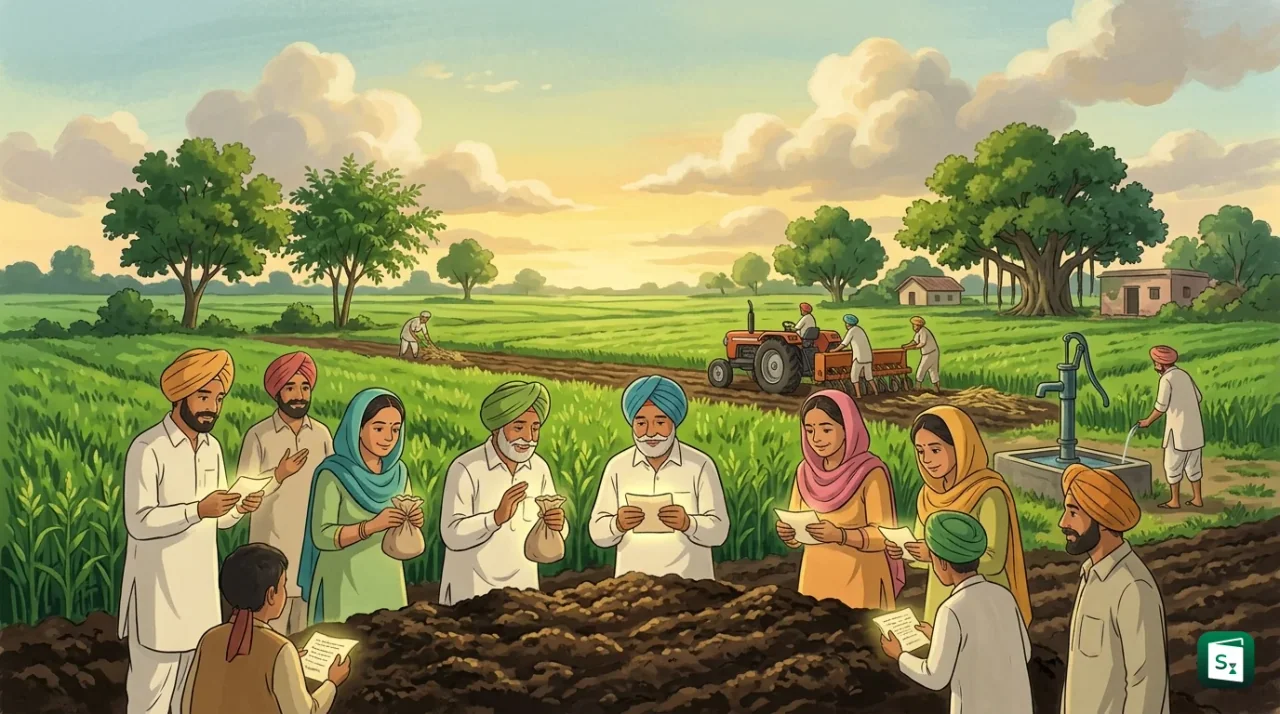
India has made its first farm-level soil carbon payments to 2,550 smallholder farmers in Punjab and Haryana at the Punjab Agricultural University (PAU) in Ludhiana. The farmers will receive more than ₹2.9 crore under the Aadi farmer carbon programme of Grow Indigo for adopting verified regenerative practices between 2019 and 2022. The event marks the first time Indian farmers have earned a direct income from carbon stored in their soil while saving water and reducing stubble burning.
What Is a Carbon Credit?
A carbon credit is a tradable certificate that represents the reduction, removal or avoidance of one tonne of carbon dioxide equivalent (tCO2e). A company or farmer earns this certificate after an independent auditor confirms that the emission cut is real, extra and lasting. The holder can then sell the credit to a buyer who wants to compensate for its own emissions.
Carbon credits are generated through specific activities that either stop greenhouse gases from entering the air or pull carbon already in the air into soil, plants or storage. In farming, such activities include using less fertiliser, saving diesel, avoiding stubble fires and building soil organic carbon. In industry, they include improving energy efficiency and shifting to cleaner fuel. Each tonne saved or stored, after careful measurement and checks for leakage and permanence, can become one credit.
Carbon credits are calculated by comparing actual emissions after the new practice with a baseline of what would have happened without the project. The Aadi project uses soil sampling, farm records, satellite monitoring and a calibrated biogeochemical model to estimate this difference. An independent validation and verification body then audits the data before the registry issues Verified Carbon Units (VCUs). A share of credits is kept in a buffer pool as insurance against reversals such as a return to deep ploughing or burning.
What Is Soil Carbon Sequestration and Carbon Farming?
Soil carbon sequestration is the process by which plants pull carbon dioxide from the air through photosynthesis and store part of that carbon in the soil as roots, residues and humus. When farmers protect this stored carbon through better practices, the soil holds more water, needs less fertiliser and releases fewer greenhouse gases. Soil organic carbon, which is the carbon part of soil organic matter, is the main measure scientists use to track this gain.
Carbon farming means practising agriculture in a way that stores more carbon in soil and plants while cutting emissions from fields. Regenerative agriculture is the wider approach behind carbon farming. It focuses on rebuilding soil health through low disturbance, cover with residues, diverse rotations and careful use of water and nitrogen. Farmers can raise soil carbon by reducing tillage, keeping paddy straw in the field instead of burning it, sowing directly without puddling, adding compost or biochar and using balanced fertiliser with alternate wetting and drying in rice.
Biochar is a charcoal like material made by heating crop waste in low oxygen through a process called pyrolysis. Because its carbon is very stable, mixing biochar into soil can lock carbon for many years while improving water retention. The Aadi programme in Punjab and Haryana did not depend on biochar in its first issuance, but biochar is part of Grow Indigo’s wider carbon portfolio in other states and remains relevant for understanding soil carbon storage options in India.
| Term | Simple Meaning | How It Is Checked |
|---|---|---|
| Soil carbon | All carbon stored in soil, including living roots and humus | Soil sampling and laboratory testing |
| Soil organic carbon | The organic part of soil carbon, used as the main health indicator | Walkley Black method and dry combustion tests in labs |
| Soil carbon sequestration | Net addition of carbon to soil over time after subtracting losses | Measure and model approach with retesting every few years |
| Carbon farming | Farming practices that increase sequestration and reduce field emissions | Field records, satellite checks and independent audit |
First Soil Carbon Payments at Punjab Agricultural University, Ludhiana
The first payments were released at an event held at the Punjab Agricultural University (PAU) in Ludhiana. The Secretary of the Department of Agricultural Research and Education (DARE) and Director General of the Indian Council of Agricultural Research (ICAR), M. L. Jat, initiated the Direct Benefit Transfer (DBT) to the farmers. Grow Indigo released the money digitally from its own funds before the credits were fully sold, so farmers did not have to wait for buyer payments.
The first issuance covered around 30,000 acres and produced more than 50,000 verified carbon credits. The 2,550 farmers in this cohort will share over ₹2.9 crore according to the volume of credits linked to their own fields. Individual payouts range from about ₹3,000 to ₹15,000. Farmers had the option to take an assured upfront amount or to receive 75 percent of the net carbon revenue after sale. Farmers who joined the programme after 2022 form part of the next monitoring cycle and will be paid when their credits are issued.
PAU Ludhiana gives institutional weight to the launch. PAU was established in 1962 and was formally inaugurated by Prime Minister Jawaharlal Nehru on 8 July 1963. The university, which is affiliated with ICAR and operates under the Punjab Agricultural University Act, played a central role in the Green Revolution by developing high yielding wheat and rice varieties for the region. ICAR itself is the apex body for farm research in India. It was set up in 1929, is headquartered in New Delhi, and works through institutes, agricultural universities, All India Coordinated Projects and Krishi Vigyan Kendras to carry lab findings to fields.
The Aadi Farmer Carbon Programme by Grow Indigo
The Aadi programme is Grow Indigo’s flagship farmer carbon programme. Grow Indigo launched Aadi in 2019 with technical guidance from ICAR. The programme is registered under the Verified Carbon Standard (VCS) of Verra, a global nonprofit that runs the world’s leading voluntary carbon crediting system. Aadi follows Verra’s VM0042 methodology for Improved Agricultural Land Management, which lays down rules for measuring emission cuts and soil organic carbon gains from better farm practices.
Grow Indigo is a Mumbai based joint venture between Mahyco, an Indian seed and agriculture innovation group, and Indigo Ag of the United States. The venture was announced in 2018 to bring microbial products, biological inputs and carbon solutions to smallholders. Grow Indigo now works in more than 14 states and says it connects with a large network of farmers, retailers and farmer producer organisations. In March 2025, British International Investment committed about $10 million in debt finance to help Grow Indigo expand carbon farming.
Aadi today covers more than 2 million acres and over 100,000 farmers across seven states. The Punjab and Haryana cohort, recorded as VCS Project 2590, received its first credit approval in January 2026. That approval confirmed that science led soil carbon credits can be produced at scale with smallholders. Grow Indigo reports a wider footprint of more than one million acres under regenerative practices, with a pathway to expand to more than three million acres, which would allow a steady supply of verified credits for buyers seeking farm based climate action.
How Do Farmers Earn and Sell Carbon Credits in India?
Farmers in India can earn carbon credits when they shift to approved low emission practices and allow the resulting climate benefit to be measured and verified. An individual smallholder does not usually register alone because sampling, modelling and audit costs are high. In the Aadi model, Grow Indigo aggregates thousands of farmers into one registered project, carries out the science and paperwork, and passes 75 percent of net carbon revenue back to the farmers. This answers the common question of whether farmers can sell carbon credits. They can, but in practice they do so through a project developer that handles registration, verification and sale.
Carbon credit registration in India for farm projects currently happens mainly through international voluntary registries such as Verra. The developer lists the project, defines the boundary and practices, and sets a crediting period of 20 years or more. Field teams then collect geotagged farm data through a mobile app, take stratified soil samples based on soil type and crop, and track boundaries and practices with multi temporal satellite images. A calibrated model estimates emission cuts and soil gains. An accredited independent auditor validates the project and later verifies each monitoring period before the registry issues credits.
| Stage in the Aadi Cycle | What Happens on the Ground | Who Checks It |
|---|---|---|
| Enrolment from 2019 onward | Farmer joins, field boundary is mapped and baseline practice is recorded | Grow Indigo field team with app and satellite maps |
| Practice change between 2019 and 2022 | Farmer adopts Direct Seeded Rice, reduced tillage and residue management | Regular field visits and satellite practice monitoring |
| Measurement and modelling | Soil samples are tested and a digital twin of fields estimates carbon change | In-house science team plus independent modelling expert |
| Verification and issuance | Auditor reviews data and registry issues Verified Carbon Units | Validation and Verification Body and Verra registry |
| Payment in September 2026 | DBT payment is made as per the farmer share of credits | Direct transfer to farmer bank accounts |
Grow Indigo paid farmers before completing the sale of all credits, which removed the waiting risk for households. Farmers who prefer certainty can choose the assured upfront option. Others can wait for the sale linked payout. The price of farm carbon credits varies by buyer, vintage and quality, and recent market reports place high integrity VM0042 credits in the range of about $30 to $40 per tonne of carbon dioxide equivalent, though the exact Indian farm gate price depends on the contract and the 75 percent share rule.
Regenerative Practices Behind the Credits
The credits in the first issuance came from three linked changes adopted between 2019 and 2022. The first is Direct Seeded Rice (DSR). In the common puddled transplanted method, farmers raise seedlings in a nursery, flood and puddle the field, and then transplant seedlings by hand. In DSR, seeds are sown directly into the field with a seed drill without nursery raising and puddling. Research bodies report that well managed DSR can save 12 to 35 percent of irrigation water, cut labour and energy use, shorten crop duration and lower methane emissions from continuously flooded fields.
The second change is reduced tillage. Less ploughing keeps soil structure intact and slows the breakdown of organic matter, so more carbon stays in the ground. The third change is improved crop residue management. Instead of burning paddy straw to clear fields quickly for wheat, farmers retain, incorporate or remove straw for other uses with machines such as the Happy Seeder and Super Seeder. This builds organic matter and avoids the smoke that harms health and soil life.
The environmental gains reported for the enrolled 2019 to 2022 fields are large. The programme estimates savings of about 45 billion litres of water and prevention of more than 2 lakh tonnes of crop residue from burning, which avoided about 1,000 tonnes of PM2.5 fine particle emissions. The backdrop is the wider fall in farm fires in Punjab from more than 83,000 incidents in 2020 to fewer than 5,000 in 2025, supported by central assistance for in situ and ex situ machines, state incentives for baling and DSR, and village models such as Ransinh Kalan in Moga where burning was avoided across 1,310 acres for six straight years.
Carbon Credits in India: Scheme, Trading Mechanism and Price Context
Carbon credits in India operate through two parallel tracks. The farm payments in Punjab and Haryana belong to the voluntary carbon market, where buyers willingly purchase verified credits to meet sustainability goals. The national compliance market is governed by the Carbon Credit Trading Scheme (CCTS), which was notified on 28 June 2023 under powers given by the Energy Conservation (Amendment) Act, 2022. The scheme aims to price greenhouse gas emissions and help India meet its climate pledges, including the target to cut emission intensity of GDP by 47 percent below 2005 levels by 2035 and to reach net zero by 2070.
The CCTS is run as the Indian Carbon Market (ICM). The Bureau of Energy Efficiency (BEE) serves as the administrator. BEE was established in 2002 under the Energy Conservation Act, 2001, works under the Ministry of Power and is headquartered in New Delhi. The Grid Controller of India acts as the registry that holds accounts and records issuance and transfers. The Central Electricity Regulatory Commission provides regulatory support for trading, and a National Steering Committee co chaired by the Secretaries of the Ministry of Power and the Ministry of Environment, Forest and Climate Change oversees the market. Trading of Carbon Credit Certificates (CCCs) takes place through power exchanges.
| Feature | Compliance Mechanism | Offset Mechanism |
|---|---|---|
| Who takes part | Obligated entities in energy intensive industries that must meet Greenhouse Gas Emission Intensity targets | Non obligated entities that voluntarily carry out approved emission cut projects |
| How credits arise | A factory that beats its target receives certificates for the extra cut | A project such as clean energy or farm carbon action earns certificates after audit |
| Current coverage | 490 obligated entities across aluminium, cement, chlor alkali, petrochemicals, petroleum refineries, pulp and paper and textiles | Methodologies approved and detailed procedures for accreditation of verification agencies in place |
The compliance base was built in two steps. Targets for aluminium, cement, chlor alkali and pulp and paper covering 282 entities were notified in October 2025. Targets for petroleum refineries, petrochemicals, textiles and secondary aluminium covering 208 entities were notified on 13 January 2026. The earlier Perform, Achieve and Trade (PAT) scheme, started in 2012 for energy efficiency, is being gradually shifted into this carbon intensity framework. Farm soil credits like those from Aadi are not part of the industrial compliance obligation today, but the offset design shows how verified farm action could link to domestic demand in future as rules for agriculture methodologies develop.
Why the Punjab and Haryana Outcome Matters
Punjab and Haryana sit at the centre of India’s rice wheat system and also face its sharpest stresses. Groundwater tables have fallen after years of flooded rice in the pre monsoon heat, and paddy straw burning has harmed soil life and winter air across the north. A payment that rewards less water, less fire and healthier soil therefore connects climate action to the daily costs farmers already bear. Even a modest addition of ₹3,000 to ₹15,000 per farmer matters for smallholders with two to three acre holdings, and it comes without giving up the main crop income.
The outcome also matters because it shows that smallholder fields can pass a strict global audit. The credits were issued only after multi year measurement, soil testing and third party review under VM0042, which has recently been recognised for high integrity by the Integrity Council for the Voluntary Carbon Market. The process used geotagged records and satellite monitoring, which reduces doubts about whether the practice really happened. For buyers, this traceability supports supply chain claims on Scope 3 farm emissions for food and apparel value chains. For policy, it offers field evidence for ICAR’s Lab to Land approach, where research from institutes and Krishi Vigyan Kendras is tested on real farms and then linked to income.
The Way Forward
The immediate next step is the second payment cycle. Farmers who joined Aadi after 2022 are already in monitoring, and their credits will be issued after the required soil retesting and audit. Grow Indigo has set a scale goal of reaching lakhs of additional farmers and expanding enrolment toward 2.5 million farmers and more than 5 million hectares by 2030, with new projects on alternate wetting and drying in rice and on biochar from cotton and cereal residues. If verification stays credible and costs fall through digital mapping and standard models, more smallholders can join without high entry barriers.
Policy can build on this start by linking verified farm credits to wider support. Clear domestic rules for agriculture under the offset mechanism, continued finance for DSR machines and residue value chains such as pellets, biogas and ethanol, and stronger extension through PAU, ICAR institutes and state departments can keep the practices in place after the first payment. Permanence will remain the key test, since carbon stored in soil can be lost if burning or deep puddling returns. Long crediting periods, buffer reserves and repeat satellite checks are designed to guard against that risk and to keep the income stream steady for farmers who continue the practices year after year.
Key Takeaways
- India’s first farm-level soil carbon payments were released at Punjab Agricultural University, Ludhiana, with 2,550 farmers in Punjab and Haryana receiving over ₹2.9 crore.
- The first issuance covered 30,000 acres and generated over 50,000 verified carbon credits, with individual payouts of ₹3,000 to ₹15,000 linked to each field’s share.
- The payments belong to the Aadi programme, launched by Grow Indigo in 2019 with ICAR guidance and issued as VCS Project 2590 under Verra’s VM0042 methodology.
- Enrolled farmers adopted Direct Seeded Rice, reduced tillage and crop residue management between 2019 and 2022, saving about 45 billion litres of water and avoiding 1,000 tonnes of PM2.5 emissions.
- Grow Indigo, a 2018 joint venture of Mahyco and Indigo Ag, passes 75 percent of net carbon revenue to farmers and paid digitally before full sale of credits.
- The Carbon Credit Trading Scheme was notified on 28 June 2023, is administered by the Bureau of Energy Efficiency (established in 2002), and now covers 490 obligated entities across seven industrial sectors.