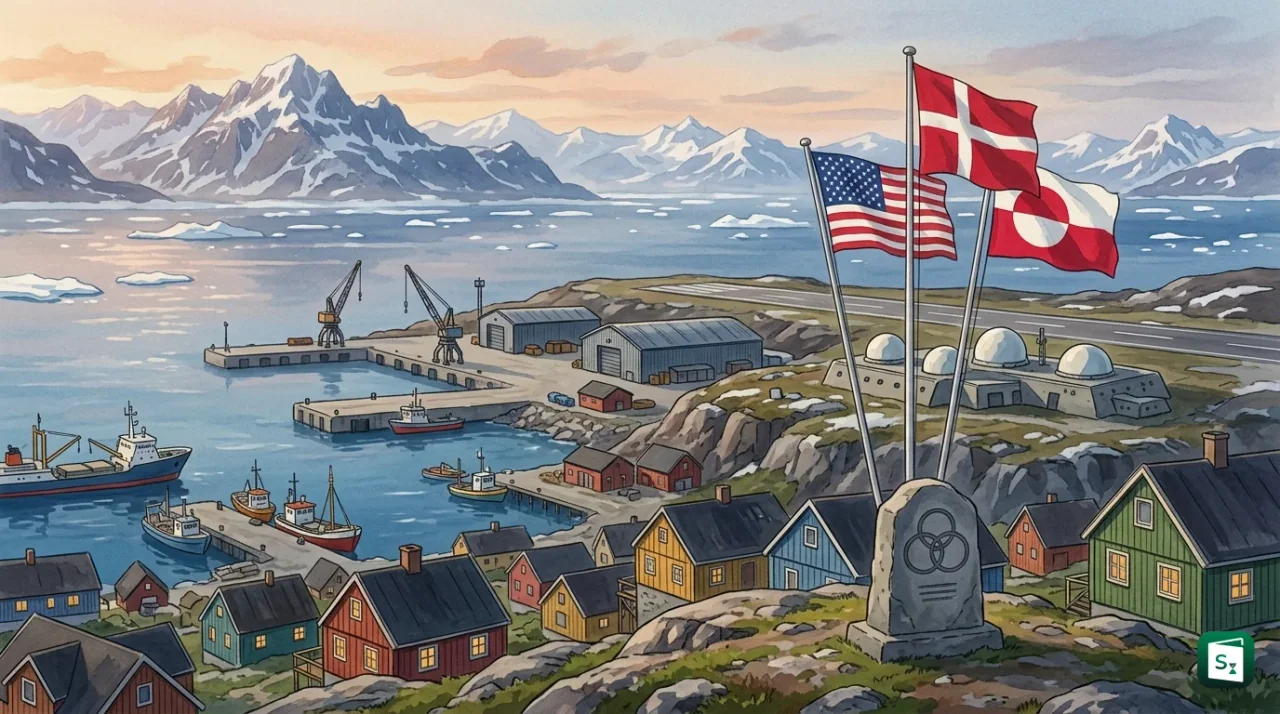
The United States, Denmark and Greenland signed a trilateral Arctic security agreement titled Infinite Life on 22 September 2026 in New York on the sidelines of the 81st United Nations General Assembly (UNGA). The pact gives Washington permanent basing, overflight and operational rights in Greenland, which lies between the Arctic Ocean and the North Atlantic northeast of Canada in North America, while keeping Danish sovereignty unchanged. Described as a deal with no end date, it updates the 1951 Defense of Greenland Agreement and closes months of tension over demands for a United States takeover of the island.
What Is the Infinite Life Agreement?
The Infinite Life agreement is a trilateral security pact between the United States of America, the Kingdom of Denmark and the Government of Greenland to strengthen Arctic and North Atlantic security. The United States President Donald Trump signed the pact with Denmark Prime Minister Mette Frederiksen and Greenland Prime Minister Jens-Frederik Nielsen on 22 September 2026 in New York during the High Level Week of the 81st United Nations General Assembly (UNGA). The full text was published by the White House immediately after the signing ceremony.
The agreement formally amends and supplements the Agreement of 27 April 1951 concerning the defence of Greenland, along with later additions including the 2004 Igaliku Agreement. The 1951 pact was signed in Copenhagen under the North Atlantic Treaty of 1949, which created the North Atlantic Treaty Organization (NATO). NATO is a military alliance of 32 countries in North America and Europe (as of September 2026) that promises collective defence, which means an attack on one member is treated as an attack on all.
The new pact states that it does not have an end date and can be changed only with the consent of all parties. Denmark described the pact as a deal that can last forever. If Greenland later chooses independence, the pact requires the new independent state to remain in NATO and to accept all the rights and duties that Denmark holds under the agreement.
Is Greenland a Country? Political Status and Sovereignty
Greenland is not a fully independent country. It is an autonomous territory within the Kingdom of Denmark with its own parliament and government, while Denmark handles foreign affairs, defence and currency.
The Kingdom of Denmark consists of three parts, which are Denmark, Greenland and the Faroe Islands. Greenland gained Home Rule in 1979 and wider Self Government in 2009 after a referendum in 2008 in which 75.5 percent of voters supported greater autonomy. The Self Government Act of 2009 is the law that defines this arrangement. It gave Greenland control over most domestic subjects including natural resources, while Denmark kept control over foreign policy, defence and monetary policy. The Act also recognises Greenlanders as a people with the right to self determination under international law.
In practice, Greenland has its own parliament called the Inatsisartut and its own government called the Naalakkersuisut. The capital is Nuuk on the southwest coast. Greenland sends two members to the Danish Parliament, the Folketing. Denmark provides an annual block grant of about 4.45 billion Danish kroner (about €600 million), which funds roughly half of Greenland public revenue. This dependence is a central reason why a move to full independence remains economically difficult.
The Infinite Life pact clearly reaffirms the sovereignty and territorial integrity of the Kingdom of Denmark. The text states that no change is made to the territorial status of Greenland. Denmark and Greenland have stressed that sovereignty was a red line and was not negotiated. The United States gains security access, not ownership or sovereignty. This marks a shift from earlier demands in 2019 and early 2026 for purchase or takeover of Greenland, which Denmark and Greenland rejected with the position that Greenland is not for sale.
Where Is Greenland Located? Geography and Size
Greenland lies in the North Atlantic and Arctic Oceans between North America and Europe, northeast of Canada and northwest of Iceland. Geographically it belongs to the continent of North America, though politically it is linked to Denmark and therefore to Europe.
Greenland is the largest island in the world that is not a continent. It covers 2,166,086 square kilometres, which is slightly more than three times the size of Texas and about two thirds the size of India. More than two thirds of its land sits inside the Arctic Circle. The Arctic Circle is an imaginary line of latitude at about 66.5 degrees north, above which parts of the year have continuous daylight or continuous darkness. About 80 percent of Greenland is covered by the Greenland Ice Sheet, a layer of ice up to three kilometres thick. Only a narrow coastal strip is ice free, and almost all settlements are located there.
Greenland has about 56,000 people (as of 2026), which makes it one of the least populated territories in the world. Around 88 percent are Inuit, who call their homeland Kalaallit Nunaat, which means Country of the Greenlanders. The capital Nuuk holds about 20,000 people, or more than one third of the total population. The official language is Greenlandic (Kalaallisut), and the currency is the Danish krone.
| Feature | Detail |
|---|---|
| Location | Northern North America, between Arctic Ocean and North Atlantic, 16 miles from Canada Ellesmere Island at closest point |
| Continent | North America geographically, politically tied to Europe through Denmark |
| Area | 2,166,086 sq km, largest island in the world |
| Ice cover | About 80 percent under ice, ice free area about 410,449 sq km |
| Coastline | 44,087 km, deeply cut by fjords |
| Capital | Nuuk (64 degrees 11 minutes north, 51 degrees 44 minutes west) |
| Greenland vs India size | Greenland is about 66 percent the size of India (India is about 3.28 million sq km) |
Greenland is often compared with Iceland because the names sound opposite. Iceland lies southeast of Greenland and is far smaller at about 103,000 square kilometres, with a warmer climate in its southern lowlands due to ocean currents, while Greenland is largely ice covered and much larger.
Why Does the US Want Greenland? Strategic Rationale
The United States values Greenland for three reasons, which are location for missile warning, control over emerging Arctic sea routes, and access to critical minerals. Greenland sits directly between North America and Russia, so radars there give the earliest warning of missile threats.
Greenland sits on the shortest air and sea paths between North America and Europe and guards the GIUK Gap, the sea passage between Greenland, Iceland and the United Kingdom through which Russian ships and submarines must pass to reach the Atlantic. As Arctic ice melts, the Northwest Passage through Canada Arctic islands is opening for longer summer periods. This route can shorten the distance between East Asia and Western Europe by about 7,000 kilometres compared with the Panama Canal route. Control and monitoring of these waters is therefore becoming central to trade and naval planning.
The second reason is minerals. Greenland holds deposits of iron ore, graphite, zinc, copper and rare earth elements. Rare earth elements are a group of 17 metals used in mobile phones, computers, electric vehicle motors, wind turbines and guided weapons. Greenland ranks eighth in the world for rare earth reserves with about 1.5 million tonnes. The United States now treats secure supply of these metals as a national security goal because China processes more than 90 percent of global rare earth output. A 2019 memorandum between the United States and Greenland for joint mapping of minerals, and United States support for the Tanbreez rare earth project in southern Greenland through a $120 million loan interest from the Export Import Bank, show this economic interest.
The third reason is denial of rivals. Washington argues that Russia has rebuilt Arctic military bases and China has declared itself a near Arctic state with growing polar research, shipping and investment interest. The pact therefore blocks persistent military presence by non NATO states and gives Washington a say over sensitive investments, to prevent rivals from gaining a foothold near North America.
From 1951 to 2026: How US Basing Rights Have Evolved
The United States military presence in Greenland began during the Second World War. After Denmark was occupied in 1940, the United States occupied Greenland to stop it from falling under German control and to protect North Atlantic shipping lanes. In 1941, the United States signed a defence arrangement for Greenland, and after the war the presence continued into the Cold War to watch the Soviet Union.
The core legal base is the Defense of Greenland Agreement of 27 April 1951. The agreement was signed in Copenhagen and registered with the United Nations. It allowed the United States to build and operate defence areas in Greenland after notifying Denmark, to defend Greenland and the wider NATO area. At its peak, the United States operated 17 bases and installations with thousands of soldiers in Greenland. Over time the footprint shrank to a single major base with about 150 to 200 personnel.
| Year | Development |
|---|---|
| 1941 | Wartime defence arrangement allows United States bases in Greenland |
| 27 April 1951 | Defense of Greenland Agreement signed under NATO, permits United States defence areas across Greenland |
| 1991 | Memorandum on use of Sondrestrom Aviation Facility and Kulusuk Airfield defines local cooperation |
| 6 August 2004 | Igaliku Agreement amends 1951 pact, confirms Thule as the only defence area and gives Greenland a formal role |
| 6 April 2023 | Thule Air Base renamed Pituffik Space Base and transferred to the United States Space Force |
| 22 September 2026 | Infinite Life agreement allows modernisation of Pituffik, new areas at Narsarsuaq and Mestersvig, and a process for further areas |
Is Pituffik the Same as Thule? Where Is Pituffik Space Base?
Yes, Pituffik Space Base is the new name for Thule Air Base. The United States renamed the base on 6 April 2023 to honour Greenlandic heritage and to reflect its space role. Pituffik is the traditional Greenlandic name for the region.
The Pituffik Space Base lies on the northwest coast of Greenland, about 750 miles north of the Arctic Circle and across Baffin Bay from Canada. It is the northernmost installation of the United States Department of Defense and is locked by ice for nine months a year. The base is operated by the 821st Space Base Group under Space Base Delta 1. Its main units are the 12th Space Warning Squadron, which runs an Upgraded Early Warning Radar for missile warning, missile defence and space surveillance, and Detachment 1 of the 23rd Space Operations Squadron, which tracks satellites in polar orbit. The radar sits directly between North America and Russia, so it can detect sea launched and intercontinental ballistic missiles approaching over the Arctic.
What Does the New Pact Allow? Basing, Overflight and Investment Controls
The Infinite Life pact keeps the 1951 framework but adds clear operational permissions for the United States. The text was signed in three languages, which are English, Danish and Greenlandic, with English prevailing in case of doubt. It will enter into force after Denmark completes its parliamentary procedures and informs Washington through a diplomatic note.
First, the United States can modernise and expand activities at Pituffik Space Base. Second, the United States can establish an additional defence area at Narsarsuaq in the south and Mestersvig in the east, with technical details to be agreed later. Narsarsuaq hosts a former wartime airfield with a harbour, while Mestersvig hosts a short airstrip on the remote east coast. Both locations would extend surveillance and rapid response beyond the far northwest. Third, the United States can propose further defence areas in future. The proposal goes to a joint Permanent Committee created under the 1991 memorandum. If no decision is reached in 90 days, talks move up to deputy minister level and then to minister level.
For movement outside these bases, United States public vessels, aircraft, armed forces and vehicles receive free access and movement between defence areas through Greenland, including territorial waters, by land, air and sea. United States aircraft can fly over and land anywhere in Greenland, and United States public vessels can move undersea within territorial waters. Additional access can be agreed when the military situation requires it for defence of the NATO area, Greenland and the American continent. These rights must respect Greenlandic society and way of life, including hunting, fishing and traditional activities.
The pact also sets two exclusion rules. No state outside NATO can set up its own manned or unmanned military installations in Greenland or keep a persistent military presence there, unless all parties agree. In particularly sensitive sectors such as critical infrastructure and resource extraction, investors from states outside NATO, NATO partners and the European Union (EU) cannot take control, gain significant influence or access non public information that threatens security, unless the parties agree the activity is safe. Greenland will apply this rule through its investment screening laws in close consultation with Denmark and the United States.
Other clauses promise contracts for Greenlandic firms to the maximum extent possible, joint work against espionage near defence areas, and a stronger Danish Arctic posture across land, sea, air and space. The United States also points to the planned Golden Dome missile defence system as a future use of this access. Golden Dome is a proposed United States system to detect and intercept missile threats using space, ground and sea sensors.
Arctic Governance: Arctic Council, NATO Arctic Sentry and US Arctic Policy
The Arctic has two different layers of governance. The Arctic Council handles cooperation on environment, science and sustainable development, while NATO handles collective defence. The Arctic Council is a high level forum created by the Ottawa Declaration of 1996. It takes decisions by consensus and does not deal with military disputes.
The Arctic Council has eight member states with territory above the Arctic Circle. Seven of them are NATO members, and one is Russia. The Kingdom of Denmark holds the chairship for 2025 to 2027.
| Arctic Council Member | NATO Member |
|---|---|
| Canada | Yes |
| Kingdom of Denmark (including Greenland and Faroe Islands) | Yes |
| Finland | Yes |
| Iceland | Yes |
| Norway | Yes |
| Sweden | Yes |
| United States | Yes |
| Russia | No |
The Council also includes six Indigenous peoples organisations as Permanent Participants and works through six working groups on issues such as biodiversity, pollution and emergency response.
On defence, NATO has increased its Arctic role since 2025 at the request of its seven Arctic members. In February 2026, NATO launched Arctic Sentry, a multi domain vigilance activity led by Joint Force Command Norfolk in Virginia under strategic direction from Allied Command Operations. Arctic Sentry brings national exercises and deployments under one command to improve surveillance, air policing over Iceland, maritime awareness and rapid response in harsh polar conditions. In June 2026, NATO also set up Forward Land Forces Finland, a multinational ground presence led by Sweden to guard the northern and eastern flanks.
The Infinite Life pact fits directly into this structure. The parties support stronger NATO planning, presence, exercises and joint intelligence gathering in the Arctic. Denmark has promised to strengthen its own surveillance and interoperability with allies. For Washington, the pact secures predictable legal access for Arctic operations without raising the far larger question of changing borders, which would have shaken NATO unity.
Significance and The Way Forward
The pact matters because it settles the immediate dispute while leaving deeper questions open. For the United States, it delivers the core security goals of permanent access, freedom to build and a veto over rival military and investment entry, without the cost and backlash of a takeover. The plan for two major new facilities and possible Golden Dome sensors strengthens early warning and space tracking over the central Arctic, where coverage gaps existed.
For Greenland, the pact protects formal sovereignty and the right to decide its own future, and it promises local contract benefits and environmental safeguards under the 1991 memorandum and the 2004 Joint Declaration on environment. For Denmark, it keeps the unity of the realm intact and places Arctic security firmly under NATO watch. For NATO, it avoids a split between allies and adds a legal base for Arctic Sentry to use Greenland airfields and waters.
Limits remain. The text does not set timelines, troop numbers or funding for Narsarsuaq and Mestersvig. Mining of rare earths will still face harsh climate, lack of roads and ports, and strict environmental rules, including Greenland 2021 ban on uranium mining which affects projects such as Kvanefjeld. Trust will also take time to rebuild after threats of force, and analysts note the pact could become a platform for further United States requests.
The next steps are parliamentary approval in Denmark together with Greenland, entry into force through a diplomatic note, and technical talks in the Permanent Committee on the size, environmental safeguards and contract terms for each new site. The handling of investment screening and the first construction decisions will show whether the promise of lasting security with intact sovereignty holds in practice.
Key Takeaways
- The Infinite Life pact was signed on 22 September 2026 in New York at the 81st UNGA by the leaders of the United States, Denmark and Greenland.
- The pact grants the United States permanent basing, overflight and operational rights while confirming Danish sovereignty over Greenland remains unchanged.
- The pact is an update to the Defense of Greenland Agreement of 27 April 1951 signed under the 1949 North Atlantic Treaty.
- The United States can expand Pituffik Space Base, formerly Thule Air Base renamed in 2023, and build new defence areas at Narsarsuaq and Mestersvig.
- Greenland is the largest island in the world at 2,166,086 sq km, located in North America, with capital Nuuk and population of about 56,000.
- NATO Arctic Sentry, launched in February 2026 and led by Joint Force Command Norfolk, coordinates allied deterrence across the Arctic with seven of eight Arctic Council states as NATO members.