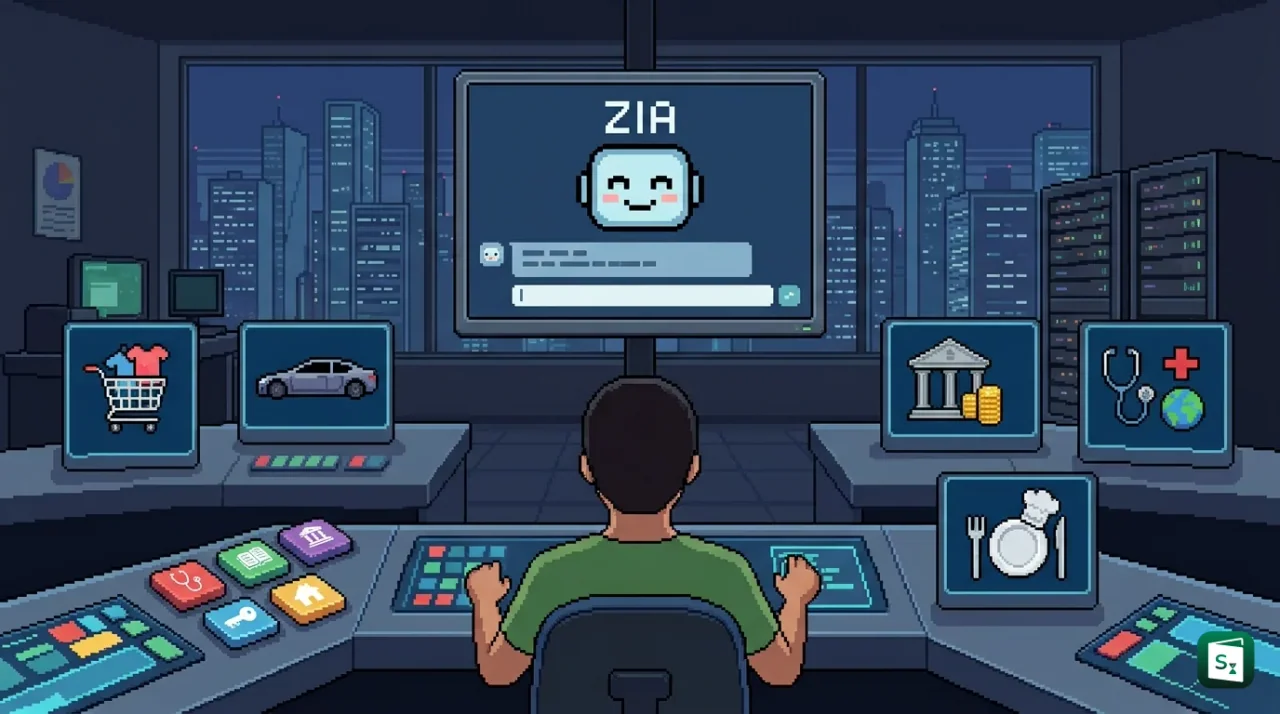
Zoho Corporation launched Zia Chat on 23 September 2026, a single conversational Artificial Intelligence (AI) interface that lets employees find information and complete tasks across its business apps. On the same day, the Chennai based company entered vertical Software as a Service (SaaS) with seven industry specific applications for retail, automotive, Banking, Financial Services and Insurance (BFSI), healthcare, education, real estate and restaurants. The twin launch links Zoho Zia, its long running AI assistant, directly with industry workflows to cut search time and token costs for businesses.
What Is Zoho and What Is Zia in Zoho?
Zoho is an Indian multinational technology company that sells cloud based business software on subscription. Zia is the built in Artificial Intelligence (AI) assistant of Zoho that works across its apps to search data, predict outcomes, create content and run autonomous agents for sales, service, finance and human resources tasks.
Zoho Corporation was founded in 1996 as AdventNet Inc. by Sridhar Vembu and Tony Thomas. The company is privately held and profitable and is headquartered in Chennai, Tamil Nadu, with its United States headquarters in Austin, Texas. Zoho owns and operates its data centres and offers more than 55 integrated applications, including Zoho CRM (Customer Relationship Management), Zoho Mail, Zoho Books for accounting, Zoho People for human resources, Zoho Desk for customer support and Zoho One, which is a bundle of its apps. Zoho serves more than 150 million users and more than one million paying customer organisations globally (as of September 2026) and employs about 19,000 people with over 90 offices in 28 countries.
Zia, which stands for Zoho Intelligent Assistant, was first launched in 2015. Zoho expanded Zia in stages from simple predictions to generative AI and then to agentic AI. In February 2025, Zoho introduced Zia Agents, which are autonomous digital workers for tasks such as sales prospecting, customer service and IT helpdesk, along with Zia Agent Studio for building custom agents and an Agent Marketplace for sharing them. In July 2025, Zoho launched Zia LLM (Large Language Model), its own 7 billion parameter model trained for business documents and designed to keep customer data on Zoho servers.
What Is Zia Chat and How Does It Work?
Zia Chat is a separate AI product that gives every employee one chat window to ask questions and get work done across Zoho apps. A user can type a request in plain English and Zia Chat will pull the right records, join the context and also take action such as drafting a reply, updating a deal or escalating a ticket.
Zia Chat is built natively into the Zoho ecosystem. It works across more than 45 Zoho applications, including CRM, Desk, Books, Mail, Projects, People, Analytics, Cliq for team chat, Campaigns for marketing and Inventory. Zoho says a monthly renewal review that earlier needed separate checks in CRM, Desk and Books and took 45 to 60 minutes can now be done in under five minutes with one prompt and a scheduled repeat. Zia Chat respects the roles and permissions already set in each app, so a user can only see and change records that the user is allowed to access. Administrators can switch on Zia Chat once for the full organisation and control which users get access.
Zoho has designed Zia Chat to be model flexible and cost efficient. Users can use supported frontier models through Bring Your Own Key (BYOK), which means the company uses its own paid key for models such as OpenAI, or they can use the Zoho hosted Zia LLM which keeps all processing inside Zoho. Zoho Co-founder and Chief Scientist Sridhar Vembu said the goal is to commoditise intelligence so that customers can finish work without paying high token charges, where tokens are the small text units that AI models charge for. Early access to Zia Chat is free and is currently available only in English in the India and United States data centres. Zoho plans to bundle Zia Chat with Zoho One and other plans at the time of general availability, with pricing to be announced then. Customer data is not used to train AI models.
| Work Role | Example Use of Zia Chat | Apps Joined Together |
|---|---|---|
| Sales | Review deals closing this month that have gone cold, open tickets or overdue invoices | CRM, Desk, Books, Analytics |
| Support | Get full customer history with open issues, projects and recent chats before a call | Desk, CRM, Projects, Cliq |
| Marketing | Compare two campaigns on leads, conversion rate and cost per lead | Campaigns, CRM, Analytics |
| Finance | Find overdue invoices, check active deals and draft payment reminders | Books, CRM |
| Operations | List products likely to run out in 30 days using sales speed and open orders | Inventory, CRM, Analytics |
Seven Industry Applications Under the Vertical SaaS Push
Vertical SaaS means software built for the needs of one specific industry, with its own workflows, rules and legal requirements. This is different from horizontal SaaS, which means general software such as email, accounting or customer management that any industry can use. Zoho has spent more than two decades building horizontal apps. Zoho will now combine that broad platform with vertical depth so that its AI gets full context about industry terms, relationships and compliance steps.
The first set of vertical solutions covers seven industries. Each solution is purpose built for that industry and is deeply joined with the wider Zoho suite, so data can move freely between the industry app and tools such as Mail, WorkDrive for file storage, Creator for custom apps and Books.
| Industry | New Product and Platform | What It Does |
|---|---|---|
| Retail | Zoho RetailIQ under Zoho for Retail | Retail specific CRM that joins billing, loyalty, SMS, WhatsApp, email and Instagram data to track buying habits, run loyalty programmes and send personal offers |
| Automotive | Zoho AutoDMS under Zoho for Automotive | Dealer Management System that connects sales, service, warranties, spare parts and dealer orders to give one view of each customer, vehicle and transaction |
| BFSI | Zoho LOS under Zoho for BFSI | Loan Origination System for banks, Non Banking Financial Companies (NBFCs) and insurers that handles the full lending journey from application and verification to approval and disbursal with AI document checks |
| Healthcare | MedScribe under Zoho for Healthcare | AI native clinical documentation tool that turns doctor patient conversation into structured records with voice to text, multilingual support and specialty templates |
| Education | Zoho Campus with Zoho Classes under Zoho for Education | Institutional platform that joins admissions, fee collection, attendance, timetables, assignments and staff records with single sign on, plus an AI student engagement tool |
| Real Estate | Zoho for Real Estate | Workflow for brokers and builders that captures leads, matches buyers to properties, plans site visits, tracks follow ups and closes deals |
| Restaurants | Zoho POS for Restaurants | Cloud point of sale that manages dine in and table service, menus, kitchen work, recipes, inventory, self ordering and catering from one screen |
Zoho said MedScribe is compliant with the Ayushman Bharat Digital Mission (ABDM), which is the national system for linking health records in India, and it can work along with existing Electronic Health Record (EHR) and hospital systems instead of replacing them. Zoho POS for Restaurants is free for restaurants with annual billing up to ₹12 lakh. In terms of reach, RetailIQ, LOS, Campus and POS for Restaurants are available in India, AutoDMS is available globally, MedScribe is in early access in India, and the real estate solution is available in India and the United States.
What Is Vertical SaaS and How Is It Different?
Vertical SaaS is software as a service designed for one industry alone. Horizontal SaaS serves one business function for all industries. A payroll tool or a general CRM is horizontal because a school, a hospital and a car dealer can all use it with small changes. A loan origination system for banks or a dealer management system for car showrooms is vertical because it contains the forms, approvals, risk rules and reports of that industry alone.
Buyers prefer vertical tools when compliance is strict and daily work is special. A generic finance app cannot easily create ABDM linked clinical notes or track vehicle warranties and insurance without heavy custom work. Vertical products reduce that custom work, improve adoption by staff and raise customer loyalty for the vendor. Analysts note that vertical SaaS is growing faster than horizontal SaaS and often shows stronger retention because the software mirrors the way the business already works.
| Feature | Horizontal SaaS | Vertical SaaS |
|---|---|---|
| Target users | All industries with a common need | One industry with special needs |
| Example | Zoho Mail, Zoho Books, Zoho People | Zoho LOS for lending, Zoho AutoDMS for dealerships, MedScribe for clinics |
| Customisation need | High custom work to fit industry rules | Low custom work as rules are built in |
| Market size | Very large but crowded | Narrower but deeper and more loyal |
| Growth driver | New users across sectors | Digitisation of one sector plus cross sale of payments and AI |
Business Context, Significance and the Way Forward
Zoho announced Zia Chat and the vertical suite at a time of strong domestic growth. Zoho reported 45 to 47 percent year on year revenue growth in India in 2025, led by Zoho Workplace for office work, Zoho One, Zoho CRM, Zoho Books and Zoho People. Growth came from Information Technology enabled Services (ITeS), manufacturing, BFSI, professional services, retail and automotive customers. At the group level, Zoho Corporation recorded revenue of about ₹13,543 crore in financial year 2024-25. Zoho marked its 30th anniversary in February 2026 with the same scale markers that explain its product strategy.
The significance of the launch lies in three shifts. First, Zia Chat tries to solve the interface problem. Employees now work across many apps and spend time searching for context. A single chat that can read and write across apps can reduce that search time and improve follow through in sales, support and finance. Second, vertical apps give AI better industry context. An AI that knows what a loan file, a vehicle chassis number or a clinical note means can give more correct answers and draft more useful summaries than a generic assistant. Third, the move positions Zoho against global rivals such as Salesforce, Microsoft, SAP and HubSpot and domestic rival Freshworks. While rivals sell broad platforms or charge high AI add on fees, Zoho is offering an India built stack with owned data centres, a no advertisement privacy model and low cost AI.
The way forward will depend on execution on language, pricing and adoption. Zia Chat will be available for early access within a month of launch and Zoho will announce final pricing and bundling at general availability. Support for more Indian languages and more data centre regions will be key for schools, hospitals and small retailers that work outside English. For vertical SaaS, Zoho will need to prove faster deployment and clear compliance benefits in regulated sectors such as BFSI and healthcare. If hospitals can safely create ABDM ready records, if banks can shorten loan approval time and if small restaurants can go digital at zero cost up to the free limit, the vertical bet can widen Zoho presence beyond its current base of technology and services firms.
Key Takeaways
- Zoho launched Zia Chat on 23 September 2026 as a single conversational AI interface across more than 45 Zoho apps.
- Zia, launched in 2015, is the Zoho Intelligent Assistant that powers predictions, generative answers and Zia Agents across the Zoho suite.
- Zoho entered vertical SaaS with seven industry solutions for retail, automotive, BFSI, healthcare, education, real estate and restaurants.
- Zoho RetailIQ is a retail CRM, Zoho AutoDMS is a dealership manager, Zoho LOS is a loan origination system and MedScribe is an ABDM compliant clinical documentation tool.
- Zoho Corporation was founded in 1996 in Chennai and serves more than 150 million users with about 19,000 employees globally.
- Zoho reported 45 to 47 percent India revenue growth in 2025, led by Workplace, Zoho One, CRM, Books and People.