The Gujarat International Finance Tec-City (GIFT City) has signed an MoU with the Vietnam International Financial Center-Da Nang (VIFC-DN) in New Delhi.
The agreement aims to support the development of the international financial centre of Vietnam, promote cross-border investments, and strengthen financial and business linkages between India and Vietnam.
According to the 'Unified District Information System for Education Plus (UDISE+) 2025-26' report released by the Ministry of Education, the total number of teachers in India rose by 8.3% to 1.02 crore in 2025-26, from 94.8 lakh in 2022-23.
The report highlights that the Pupil-Teacher Ratio (PTR) stands at 10 for Foundational, 12 for Preparatory, 17 for Middle, and 21 for Secondary levels, which remains better than the National Education Policy (NEP) recommended ratio of 30:1. The Gross Enrolment Ratio (GER) at the secondary level has increased to 71.7%.
The India-led Global Biofuel Alliance (GBA) has launched its flagship Global Biofuel Champion Fellowship (GBCF) programme at the India Habitat Centre in New Delhi.
The GBA has selected 15 early-career researchers from leading global universities and research institutions to serve as GBA Ambassadors for a tenure of 2 years. Each fellow will receive a research grant of $15,000. The selected cohort includes 2 researchers from India: Ruchi Agrawal from The Energy and Resources Institute (TERI), Delhi, and Abhishek Sahoo from the IIT Delhi.
The Council of Scientific and Industrial Research-Central Institute of Mining and Fuel Research (CSIR-CIMFR) has developed the Smart Algal Liquid Tree (SALT), a mobile liquid tree designed to purify air in crowded urban areas.
The patented technology functions as a photobioreactor that uses microalgae to absorb carbon dioxide, release oxygen, and reduce dust concentrations. It is currently deployed at the CSIR-CIMFR facility in Dhanbad, Jharkhand, and at Northern Coalfields Ltd (NCL) in Singrauli, Madhya Pradesh.
The ISRO has successfully conducted the Integrated Main Parachute Airdrop Test-05 (IMAT-05) for the Gaganyaan G1 mission at the Aerial Delivery Research and Development Establishment (ADRDE) drop zone in Sheopur, Madhya Pradesh.
The test aimed to validate the Main Parachute System under maximum expected load conditions for the first uncrewed Gaganyaan G1 mission. It is to be noted that the Gaganyaan Crew Module uses a system of 10 parachutes of 4 distinct types.
The West Bengal government has announced special financial assistance of ₹313 crore for tea garden workers in the state under the 'PM Cha Shramik Protsahan Yojana' (PMCSPY).
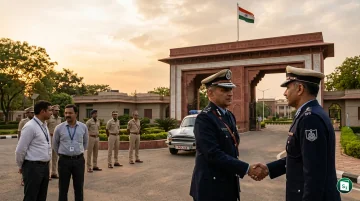
The Appointments Committee of the Cabinet (ACC) has appointed Alok Kumar Mittal as the Director General (DG) of the Bureau of Police Research & Development (BPR&D) until June 2029.
The ACC has also appointed Sujeet Pandey as the Director of the Sardar Vallabhbhai Patel National Police Academy (SVPNPA) until July 2028.
Leander Paes, a former Indian professional tennis player and Olympic medallist, has been appointed as the Player Ambassador of the Asian Tennis Federation (ATF).
India achieved a perfect golden sweep at the 56th International Physics Olympiad (IPhO) 2026, held in Bucaramanga, Colombia.
The Indian contingent, comprising Kanishk Jain, Riddhesh Bendale, Rishit Garg, Shresth Suraiya, and Svarit Joshi, secured a joint No.1 World Rank alongside China, Russia, Kazakhstan, South Korea, and Taiwan.
Union Minister Mansukh Mandaviya has announced that Telangana will host the 8th Khelo India Youth Games (KIYG) in November 2026.
The 7th edition of the KIYG was hosted by Bihar, where Maharashtra emerged as the overall champion. It is to be noted that the Khelo India Programme was launched in 2018.
A 28-km long plastic-lined artificial reservoir has been developed in the Thar Desert near Jaisalmer, Rajasthan, under the Jal Jeevan Mission (JJM) to provide a consistent, year-round drinking water supply.
Recognized as one of Asia's largest artificial desert reservoirs, it has a storage capacity of 1.41 billion liters and a depth of 13 meters. The reservoir captures rainwater and surplus monsoon water, which is channeled from the Indira Gandhi Canal via a 1-km escape channel.
The Ministry of Electronics and Information Technology (MeitY), in collaboration with the Drone Federation India (DFI), has launched the second edition of the 'National Innovation Challenge for Drone Application and Research' (NIDAR 2.0, 2026-27) at Electronics Niketan, New Delhi, in a hybrid mode.
The challenge is conducted under the 'SwaYaan' initiative, which was approved by MeitY in 2022 with a total financial outlay of ₹89.87 crore over a five-year period.
Union Minister Amit Shah has launched various initiatives during the 5th Foundation Day Ceremony of the Ministry of Cooperation held at Bharat Mandapam, New Delhi.
The event was organised in alignment with the vision of PM Narendra Modi of "Sahakar Se Samriddhi" (Prosperity through Cooperation).
He also announced that the centre plans to establish a Cooperative Life Insurance Company to expand the cooperative sector.
Regarding infrastructure, 135 godowns were transferred, 85 were inaugurated, and the foundation stone was laid for 47 grain-storage godowns.
The Geographical Indication Registry (GIR) has granted the Geographical Indication (GI) tag to Sirsa Kinnow, making it the first fruit from Haryana to receive this recognition.
The certification has been awarded to the Kharisureran Farmer Producer Company Ltd, based in the Sirsa district of Haryana.
According to the 'World Economic Outlook (WEO) Update - July 2026' report titled 'Global Economy in Crosscurrents of War and Technology' released by the International Monetary Fund (IMF), India's GDP growth is revised to 6.4% for FY27 from the 6.5%.
For FY28, the report has revised India's growth projection to 6.7% from the earlier estimate of 6.5%. The report also noted that India's GDP recorded a growth of 7.7% during FY26.
The World Bank has approved a financing package of $890 million for India's rooftop solar programme.
This financing is intended to support the implementation of the “PM Surya Ghar: Muft Bijli Yojana”, which aims to install rooftop solar systems in 10 million rural and urban households across India. Additionally, the World Bank will facilitate the mobilization of $4.2 billion in private financing through commercial loans to support households in installing these systems.
The Ministry of Micro, Small and Medium Enterprises (MSME) has mandated that all Central Public Sector Enterprises (CPSEs) must route the settlement of invoices related to procurement from MSMEs through the Trade Receivables Discounting System (TReDS).
The TReDS mechanism has been progressively expanded, starting with mandatory onboarding for CPSEs and companies with a turnover above ₹500 crore in 2018. The threshold was lowered to ₹250 crore in 2024, and mandatory TReDS settlement will be implemented from June 30, 2026.
According to the Ministry of MSME, invoice financing through the TReDS platform has grown from ₹40,000 crore in FY22 to ₹3.47 trillion in FY26. It is to be noted that the TReDS is an electronic platform regulated by the RBI that facilitates the financing and discounting of trade receivables of MSMEs by multiple financiers.