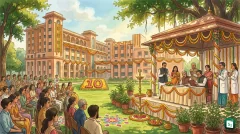
Vice-President C. P. Radhakrishnan released the book Bhupen Hazarika: Hundred Years of Wandering Songs at Gauhati University in Assam on 7 September 2026. Edited by Ankuran Dutta and Nani Gopal Mahanta, the book marks the birth centenary of singer, composer and filmmaker Bhupen Hazarika. At the same event, the Vice-President also released the fifth revised and enlarged edition of Chandrakanta Abhidhan, the historic Assamese dictionary, and laid the foundation stone for infrastructure projects worth ₹110 crore.
What Happened at Gauhati University?
The Vice-President visited the Gauhati University campus at Jalukbari, Guwahati, on 7 September 2026 for a special ceremonial programme. The gathering included Assam Governor Lakshman Prasad Acharya, Chief Minister Himanta Biswa Sarma, Education Minister Ranoj Pegu, Vice-Chancellor Nani Gopal Mahanta and a large number of teachers and students.
During the programme, the Vice-President released two books. The first was Bhupen Hazarika: Hundred Years of Wandering Songs, edited by Ankuran Dutta and Nani Gopal Mahanta. The second was the fifth revised and enlarged edition of Chandrakanta Abhidhan. Students also presented a cultural programme that celebrated the music and heritage of Assam.
The Vice-President also laid the foundation stone for new infrastructure works and led the students in a No to Drugs pledge. He asked young people to stay away from substance abuse, manage time wisely and use social media with care and self discipline.
What Is Bhupen Hazarika Hundred Years of Wandering Songs?
Bhupen Hazarika: Hundred Years of Wandering Songs is a centenary volume brought out to mark 100 years of the birth of Bhupen Hazarika. He was born on 8 September 1926 in Sadiya, Assam, and the year from September 2025 to September 2026 is being observed as his birth centenary year. The title refers to his lifelong identity as a jajabor, an Assamese word that means wanderer.
The book has been edited by Ankuran Dutta and Nani Gopal Mahanta. Ankuran Dutta is a professor and communication scholar associated with Gauhati University. Nani Gopal Mahanta is the Vice-Chancellor of Gauhati University and a noted political scientist. A centenary volume of this kind usually brings together essays, memories, analysis of songs and films, and reflections on the cultural meaning of an artist. It helps preserve first hand memories for future readers and gives researchers a single reference on the life and ideas of the artist.
The release is part of a larger series of centenary tributes. The Assam government began year long celebrations on 8 September 2025 at the Dr Bhupen Hazarika Samannay Tirtha memorial near Gauhati University, where Hazarika was cremated in 2011. Other institutions have also released books during this period, including a biography released during the centenary events in Guwahati. A ₹100 commemorative coin to honour Hazarika was issued in 2025.
Who Is Bhupen Hazarika and Why Is He Famous?
Bhupen Hazarika (1926 to 2011) was a singer, lyricist, music composer, poet, writer and filmmaker. He is widely known as the Bard of the Brahmaputra and as Sudhakantha, a word that means nectar throated voice. The names capture his deep connection with the Brahmaputra river, the people of Assam and the culture of Northeast India.
He was born to Nilakanta Hazarika and Shantipriya Hazarika as the eldest of ten children. As a child, he absorbed Assamese folk songs and tribal music. He sang his first song for the film Indramalati in 1939 at the age of 12. He later studied political science at Banaras Hindu University and earned a PhD in mass communication from Columbia University in the United States in 1952. During his stay in New York, he met American singer and civil rights activist Paul Robeson, whose song Ol Man River inspired Hazarika to compose his famous song Bistirno Parore.
Hazarika created more than 1,500 songs in Assamese, Hindi, Bengali and other languages. His well known songs include Manuhe Manuhor Babe, Moi Eti Jajabor, Dil Hoom Hoom Kare and O Ganga Behti Ho Kyun. His lyrics spoke of humanity, unity, justice for the poor and the dignity of labour. He also directed Assamese films such as Era Bator Sur, Shakuntala, Pratidhwani and Chik Mik Bijuli, and composed music for Hindi films such as Rudaali, Ek Pal and Daman.
His public roles added to his influence. He taught briefly at Gauhati University, served as an independent member of the Assam Legislative Assembly from 1967 to 1972, headed the Sangeet Natak Akademi as chairman from 1998 to 2003, and served as president of the Asom Sahitya Sabha in 1993. His major honours are summarised below.
| Year | Honour |
|---|---|
| 1975 | National Film Award for Best Music Direction for Chameli Memsaab |
| 1977 | Padma Shri, the fourth highest civilian award of India |
| 1987 | Sangeet Natak Akademi Award for music |
| 1992 | Dadasaheb Phalke Award, the highest honour for Indian cinema |
| 2001 | Padma Bhushan, the third highest civilian award of India |
| 2008 | Sangeet Natak Akademi Fellowship, the highest honour of the Akademi |
| 2009 | Asom Ratna, the highest civilian award of Assam |
| 2012 | Padma Vibhushan (posthumous), the second highest civilian award of India |
| 2019 | Bharat Ratna (posthumous), the highest civilian award of India |
The Dhola Sadiya bridge over the Lohit river, one of the longest bridges in India at 9.15 km, has been named the Bhupen Hazarika Setu in his honour. It connects Assam and Arunachal Pradesh.
What Is Chandrakanta Abhidhan?
Chandrakanta Abhidhan is a comprehensive dictionary of the Assamese language. The word abhidhan means dictionary in Assamese and several other Indian languages. This dictionary gives the meanings of Assamese words in both Assamese and English, along with notes on origin and usage with examples. Such notes help readers understand how a word was formed and how it is correctly used.
It is the third major Assamese dictionary in modern history. The first was the Assamese English dictionary by American missionary Miles Bronson in 1867. The second was Hemkosh by Hemchandra Barua in 1900. Chandrakanta Abhidhan was first compiled under the aegis of the Asam Sahitya Sabha and published in 1933 at Jorhat. It contained about 36,816 words. The Sabha is the leading literary body of Assam, founded in 1917 to promote Assamese language and literature.
The responsibility for later editions passed to Gauhati University. The university published a revised edition in 1962 and a third edition in 1987, edited by scholars Maheswar Neog and Upendranath Goswami. The dictionary has also been available online since 2009 through the Digital Dictionaries of South Asia project. The new release is the fifth revised and enlarged edition, which updates and expands the word list for present day students, teachers, translators and researchers.
The work matters because Assamese is listed in the Eighth Schedule of the Constitution, which recognises the official languages of India. A strong and updated dictionary supports teaching, official use, translation and preservation of the language. It also helps research on endangered languages and multilingualism, two areas in which Gauhati University is active.
Gauhati University and the ₹110 Crore Infrastructure Push
Gauhati University is the oldest university in Northeast India. It was incorporated under the Gauhati University Act, 1947 and started functioning on 26 January 1948. The first court meeting was held at Sudmerson Hall in Cotton College, Guwahati. The first Vice-Chancellor was Sanskrit scholar Krishna Kanta Handique. The university later moved to its present campus at Jalukbari and now spreads over about 650 acres.
The university began with 17 affiliated colleges and eight postgraduate departments. It is now a large affiliating, teaching and residential university with courses in arts, science, commerce, law and technology. It has been accredited with NAAC A plus grade in its fourth cycle in July 2024. It stood ninth among State Public Universities in the NIRF 2025 ranking. Its Krishna Kanta Handique Library is the largest library in Assam and is a designated Manuscript Conservation Centre under the National Mission for Manuscripts.
The new projects worth ₹110 crore include a multidisciplinary academic building, a boys hostel, a hostel for international students, and renovation of the auditorium and library. A multidisciplinary building is a single complex meant for teaching and research across many subjects, which supports flexible courses and shared laboratories. The Vice-President noted that the university grew out of a public movement in which leaders such as Gopinath Bordoloi collected donations from ordinary people to create a centre of higher learning for Assam.
| Project Component | Purpose |
|---|---|
| Multidisciplinary academic building | New classrooms and research space for many departments |
| Boys hostel | More residential seats for students |
| International students hostel | Residential facility for students from other countries |
| Auditorium and library works | Repair, upgrade and expansion of cultural and reading facilities |
Why These Releases Matter in the Birth Centenary Year
The two releases serve two connected goals. The Hazarika volume preserves the memory of a cultural figure who carried Assamese music to the national stage. The dictionary strengthens the language in which many of those songs were written. Together, they link art and language, which is central to Assamese identity.
The timing is important. Hazarika was born on 8 September 1926 and died on 5 November 2011 in Mumbai. His cremation at Jalukbari created a lasting bond between his memory and Gauhati University. He had also composed the university theme song Jilikabo Luitore Paar, which imagines the university lighting up the banks of the Luit, another name for the Brahmaputra. A book on him released on the campus during the centenary year therefore carries special meaning.
The Vice-President used the occasion to stress the role of language in preserving civilisation. He welcomed translation between Assamese and Tamil works and called for closer academic exchange between Assam and Tamil Nadu. He also pointed to the need for research on the Brahmaputra basin, endangered languages, women studies, environmental sustainability and Indian Knowledge Systems. Indian Knowledge Systems refers to the study of traditional Indian thought, science, arts and practices through modern research methods. For readers, the key point is simple. Centenary books keep a legacy alive, updated dictionaries keep a language usable, and new campus buildings give students the space to carry both forward.
Key Takeaways
- Vice-President C. P. Radhakrishnan released Bhupen Hazarika: Hundred Years of Wandering Songs at Gauhati University on 7 September 2026.
- The book is edited by Ankuran Dutta and Nani Gopal Mahanta and marks the 100th birth anniversary of Bhupen Hazarika, born on 8 September 1926.
- The Vice-President also released the fifth revised and enlarged edition of Chandrakanta Abhidhan, first published in 1933 with about 36,816 words.
- Foundation stone was laid for ₹110 crore projects at Gauhati University, including a multidisciplinary academic block and hostels.
- Bhupen Hazarika, known as the Bard of the Brahmaputra, received the Bharat Ratna in 2019 (posthumous) and the Dadasaheb Phalke Award in 1992.