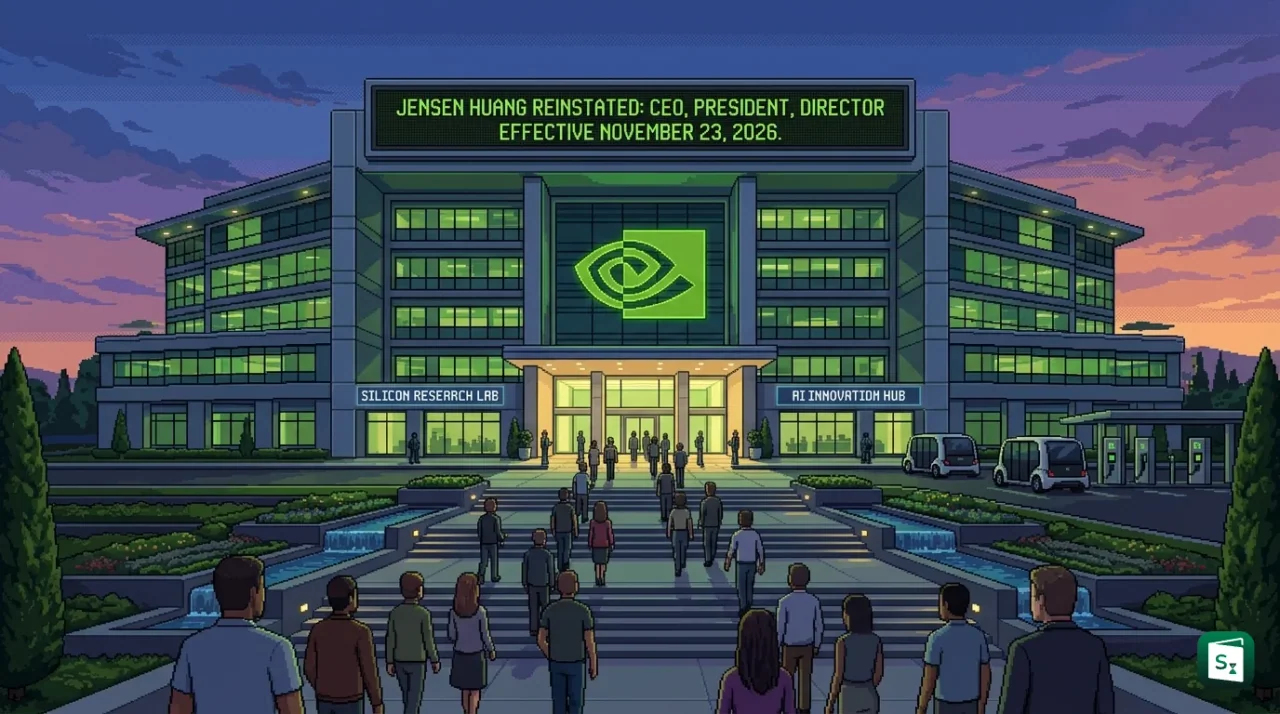
Nvidia’s board unanimously reinstated Jensen Huang as President, Chief Executive Officer and Board Director effective 23 November 2026. The decision ended an 11 day leadership crisis after Huang resigned on 11 November 2026 amid reports about his personal conduct and alleged foreign intelligence targeting. The board said it acted after meetings with Huang and input from senior United States government officials who saw no national security risk in his return.
Is Jensen Huang Back as Nvidia CEO?
Yes. Jensen Huang is again the President, Chief Executive Officer and member of the Board of Directors of Nvidia. The Nvidia Board of Directors voted unanimously to reinstate him on 22 November 2026, and the company announced the decision on 23 November 2026 with immediate effect.
The filing with the United States Securities and Exchange Commission records the same date as the formal return to all three roles. Colette Kress, who served as interim CEO for 11 days, continues as Executive Vice President and Chief Financial Officer. Harvey C. Jones, appointed as the first ever Chair of the Board on 11 November 2026, remains in that post.
Why Was Jensen Huang Reinstated?
The board said it was satisfied with Huang’s candour and ability to lead after a series of discussions and meetings with him over the weekend of 21 to 22 November 2026. The directors also said they had received input from senior levels of the United States government. Based on that input, the board stated it was confident that the reinstatement posed no national security risk.
Several pressures shaped the reversal. The share price collapse raised investor alarm. Nvidia lost about $2.6 trillion in market value during seven straight weeks of falls, and the board faced calls from employees, customers and shareholders for Huang to return. The White House also intervened directly. President Donald Trump said he spoke to the board and to Huang, and publicly stated that Huang had done nothing wrong. The board linked the return to stronger oversight rather than a clean chit, and said its independent investigation would continue to its conclusion.
What Led to the Resignation and Return?
The crisis unfolded in just over two weeks. It began with a personal disclosure, widened into questions about foreign intelligence targeting and chip diversion to China, and ended with a rapid board reversal.
| Date in November 2026 | Event |
|---|---|
| 8 November | Huang told employees he had been unfaithful to his wife and accepted full responsibility. The board said it would probe reports that he had been the target of a foreign intelligence effort. |
| 11 November | The board accepted Huang’s resignation as President, CEO and director. It named Colette Kress as interim CEO and Harvey C. Jones as Chair. |
| 12 November | Nvidia formally announced the transition and said it would search for a permanent CEO among internal and external candidates. |
| 17 November | The board created a National Security and Export Control Oversight Committee and said Huang would cooperate with the ongoing independent review. The board chair said at the time that the board did not intend to reinstate Huang. |
| 22 to 23 November | After government briefings and two rounds of talks with Huang, the board voted unanimously to reinstate him with immediate effect. |
The central allegation concerned a relationship with a Chinese businesswoman identified as Alice Huang, who has no family link to Jensen Huang. She was linked in reports to a Singapore based cloud firm that had purchased large volumes of Nvidia chips and was under scrutiny for possible diversion of restricted chips to China. The company has said it has no reason to believe that national security or company secrets were compromised, but added that the inquiry will examine all available information.
What Is Nvidia and How Does It Make Money?
Nvidia Corporation is an American multinational technology company headquartered in Santa Clara, California. It designs graphics processing units, which are specialised chips that can perform thousands of calculations at the same time. Its shares trade on the Nasdaq stock exchange under the ticker NVDA.
The company was founded on 5 April 1993 by Jensen Huang, Chris Malachowsky and Curtis Priem. The three engineers first sketched the idea at a Denny’s restaurant in San Jose in California. Nvidia went public in 1999, the same year it introduced the graphics processing unit. It is a fabless maker, which means it designs chips and gets them manufactured by partners such as the Taiwan Semiconductor Manufacturing Company (TSMC).
Nvidia reports business in two segments. The Compute and Networking segment supplies data centre chips, networking and software for artificial intelligence. This part now brings most of the revenue. The Graphics segment covers GeForce chips for gaming PCs, workstation graphics and automotive solutions, including the GeForce NOW cloud gaming service.
How Nvidia Became So Big
Technical shifts explain the rise. The invention of the GPU in 1999 made realistic video games possible. The launch of CUDA in 2006, a software platform that lets programmers use GPUs for general computing, opened the chips to science and data work. In 2012, researchers used Nvidia GPUs to train the AlexNet neural network, a breakthrough that started the modern AI boom.
Demand for training and running large AI models then lifted Nvidia from a gaming chip firm to the core supplier of AI infrastructure. Cloud providers, model makers and governments buy its Hopper and Blackwell systems to build data centres that function as large AI factories. Nvidia became the first company to cross $4 trillion in market value in July 2025 and crossed $5 trillion in October 2025, before the November selloff pulled it lower.
Who Is Jensen Huang?
Jen Hsun Huang, known as Jensen Huang, is a Taiwanese American electrical engineer and businessman. He co founded Nvidia in 1993 at age 30 and led it as President and CEO from its founding until his brief resignation in November 2026.
| Detail | Fact |
|---|---|
| Born | 17 February 1963 in Taipei, Taiwan |
| Citizenship | Taiwan and United States |
| Education | Bachelor’s in electrical engineering from Oregon State University in 1984, master’s from Stanford University in 1992 |
| Early career | Microprocessor designer at Advanced Micro Devices (AMD), then director at LSI Logic |
| Family | Married to Lori Huang, whom he met at Oregon State University |
| Stake in Nvidia | Owns more than 3.5 percent of Nvidia |
| Net worth | About $144 billion at the close on 24 November 2026, up about $34 billion on the day of his return |
Huang spent his childhood in Taiwan and Thailand before moving to the United States at age nine. He lived briefly in Washington state and Kentucky, then reunited with his parents in Oregon. He graduated from high school at 16 and worked early jobs as a dishwasher, busboy and waiter. His leadership built Nvidia from a 40,000 dollar startup backed by Sequoia Capital into one of the world’s most valuable firms.
Who Led Nvidia During the Transition?
Colette Kress led the company as interim CEO from 11 to 22 November 2026 while continuing as Chief Financial Officer. Kress joined Nvidia in September 2013 after nearly 25 years in finance at Cisco, Microsoft and Texas Instruments. She has been the main finance voice on earnings calls and oversees the balance sheet that funds large AI infrastructure deals.
Harvey C. Jones, a board member since 1993, became the first ever Chair of the Board during the same period. Jones is a technology executive and venture investor who earlier led Synopsys as CEO. The board said Kress and the existing leadership team kept operations, customer commitments and the product roadmap running without break.
What Are the National Security and Export Control Safeguards?
The board has paired Huang’s return with tighter governance. A committee of independent directors, assisted by outside counsel, is investigating whether Huang was targeted by a foreign intelligence effort and whether any company or national security information was affected. Huang has said he supports the review and will cooperate.
On 17 November 2026, the board set up a standing National Security and Export Control Oversight Committee chaired by director Suzanne Nora Johnson, with Stephen C. Neal and John O. Dabiri as members. The company’s national security and global trade compliance teams now report to this committee and to the CEO. Nvidia is also hiring a new Chief Compliance Officer and bringing in outside experts on national security and trade law.
The steps matter because the United States bars sale of Nvidia’s most advanced AI chips to China. Lawmakers in Washington have questioned possible diversion of chips through third countries and cloud access, and House committees have sought interviews with Huang and company counsel. The Commerce Department has also tightened rules on remote access to advanced computing outside the United States.
What Does the Return Mean for Markets and India?
Markets reacted sharply. Nvidia shares closed up 31.5 percent on 23 November 2026. Market value climbed back to about $4.03 trillion, making Nvidia the world’s second most valuable company behind Apple. The jump added about $34 billion to Huang’s personal wealth in a single session. Before the rebound, the stock had fallen about 46 percent over seven weeks and slipped to fourth place behind Apple, Microsoft and Alphabet.
For India, continuity at the top steadies a large AI partnership network. Nvidia has engineering centres in Bengaluru, Hyderabad, Pune and Gurugram and employs several thousand engineers in India. It works with Reliance Industries on a one gigawatt AI data centre in Jamnagar in Gujarat using Blackwell processors, and with Yotta Data Services, Tata Communications and the Tata group on cloud and supercomputing projects. Indian IT firms such as Infosys, Tata Consultancy Services, Wipro and Tech Mahindra use Nvidia’s AI Enterprise software to build services, including Hindi language models.
Huang has met Prime Minister Narendra Modi and described India as one of the largest future markets for AI. Indian data centre operators have ordered tens of thousands of Hopper and Blackwell chips, and local maker Netweb Technologies assembles Nvidia based systems in India. The board’s decision therefore calms near term uncertainty for these projects, though export control rules and the pending investigation will continue to shape chip supply.
Key Takeaways
- The Nvidia Board of Directors unanimously reinstated Jensen Huang as President, CEO and Board Director effective 23 November 2026.
- Huang resigned on 11 November 2026 and Colette Kress served as interim CEO for 11 days before returning to her role as Chief Financial Officer.
- Nvidia was founded on 5 April 1993 by Huang, Chris Malachowsky and Curtis Priem and invented the GPU in 1999 and CUDA in 2006.
- Nvidia shares rose 31.5 percent on the day of the return, lifting market value to about $4.03 trillion as the world’s second most valuable company.
- The board set up a National Security and Export Control Oversight Committee chaired by Suzanne Nora Johnson, and its independent investigation will continue.