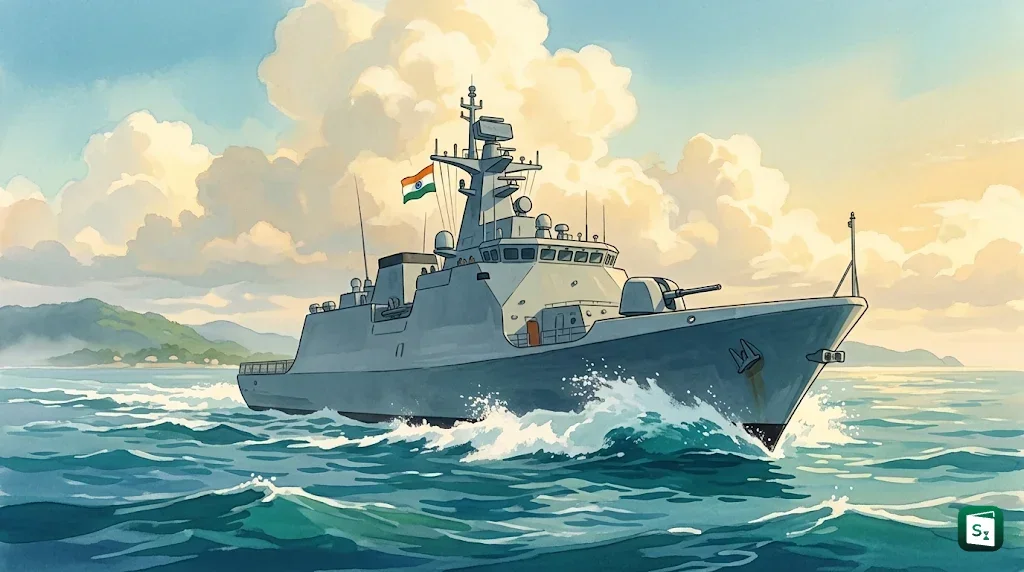
Garden Reach Shipbuilders and Engineers delivered the Anti Submarine Warfare Shallow Water Craft Ashank (Yard 3036) to the Indian Navy at Visakhapatnam on 23 November 2026. Ashank is the sixth Arnala class craft built by the Kolkata shipyard and the 120th warship built by the company. The handover came only 18 days after the delivery of Amini and adds fresh strength to coastal submarine hunting.
What Does SWC Stand For and What Is Anti Submarine Warfare?
SWC stands for Shallow Water Craft. An Anti Submarine Warfare Shallow Water Craft (ASW SWC) is a small warship designed to find, track and destroy enemy submarines operating close to the coast. Anti submarine warfare is the combined use of ships, aircraft, helicopters, sonars and weapons such as torpedoes and rockets to detect underwater threats and neutralise them before they can attack.
Large warships and conventional submarines struggle in shallow coastal water. The water is noisy, the depth is low and manoeuvre room is limited. India has a coastline of more than 7,500 km with 12 major ports, 184 minor ports and 1,197 island territories, so this coastal zone needs constant guard.
The Indian Navy uses ASW SWC vessels as fast, agile submarine hunters for this zone. These corvettes, or small warships built for escort and coastal combat, operate within about 200 nautical miles of the coast. Their main jobs are subsurface surveillance, search and attack missions and coordinated operations with naval aircraft. Their secondary jobs include coastal patrolling, mine laying on the seabed, and search and rescue by day and night.
What Happened at Visakhapatnam on 23 November 2026?
The Indian Navy took delivery of Ashank (Yard 3036) at Visakhapatnam on 23 November 2026. Rear Admiral Gautam Marwaha, Chief Staff Officer (Technical) at Headquarters Eastern Naval Command, accepted the vessel on behalf of the Navy. The ship was indigenously designed and built by Garden Reach Shipbuilders and Engineers (GRSE), Kolkata, as per the classification rules of the Indian Register of Shipping.
The timing drew attention. GRSE had delivered another craft of the same series, Amini, at Kattupalli in Tamil Nadu on 5 November 2026. Ashank followed only 18 days later, making it the second GRSE warship delivery within the same month.
With Ashank, GRSE completed its 120th warship, of which 82 warships have been delivered to the Indian Navy. The company reports more than 80 percent indigenous content in the vessel, with some programme updates placing the figure near 88 percent. The name Ashank conveys fearlessness and an undaunted spirit, in keeping with the Navy practice of giving fighting names to combat craft.
How Is Ashank Built to Hunt Submarines in Shallow Waters?
Ashank is built for speed, silence and shallow draught. The craft uses three diesel driven waterjets instead of conventional propellers. A waterjet pushes the ship forward by forcing a powerful jet of water backward, which gives quick turns and safe operation in very shallow water. These ships are among the largest waterjet propelled warships in the Indian Navy. GRSE won the Raksha Mantri Award in 2022 for designing this class as the most silent ship for anti submarine operations, since low noise makes detection by enemy submarines harder.
| Feature | Detail for Arnala Class including Ashank |
|---|---|
| Length | About 77.6 metres |
| Breadth | About 10.5 metres |
| Draught | About 2.7 metres |
| Displacement | About 900 tonnes |
| Maximum speed | 25 knots |
| Endurance | More than 1,800 nautical miles at 14 knots |
| Crew | 57 personnel, including 7 officers |
| Propulsion | Three diesel engines driving waterjets |
| Build standard | Indian Register of Shipping rules |
For attack, Ashank carries lightweight torpedoes fired from triple torpedo tubes on both sides and an indigenous RBU-6000 anti submarine rocket launcher at the bow. For surface action, it carries a 30 mm naval surface gun developed by GRSE and two 12.7 mm stabilised remote control guns. Mine laying rails allow it to place mines on the seabed.
For detection, it uses a hull mounted sonar and a low frequency variable depth sonar that can be lowered to different depths to hear submarines hiding in layered water. A combat management system links sensors to weapons, while an Integrated Platform Management System controls propulsion, power generation and damage control from central stations. The fit also supports the Maareech Advanced Torpedo Decoy System concept used across the programme to mislead incoming torpedoes, along with data links to share submarine contacts with friendly ships and aircraft.
How the 16 Ship ASW Shallow Water Craft Project Is Shared Between Two Shipyards
The ASW SWC project began with a Defence Acquisition Council clearance in December 2013 for 16 coastal anti submarine vessels to replace the ageing Abhay class corvettes. The Abhay class were Soviet origin Pauk II variants that entered service in 1989 and were decommissioned between 2017 and 2025. The Navy issued the request for proposal in April 2014.
The Ministry of Defence signed two separate contracts in April 2019, each worth ₹6,311.32 crore. Garden Reach Shipbuilders and Engineers will build eight ships and Cochin Shipyard Limited (CSL) will build eight ships. Each contract required the first ship within 42 months, followed by two ships per year, with full completion within 84 months. GRSE works in partnership with L and T Shipbuilding at Kattupalli, where part of the hull construction and outfitting takes place, while GRSE retains design, procurement and quality control.
Arnala Class and Mahe Class: Two Builders, One Mission
Ships built by GRSE are called the Arnala class and serve the Eastern Fleet. Ships built by CSL are called the Mahe class and serve the Western Fleet. Both classes share speed, range and crew size but differ slightly in design detail such as mast, funnel and gun deck layout. CSL designed its ships with Kochi based Smart Engineering and Design Solutions, with inputs from Finland based Surma for signature control.
| Aspect | Arnala Class by GRSE | Mahe Class by CSL |
|---|---|---|
| Number of ships | 8 | 8 |
| Lead ship | INS Arnala | INS Mahe |
| Naming pattern | Coastal places starting with A | Coastal places starting with M |
| Ships in class | Eight hulls, including Arnala, Androth, Anjadip, Amini, Agray and Ashank | Mahe, Malvan, Mangrol, Malpe, Mulki, Magdala, Machilipatnam and one more hull |
| Build standard | Indian Register of Shipping | Det Norske Veritas |
| Base fleets | Eastern Fleet, Visakhapatnam | Western Fleet, Mumbai and Karwar |
By November 2026, seven craft of the combined 16 had been commissioned. The Arnala class commissioned ships are Arnala on 18 June 2025, Androth on 6 October 2025, Anjadip on 27 February 2026 and Agray on 21 June 2026. The Mahe class commissioned ships are Mahe on 24 November 2025, Malvan on 22 July 2026 and Mangrol on 12 October 2026. Amini, delivered on 5 November 2026, and Ashank, delivered on 23 November 2026, are the next Arnala class vessels awaiting commissioning. GRSE has said it plans to complete its eight ship series in the first half of 2027, while the final hull of the overall 16 ship programme is expected by June 2028.
What Is GRSE, the Company That Built Ashank?
GRSE stands for Garden Reach Shipbuilders and Engineers Limited. It is a Navratna public sector undertaking under the Department of Defence Production in the Ministry of Defence, headquartered at Garden Reach Road in Kolkata.
The origin of the company goes back to 1884, when it started as a small workshop on the eastern bank of the Hooghly river to repair vessels of the River Steam Navigation Company. The workshop was incorporated as a company on 26 February 1934 under the Indian Companies Act, 1913. The Government of India took over the company on 1 April 1960, and it was renamed Garden Reach Shipbuilders and Engineers Limited in 1977.
GRSE holds the record of building the first warship of independent India, the Seaward Defence Boat INS Ajay, in 1961. It also built the first Indian warship for export, CGS Barracuda for Mauritius, delivered in 2014, followed by patrol vessels for Seychelles and Guyana. The shipyard can build 20 ships at the same time, including eight large and 12 small vessels, using modular construction.
Apart from frigates, corvettes, survey vessels and patrol vessels, GRSE also makes portable steel bridges, deck machinery and marine diesel engines. With Ashank, the yard has built 120 warships, the highest by any Indian shipyard. The current Chairman and Managing Director is Commodore P R Hari.
Key Takeaways
- Ashank (Yard 3036) was delivered to the Indian Navy at Visakhapatnam on 23 November 2026 and accepted by Rear Admiral Gautam Marwaha.
- Ashank is GRSE’s 120th warship and its second delivery in 18 days after Amini on 5 November 2026, with more than 80 percent indigenous content.
- The craft is about 77.6 metres long, displaces about 900 tonnes, reaches 25 knots on waterjet propulsion and carries a crew of 57 personnel.
- Ashank carries lightweight torpedoes, an RBU-6000 rocket launcher, a 30 mm naval gun and hull mounted and variable depth sonars for coastal submarine hunting.
- The 16 ship programme uses two classes, the Arnala class built by GRSE and the Mahe class built by Cochin Shipyard, under ₹6,311.32 crore contracts signed in April 2019 to replace the Abhay class.