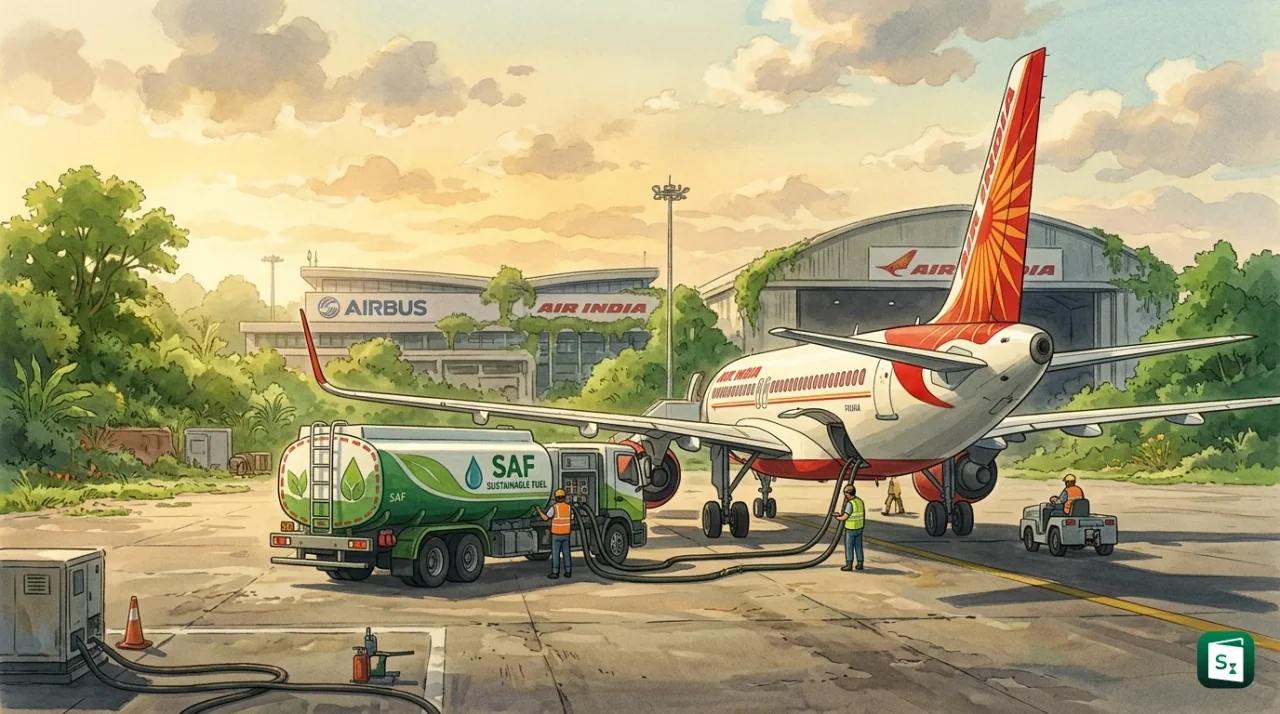
Air India and Airbus signed a Feasibility Study Agreement on 17 November 2026 to develop India’s first voluntary corporate Sustainable Aviation Fuel programme in India. The agreement was signed at the second India Sustainable Aviation Fuel Summit in New Delhi in the presence of Civil Aviation Minister Ram Mohan Naidu Kinjarapu. The proposed programme will allow businesses to voluntarily support the use of cleaner jet fuel and lower the lifecycle emissions linked to air travel.
What Is Sustainable Aviation Fuel?
Sustainable Aviation Fuel (SAF) is a renewable or waste derived jet fuel that can be mixed with conventional Aviation Turbine Fuel and used in existing aircraft without engine changes. SAF is made from feedstocks such as used cooking oil, agricultural residue, municipal solid waste, animal fats and ethanol. It is called a drop in fuel because airlines can blend it with regular jet fuel at levels from 10 percent to 50 percent depending on the production pathway.
When SAF burns in an engine, it releases almost the same carbon dioxide as regular jet fuel. The climate benefit comes earlier in the lifecycle. Plants and waste feedstocks absorb carbon while growing or would release methane if dumped. Production also avoids fresh crude extraction. As a result, SAF can cut lifecycle greenhouse gas emissions by about 70 percent to 80 percent compared with fossil jet fuel, depending on the feedstock and technology.
The most common commercial pathway today is Hydroprocessed Esters and Fatty Acids (HEFA), which converts oils and fats into jet grade hydrocarbons. Other pathways include Alcohol to Jet (ATJ), which converts ethanol or butanol into fuel, and Fischer Tropsch (FT), which converts gasified biomass or municipal waste into liquid fuel. Newer Power to Liquid methods use renewable electricity to make hydrogen and capture carbon dioxide to build synthetic fuel.
To count as sustainable, SAF must meet strict rules. Under the Carbon Offsetting and Reduction Scheme for International Aviation (CORSIA) of the International Civil Aviation Organization (ICAO), SAF must cut lifecycle emissions by at least 10 percent and meet safeguards for land, water, soil, biodiversity and food security. Fuel producers are audited by approved schemes such as the International Sustainability and Carbon Certification (ISCC). Only certified fuel can generate tradable emission savings.
What Air India and Airbus Have Agreed To Do
Air India and Airbus signed the Feasibility Study Agreement on 17 November 2026 at the Hyatt Regency in New Delhi. Airbus India President and Managing Director Jurgen Westermeier and Air India Group Head for Governance Risk Compliance and Corporate Affairs P. Balaji signed the pact. Civil Aviation Minister Ram Mohan Naidu Kinjarapu, Additional Secretary Puneet Kansal, FICCI President Elect Vijay Sankar and Indian Oil Chairman A. S. Sahney were present.
The study will assess how a voluntary corporate SAF programme could work on selected Air India routes. Airbus and Air India will examine voluntary procurement and use of SAF, certification and accounting methods, and a framework to sell the environmental benefits to business customers. The programme remains at the study stage. On implementation, Air India says it would become India’s first voluntary corporate SAF programme.
Air India is the Tata Group owned national carrier and one of India’s largest international airlines. Airbus is the European aircraft maker headquartered in Leiden in the Netherlands with main operations in Toulouse in France, and a major supplier of A320neo, A321neo and A350 aircraft to Indian carriers. The two companies said wider corporate demand for SAF is needed to scale up production, cut costs and build a local supply chain. They have invited other companies across sectors to join the framework once it is ready.
How a Voluntary Corporate SAF Programme Works
A voluntary corporate SAF programme lets a company cut the climate impact of its business travel without operating aircraft. The airline buys physical SAF and blends it into the fuel system at an airport. The company pays a premium linked to that SAF volume. In return, the company receives verified emission reduction records to report against its own carbon footprint.
The Air India Airbus model uses Scope 3 SAF certificates (SAFc). Scope 3 emissions are indirect emissions in a company’s value chain. For most service companies, employee flights fall under Scope 3 Category 6 for business travel, while air cargo falls under Category 4 and Category 9 for transport. The airline keeps the direct Scope 1 saving from burning the fuel. Corporate buyers claim the indirect Scope 3 saving. A registry retires each certificate after use so the same tonne is not claimed twice in the same scope.
The system uses a book and claim chain of custody. Fuel is blended into the common airport pipeline, so it is not possible to track which molecule goes into which aircraft. Purchase and blending records are entered in a ledger instead. The buyer books the sustainability benefit and claims it, even if the physical fuel was used on a different flight. Global standards require third party verification of feedstock, lifecycle value and traceability.
Emission savings under the proposed framework will be calculated by comparing the lifecycle carbon footprint of SAF with conventional jet fuel using globally accepted methods. ICAO sets the baseline for regular jet fuel at 89 grams of carbon dioxide equivalent per megajoule. The difference between this baseline and the certified lifecycle value of the SAF batch gives the reduction factor. Corporate customers can then disclose lower market based aviation emissions separately from their actual travel inventory.
India Sustainable Aviation Fuel Summit and the National Policy Push
The agreement was announced at the second India Sustainable Aviation Fuel Summit held on 17 November 2026. The Federation of Indian Chambers of Commerce and Industry (FICCI) organised the summit with support from the Ministry of Civil Aviation. Airlines, airports, oil companies, technology providers, financiers and policymakers attended. Two technical sessions discussed policy design and commercial viability. A FICCI report on feedstocks and pathways, prepared with Ohayo Green Energy, was released at the event.
At the summit, the Civil Aviation Minister said a draft National Sustainable Aviation Fuel Policy has been shared with the Ministry of Petroleum and Natural Gas for comments and will be placed for public consultation within one to two weeks. The draft proposes a National Council on Sustainable Aviation Fuel for inter ministerial coordination and a National SAF Registry under the Directorate General of Civil Aviation (DGCA) to record, track and verify SAF transactions. The registry is meant to bring transparency and link Indian records with CORSIA and carbon market systems.
The draft sets indicative SAF blending targets for international flights linked to CORSIA, whose mandatory phase starts on 1 January 2027. Public pricing and supply plans are still under discussion, but the direction is clear.
| Year | Proposed SAF blending target for international flights |
|---|---|
| 2027 | 1 percent |
| 2028 | 2 percent |
| 2029 | 3 percent |
| 2030 | 5 percent |
| 2035 | 10 percent indicative |
| 2040 | 20 percent indicative |
The draft also proposes that airlines operating scheduled international services from India uplift at least 90 percent of their annual fuel for those sectors at Indian airports. The aim is to prevent economic tankering, where carriers carry extra cheap fuel from abroad to avoid refuelling in India. The calculation would cover trip and taxi fuel and exclude contingency and reserve fuel. Only indigenously produced SAF would count toward the blending obligation in the first phase.
Indian Oil has already secured key certifications. Its Panipat refinery in Haryana received ISCC CORSIA certification in August 2025 and clearance for commercial SAF supply. The plant can produce about 35,000 tonnes of SAF per year from used cooking oil through co processing, which the company says is enough to meet the 1 percent international target in 2027. Indian Oil has signed supply understandings with Air India, while Hindustan Petroleum and Akasa Air are exploring similar supplies. Bharat Petroleum has also received ISCC CORSIA certification for its Mumbai refinery.
Why Sustainable Aviation Fuel Matters for India
India is the world’s third largest domestic aviation market. The government estimates that Aviation Turbine Fuel (ATF) use will rise from about 9 million tonnes now to 14.2 million tonnes by 2030. Passenger traffic is projected to cross 500 million by 2030 and reach one billion by 2040. Without cleaner fuel, emissions from this growth will rise fast. The International Air Transport Association (IATA) estimates that SAF could provide about 65 percent of the emission cuts aviation needs to reach net zero carbon by 2050.
For India, SAF links climate goals with energy security and farm incomes. Officials said a domestic SAF industry could cut the crude import bill by $5 billion to $7 billion per year and raise farmer incomes by 10 percent to 15 percent by creating value from residue. It could also create about one million green jobs across feedstock collection, processing and logistics. India has large feedstock potential, including about 3.4 million tonnes of used cooking oil, ethanol capacity above 18 billion litres per year and about 680 million tonnes of agricultural residue.
Cost remains the main barrier. SAF is still more expensive than regular jet fuel because feedstock collection is scattered and processing plants are few. Industry leaders at the summit stressed the need for long term purchase agreements to give producers revenue certainty along with financial support such as viability gap funding and tax relief. They also called for credible certification that meets CORSIA rules. The draft policy responds with a SAF Innovation Seed Fund, refinery retrofit support and green financing tools, along with aggregation networks involving farmer producer organisations, cooperatives and urban waste agencies.
How SAF Compares With Conventional Jet Fuel
Readers often ask whether SAF can replace regular jet fuel and why it costs more. The short answer is that SAF can replace part of the fuel today and more in future, but price and supply limit full replacement.
| Feature | Conventional jet fuel | Sustainable Aviation Fuel |
|---|---|---|
| Source | Crude oil refining | Used cooking oil, farm residue, municipal waste, ethanol, renewable power |
| Engine change needed | Standard fuel | No change, drop in fuel when blended as per ASTM International norms |
| Lifecycle emissions | Baseline of 89 grams per megajoule | 40 percent to more than 90 percent lower, typically 70 percent to 80 percent lower for waste based HEFA |
| Blending limit | 100 percent fossil fuel | 10 percent to 50 percent per pathway, with work underway on 100 percent SAF flights |
| Price | Lower, mature supply chain | Higher, due to limited plants, collection costs and certification |
| Sustainability proof | Quality standard IS 1571 only | Quality plus CORSIA sustainability certification and registry entry |
In April 2026, the government amended the ATF (Regulation of Marketing) Order, 2001 to bring SAF blended ATF under the same control order. SAF co processed with ATF as per IS 1571 in refineries and SAF meeting IS 17081 blended with ATF are now covered. The change gives legal clarity for storage, sale and quality control. It also helps India align with global SAF supply chains as CORSIA obligations tighten.
Key Takeaways
- Air India and Airbus signed a Feasibility Study Agreement on 17 November 2026 at the second India SAF Summit in New Delhi for India’s first voluntary corporate SAF programme.
- The proposed programme will use Scope 3 SAF certificates through a book and claim system to let companies claim emission cuts from business travel.
- India’s draft SAF policy proposes blending of 1 percent in 2027, 2 percent in 2028 and 5 percent by 2030 for international flights under CORSIA.
- A National SAF Registry under DGCA and a National Council on SAF are proposed to track transactions and coordinate production.
- Indian Oil’s Panipat refinery, with capacity of about 35,000 tonnes per year from used cooking oil, has received ISCC CORSIA certification for commercial SAF supply.