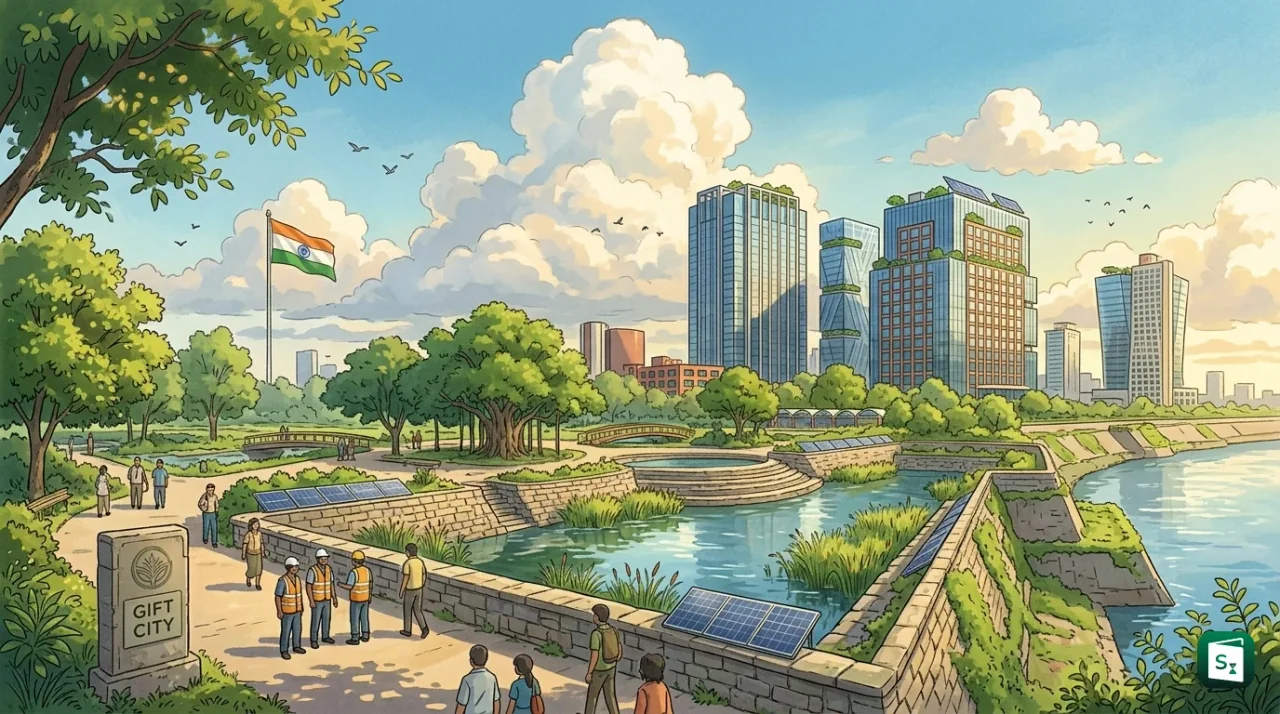
The United Nations Office for Disaster Risk Reduction has recognised GIFT City in Gandhinagar, Gujarat, as India’s first Making Cities Resilient 2030 Resilience Hub in November 2026. The tag makes GIFT City the newest hub in the Asia-Pacific region and places it in a small global network of cities known for strong disaster preparedness. It also reflects four years of work since GIFT City joined the MCR2030 initiative in July 2022.
What Is GIFT City in India?
GIFT City is Gujarat International Finance Tec-City, India’s first operational smart city and first International Financial Services Centre. GIFT City is located between Ahmedabad and Gandhinagar in Gujarat on the banks of the Sabarmati river. It covers 886 acres and hosts offices, homes, schools and hotels in one planned district.
The idea was proposed in 2007 when Narendra Modi was Chief Minister of Gujarat. The goal was to keep international financial business inside India instead of routing it through Singapore, Dubai or London. The city was developed as a joint venture of the Gujarat Urban Development Company and IL and FS, and the foundation work started in 2011.
The financial centre part of GIFT City took shape after the Union Budget of 2015. The central government approved an International Financial Services Centre (IFSC) at GIFT City in April 2015 inside a multi-services Special Economic Zone. The IFSC is treated as an offshore territory under foreign exchange rules, so banks and exchanges there can deal in foreign currency.
| Fact about GIFT City | Detail |
|---|---|
| Full form | Gujarat International Finance Tec-City |
| Location | Between Ahmedabad and Gandhinagar, Gujarat |
| Area | 886 acres, planned expansion to more than 13 sq km |
| Two zones | Special Economic Zone with IFSC, and Domestic Tariff Area |
| IFSC regulator | International Financial Services Centres Authority (IFSCA) |
| IFSCA base | Set up on 27 April 2020 under the IFSCA Act, 2019, headquartered at GIFT City |
IFSCA is India’s unified regulator for the IFSC. It combines the powers of the RBI, SEBI, IRDAI and PFRDA inside the zone. India INX, India International Bullion Exchange and many global banks, insurers and IT firms now operate from GIFT City. About 2,500 people live in the city and more than 28,000 people work there.
What Is a Resilience Hub Under MCR2030?
A Resilience Hub is a city recognised for strong disaster risk reduction work and a commitment to guide other cities. The tag is given under the Making Cities Resilient 2030 (MCR2030) initiative, a global programme launched by the UN Office for Disaster Risk Reduction in October 2020. Hub cities share tools, training and practical experience with other municipalities.
The United Nations Office for Disaster Risk Reduction (UNDRR) is the UN body that coordinates global efforts to reduce disaster losses. UNDRR was set up in 1999 and is headquartered in Geneva, Switzerland. It is the custodian of the Sendai Framework for Disaster Risk Reduction 2015 to 2030, the global plan adopted in Sendai, Japan, in March 2015 to cut deaths, economic loss and damage to critical infrastructure.
MCR2030 helps cities become inclusive, safe, resilient and sustainable by 2030. It directly supports Sustainable Development Goal 11 on sustainable cities, along with the Paris Agreement on climate change and the New Urban Agenda. Cities join the programme, assess their risks and move along a clear Resilience Roadmap.
| Roadmap stage | What the city does |
|---|---|
| Stage A: Know Better | Builds awareness among officials and the public and sets up a multi-sector committee |
| Stage B: Plan Better | Completes risk assessment with the Disaster Resilience Scorecard and gets a risk reduction strategy approved |
| Stage C: Implement Better | Puts the plan into action, secures funds for projects and mentors other cities |
The Disaster Resilience Scorecard has a preliminary version with 47 indicators and a detailed version with 117 indicators. A Resilience Hub must be in Stage C, show proven good practice, finance at least one resilience project and report its mentoring work every year through the MCR2030 dashboard. The recognition lasts for three years and can be renewed. Earlier hubs include Barcelona, Greater Manchester, Milan, Incheon and Makati. GIFT City is the 45th hub in the global network.
How GIFT City Earned the Recognition
GIFT City joined MCR2030 in July 2022 with support from the Gujarat Institute of Disaster Management (GIDM) and guidance from UNDRR. GIDM is an autonomous institute of the Gujarat government based in Gandhinagar. It trains officials in multi-hazard risk management and won the Subhash Chandra Bose Aapda Prabandhan Puraskar in 2022.
GIFT City completed Stage A and Stage B of the Resilience Roadmap and is now working through Stage C, which focuses on action on the ground. A detailed Disaster Resilience Scorecard assessment in June 2023 formed the base for its Resilience Action Plan. The city authority finalised that plan in March 2024 and has started implementing it.
GIFT City Journey on the Three Stage Roadmap
GIFT City moved step by step from awareness to planning to action. Its disaster management set up now works at three levels, city, building and utility. A Crisis Management Group leads the response, an Incident Response System defines roles during an emergency, and designated disaster management officers handle daily preparedness.
The city has held more than 15 mock drills for earthquakes, fires and other emergencies. It maintains a dedicated disaster management store with more than 36 types of emergency equipment. Daily alerts flow through a network of building and utility officers and disaster risk reduction volunteers.
Early Warning and Emergency Systems in Place
GIFT City combines national forecasts with local data for early warning. The system pulls together several official inputs, so warnings reach people in time for action.
| Warning input | What it provides |
|---|---|
| India Meteorological Department (IMD) | Weather forecasts for rain, heat, storms and cyclones |
| SACHET portal | Geo-targeted alerts from the National Disaster Management Authority, developed with C-DOT |
| City weather station | Local readings on rain, wind and temperature inside GIFT City |
| Earthquake reports | Rapid information on tremors from seismological agencies |
IMD is India’s national weather agency. SACHET is India’s common alerting platform that sends disaster alerts by SMS, mobile app, browser notification and satellite systems in regional languages. In GIFT City, these inputs are converted into clear alerts and precautionary advice for each building and utility team.
Why the Recognition Matters for India
A global financial centre must keep working during floods, heatwaves, earthquakes and power failures. UNDRR Asia-Pacific said resilience is central to the credibility of such a centre because firms and residents need confidence that risks are mapped, people are protected and essential services will continue. GIFT City Chief Executive Sanjay Kaul said the honour strengthens the plan to make resilience a core part of the city’s growth.
Disaster risk reduction means steps taken to prevent new risks and cut existing risks to lives, jobs and assets. Climate resilience means the ability of a city to absorb climate shocks and recover quickly while protecting growth. For GIFT City, both ideas link directly to business continuity, data safety and investor trust.
The hub status also gives India a teaching platform. GIFT City will now host events, hold study visits, twin with other cities and publish its lessons on urban risk management. That role fits India’s wider push for resilient infrastructure, including the Coalition for Disaster Resilient Infrastructure headquartered in New Delhi, and the duties placed on local bodies by the Disaster Management Act, 2005.
Gujarat faces cyclone risk on its long coastline, urban flooding and high heat. A planned city that tests early warnings, building level plans and volunteer networks offers a model that other Indian smart cities and riverfront business districts can adapt.
Key Takeaways
- GIFT City in Gandhinagar became India’s first MCR2030 Resilience Hub in November 2026, recognised by UNDRR.
- UNDRR, set up in 1999 and headquartered in Geneva, runs the MCR2030 programme launched in October 2020.
- GIFT City joined MCR2030 in July 2022, completed a detailed scorecard review in June 2023 and finalised its Resilience Action Plan in March 2024.
- The city runs disaster plans at city, building and utility levels, with more than 15 mock drills and over 36 types of emergency equipment.
- IFSCA was set up on 27 April 2020 under the IFSCA Act, 2019, and regulates the IFSC at GIFT City approved in April 2015.