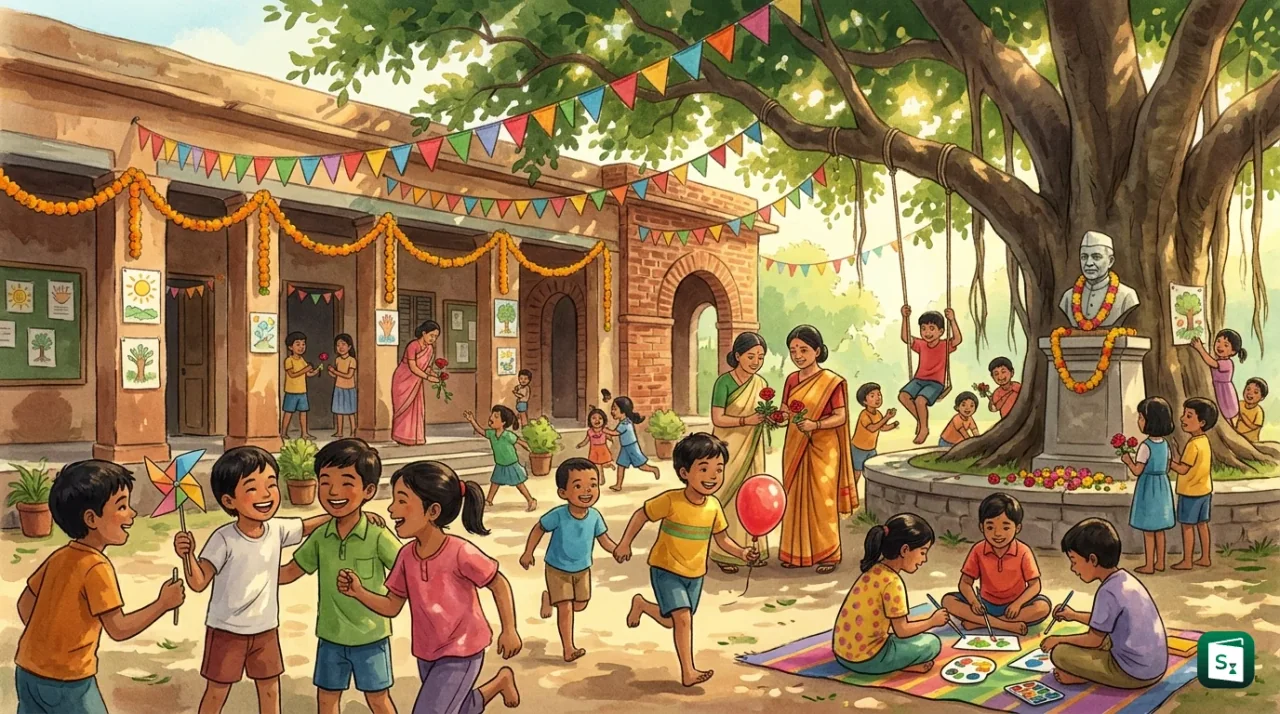
India observed Children’s Day on 14 November 2026 as Bal Diwas to mark the 137th birth anniversary of Jawaharlal Nehru, India’s first Prime Minister. The 2026 theme, For Every Child, Every Right, focuses on learning, health, protection and participation. It differs from UNICEF led World Children’s Day on 20 November.
Why Children’s Day Is Celebrated on November 14
Children’s Day in India is celebrated on 14 November because it is the birth anniversary of Jawaharlal Nehru. Nehru was born on 14 November 1889 in Allahabad, now called Prayagraj in Uttar Pradesh. The year 2026 marks his 137th birth anniversary.
Nehru is remembered as Chacha Nehru, which means Uncle Nehru. Children gave him this name because of his affection for them. He often said that the children of today make the India of tomorrow. He believed the way children are brought up decides the future of the country.
The day is observed to raise awareness about child rights, education, health, nutrition and protection. Schools use the day to remind society that every child needs safety, learning and a chance to speak and play. It is a national observance, but it is not a gazetted public holiday or a bank holiday.
Who Was Jawaharlal Nehru, the Chacha Nehru of India
Jawaharlal Nehru was India’s first Prime Minister. He held office from 15 August 1947 until his death on 27 May 1964. He is also known as Pandit Nehru.
Nehru was born into a Kashmiri Brahmin family. His father, Motilal Nehru, was a noted lawyer and Congress leader. His mother was Swarup Rani Nehru. He studied at Harrow in England and later at Trinity College, Cambridge, where he completed a degree in Natural Sciences in 1910. He trained in law at the Inner Temple in London and returned to India in 1912.
Nehru joined the freedom movement and worked closely with Mahatma Gandhi. On the eve of Independence, he delivered the famous Tryst with Destiny speech. As Prime Minister, he pushed for modern industry, science, large dams and new institutions of learning. His only child, Indira Priyadarshini, later served as Prime Minister of India.
His bond with children shaped policy. In 1955 his government set up the Children’s Film Society of India so Indian children could see films made for them. In 1956 it set up the National Bal Bhavan in New Delhi for creative activities for children aged 5 to 16. His Five Year Plans stressed free and compulsory schooling for all children.
How Bal Diwas Became November 14: A Short History
India did not start with 14 November. The story has three stages.
In 1954 the United Nations General Assembly asked all countries to observe a Universal Children’s Day. India first marked it on 20 November, along with many other countries. In the same period, the Indian Council of Child Welfare raised funds for children through the sale of flower tokens.
Soon, Nehru’s birthday itself became the focus. In 1951 United Nations fellow V. M. Kulkarni suggested that Nehru’s birthday be used as a Flag Day to collect funds for child welfare. Nehru agreed with reluctance. By 1954 large children’s gatherings were held in Delhi on 14 November. More than 50,000 schoolchildren joined the event at the National Stadium.
In 1957 the government formally declared 14 November as Children’s Day in India. The Department of Posts and Telegraphs issued commemorative stamps for Bal Din. A children’s fair at the Children’s Park near India Gate in 1963 drew thousands of children who greeted Nehru and released white pigeons for peace.
After Nehru’s death in 1964, Parliament passed a resolution to keep 14 November as Children’s Day in his memory. Since then the date has stayed fixed.
| Year | What Happened |
|---|---|
| 1954 | United Nations calls for Universal Children’s Day, India observes 20 November |
| 1954 | First large Children’s Day gathering on Nehru’s birthday in Delhi |
| 1957 | Government declares 14 November as Children’s Day, issues stamps |
| 1963 | Children’s mela at Children’s Park near India Gate for Nehru’s 74th birthday |
| 1964 | After Nehru’s death, 14 November retained as Children’s Day |
What the 2026 Theme For Every Child, Every Right Means
The theme for Children’s Day in India in 2026 is For Every Child, Every Right. It is the long standing message of UNICEF, the United Nations Children’s Fund. UNICEF was founded in 1946 and is headquartered in New York. It leads action for child rights across the world.
The theme means rights belong to every child without bias. It does not matter where a child lives, what language the child speaks, or how much money the family has. Survival, learning, safety and a voice in decisions are promises, not favours.
These rights are often grouped into four parts:
- Survival: food, health care, clean water and a safe home
- Development: schooling, play, rest and culture
- Protection: safety from abuse, neglect, child labour, trafficking and early marriage
- Participation: the right to express views and be heard on matters that affect children
How It Relates to the World Children’s Day Theme for 2026
World Children’s Day, observed on 20 November, uses the theme My Day, My Rights, My Future for 2026. It asks adults to listen to children about their daily lives and hopes. It also seeks views for a Children’s Manifesto on Child Rights and AI, as privacy and safety gain weight in digital classrooms.
The two phrases carry the same idea. For Every Child, Every Right states the principle. My Day, My Rights, My Future states it in the voice of the child.
How India Celebrates Children’s Day and Is It a Holiday
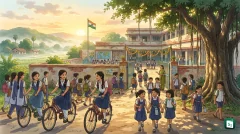
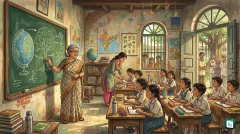
Schools form the centre of the celebration. Many schools hold special assemblies, songs, dances, plays, debates, painting contests and sports meets. In several schools teachers present programmes for students. Sweets are shared. Leaders pay tribute to Nehru and speak about child welfare.
In 2026, 14 November fell on a Saturday. Many schools kept morning functions so classes were not fully closed. Offices and banks worked as usual.
Children’s Day is not a national holiday. This is a common point of confusion. Students attend celebration events, but the day does not close government offices across the country.
How the Constitution and Laws Protect Child Rights in India
India joined the Convention on the Rights of the Child on 11 December 1992. The Convention was adopted by the United Nations on 20 November 1989. It treats persons below 18 as children and lists civil, social and cultural rights. It rests on four ideas: non discrimination, best interests of the child, life and growth, and respect for the child’s views.
The Constitution gives strong backing:
- Article 21A makes free and compulsory education a basic right for children aged 6 to 14. It was added by the 86th Amendment in 2002.
- Article 24 bans employment of children below 14 in factories, mines and hazardous work.
- Article 39(e) and 39(f) direct the state to guard children against abuse and to give them chances to grow in freedom and dignity.
- Article 45 asks the state to provide early childhood care for children below six.
- Article 15(3) allows the state to make special provisions for children.
Parliament has built laws on this base. The Right of Children to Free and Compulsory Education Act, 2009, which came into force on 1 April 2010, gives effect to Article 21A. It asks private unaided schools to reserve 25 percent of entry seats for children from weaker sections. Section 17 bans physical punishment and mental harassment.
Other shields include the Protection of Children from Sexual Offences Act, 2012, the Juvenile Justice Act, 2015 for care and protection, and the Child and Adolescent Labour Amendment Act, 2016 against hazardous work. The National Commission for Protection of Child Rights, set up under the Commissions for Protection of Child Rights Act, 2005, watches over these safeguards.
India’s November 14 Versus the World’s November 20 and Veer Bal Diwas
Many readers mix three different days. The table below clears the doubt.
| Point | India’s Children’s Day | World Children’s Day | Veer Bal Diwas |
|---|---|---|---|
| Date | 14 November | 20 November | 26 December |
| Basis | Birth anniversary of Jawaharlal Nehru | Adoption of the Declaration of the Rights of the Child in 1959 and the Convention in 1989 | Martyrdom of Sahibzada Zorawar Singh and Sahibzada Fateh Singh, younger sons of Guru Gobind Singh |
| Started | Observed from 1954, formally declared in 1957, fixed after 1964 | Call given in 1954 by the United Nations | Announced in 2022, observed from that year |
| Led by | Schools and state bodies across India | United Nations and UNICEF | Government of India |
World Children’s Day marks 20 November because the General Assembly adopted two key texts on that date, in 1959 and 1989. India earlier observed the same date. After 1964, India kept 14 November to honour Nehru.
Veer Bal Diwas is separate. It honours courage and sacrifice in Sikh history. In 2018 some members of Parliament sought to shift Children’s Day to 26 December, but the government did not change the date. Bal Diwas stays on 14 November, and Veer Bal Diwas stays on 26 December.
Key Takeaways
- India observes Children’s Day (Bal Diwas) on 14 November every year to mark the birth anniversary of Jawaharlal Nehru.
- The year 2026 marks the 137th birth anniversary of Nehru, who was born on 14 November 1889 and served as Prime Minister from 1947 to 1964.
- The 2026 theme For Every Child, Every Right stresses that learning, health, protection and participation belong to every child.
- World Children’s Day is observed on 20 November under UNICEF leadership, with the 2026 theme My Day, My Rights, My Future.
- India joined the Convention on the Rights of the Child on 11 December 1992, while Article 21A and the RTE Act, 2009 secure free schooling for ages 6 to 14.