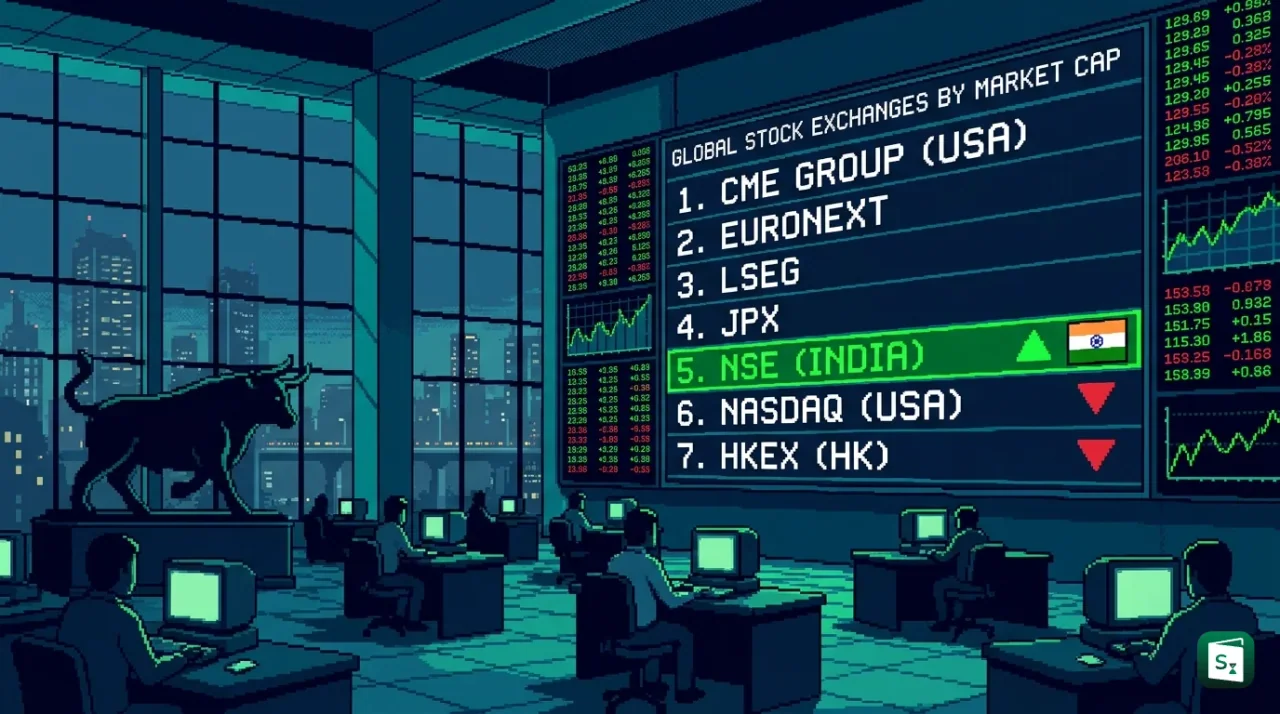
The National Stock Exchange of India (NSE) has become the fifth largest listed stock exchange operator in the world with a market value of about $59.7 billion (₹5.56 lakh crore) on 20 November 2026. The NSE market cap has now moved ahead of the Nasdaq at about $57.7 billion and Hong Kong Exchanges and Clearing (HKEX) at about $58.1 billion. The US-based CME Group tops the global list with a value of about $111 billion.
How NSE Crossed Nasdaq and HKEX to Rank Fifth
The NSE rise came from a sharp rally in its shares in less than two months after listing. NSE shares touched an intraday high of ₹2,251 on the BSE on 20 November 2026, up about 2.8 percent on the day. The shares had gained about 8 percent in three trading sessions before that day.
At a price of about ₹2,236, the market capitalisation of NSE reached about ₹5.54 lakh crore to ₹5.56 lakh crore. This is about 24.5 to 25 percent higher than its initial public offering (IPO) price of ₹1,785. At the IPO price, NSE was valued at about ₹4.4 lakh crore. The rally has therefore added about ₹1.1 lakh crore in value.
The jump has also made NSE the ninth largest listed company in India. It has moved ahead of Kotak Mahindra Bank, valued at about ₹5.03 lakh crore, and the Life Insurance Corporation of India (LIC), valued at about ₹5.15 lakh crore. The ranking of fifth place counts only exchange companies that are themselves listed on a stock market. It does not measure the total value of all companies traded on each exchange.
Largest Stock Exchange Operators in the World by Market Cap
The global ranking compares the market capitalisation of the exchange operator company. Market capitalisation means the share price multiplied by the total number of shares. It shows how much investors think the exchange business itself is worth.
| Rank | Exchange Operator | Home Market | Approx. Market Cap |
|---|---|---|---|
| 1 | CME Group | United States | $111 billion |
| 2 | Intercontinental Exchange (ICE), owner of the New York Stock Exchange | United States | $95.5 billion |
| 3 | Deutsche Borse | Germany | $63.7 to $65 billion |
| 4 | London Stock Exchange Group (LSEG) | United Kingdom | $60.1 to $60.3 billion |
| 5 | National Stock Exchange of India (NSE) | India | $59.3 to $59.7 billion |
| 6 | Hong Kong Exchanges and Clearing (HKEX) | Hong Kong | $57.7 to $58.1 billion |
| 7 | Nasdaq Inc. | United States | $57.7 billion |
The CME Group, based in Chicago, runs the largest market for futures and options in the world. Intercontinental Exchange runs the New York Stock Exchange, the largest stock market in the world by value of listed companies. Deutsche Borse runs the Frankfurt Stock Exchange. The London Stock Exchange Group runs the London Stock Exchange and also owns large data and index businesses.
NSE sits only about $800 million below the London Stock Exchange Group. The gap between NSE, HKEX and Nasdaq is small, so the order can change with daily share price moves. But the larger message is stable. An Indian exchange operator is now valued on par with century old exchanges in the United States, Europe and Hong Kong.
What Is NSE and How Does It Work?
The National Stock Exchange of India is the largest stock exchange in India by trading turnover. It provides a regulated platform where shares, derivatives, bonds, currencies and mutual fund units are bought and sold through fully electronic trading. It also runs clearing, index and market data services.
NSE was incorporated on 27 November 1992 on the advice of the Pherwani Committee. The Securities and Exchange Board of India (SEBI), the regulator for securities markets in India, recognised NSE as a stock exchange in April 1993. NSE started operations in 1994 with the wholesale debt market, followed by the cash equity segment in November 1994. It is headquartered at Exchange Plaza, Bandra Kurla Complex, Mumbai.
NSE was the first exchange in India to use screen based electronic trading with anonymous order matching. Orders from brokers across the country are matched by computer without face to face dealing. NSE Clearing Ltd. clears and settles all trades and guarantees settlement. This system reduced dependence on a physical trading ring and spread trading to hundreds of cities.
The flagship index of NSE is the Nifty 50. NSE Indices Ltd. launched it on 22 April 1996 with a base date of 3 November 1995. The index tracks 50 large listed companies and forms the base for index futures, index options, exchange traded funds and index funds. Assets linked to Nifty indices stood at about ₹8.14 lakh crore in FY26.
NSE earns money mainly from fees on trading. In FY26, transaction charges formed about 78.65 percent of operating revenue, and equity options alone contributed about 60.22 percent. Other income comes from listing fees paid by companies, connectivity and data centre charges, sale of market data, and licence fees for use of Nifty indices.
NSE vs BSE: What Is the Difference?
NSE and BSE are the two national stock exchanges of India regulated by SEBI. NSE, started in 1994, leads trading turnover with about 93 percent share in cash equities and most derivatives volume. BSE, founded in 1875, leads in number of listed companies and runs the Sensex index.
The Bombay Stock Exchange (BSE), set up in 1875, is the oldest stock exchange in Asia. Its benchmark is the Sensex, a 30 stock index. The National Stock Exchange runs the Nifty 50, a 50 stock index. Both exchanges trade from Monday to Friday, settle trades on a T plus 1 cycle, and can be reached through the same brokers.
The main differences lie in listings and liquidity:
| Feature | NSE | BSE |
|---|---|---|
| Year operations began | 1994 | 1875 |
| Benchmark index | Nifty 50 (50 stocks) | Sensex (30 stocks) |
| Listed companies, March 2026 | About 2,978 | About 5,955 |
| Value of listed companies | About ₹411.3 lakh crore | About ₹411.6 lakh crore |
| Cash market share in FY26 | 92.99 percent | About 7 percent |
| Equity futures share in FY26 | 99.79 percent | Small share |
| Equity options share by premium in FY26 | 74.71 percent | Rising, about 35 percent of index options premium in H1 FY27 |
NSE reported average daily trading volume of about ₹1.06 lakh crore in cash equities in FY26, more than 13 times the BSE figure of about ₹79,500 crore. NSE equity options premium turnover averaged about ₹57,662 crore per day in FY26, against about ₹19,523 crore for BSE.
The gap is due to liquidity. Traders send orders where spreads are tight and volumes are deep. More orders make the market deeper, which pulls in more orders. NSE built this cycle early after it launched index futures in June 2000 and then stock futures and options.
BSE has rebuilt part of its derivatives business since it relaunched Sensex options in May 2023. Its share in index options premium rose from about 3 percent in FY24 to about 35 percent in the first half of FY27. BSE listed itself in 2017. NSE answered the question is NSE listed in the stock market in 2026, when it listed on BSE on 24 September 2026.
Globally, NSE was the largest derivatives exchange by number of contracts for the seventh straight year to March 2026, as per the World Federation of Exchanges (WFE). NSE accounted for 11.38 percent of global cash equity trades and 51.18 percent of global equity derivatives contracts in FY26.
NSE IPO and Listing: From ₹1,785 Issue Price to ₹5.56 Lakh Crore Value
NSE launched its long awaited IPO from 17 to 21 September 2026. The issue was a pure offer for sale of 12.64 crore shares by existing shareholders. NSE itself received no fresh funds from the issue. The price band was ₹1,700 to ₹1,785, and the final price was fixed at the top at ₹1,785.
The issue raised about ₹22,562 crore, the second largest IPO in India after Hyundai Motor India. It was subscribed about 5.71 times, with bids of about ₹90,287 crore. NSE had already raised about ₹6,746 crore from more than 150 anchor investors before the public offer.
NSE listed on the BSE on 24 September 2026 at ₹1,800, a premium of only 0.84 percent. The stock closed day one at about ₹1,818 with a value of over ₹4.45 lakh crore. Early buyers in the unlisted market who had paid over ₹2,000 faced short term losses, while IPO allottees saw a flat start.
The picture changed after listing. Strong results, steady options volumes and foreign interest lifted the stock. In November 2026, NSE crossed the ₹5 lakh crore mark and then ₹5.5 lakh crore within two months. NSE is now the second listed exchange in India after BSE and by far the most valuable.
Why NSE Commands Such a High Valuation
Investors value NSE for scale, margins and steady fee income. NSE is the main gateway to Indian equities at a time when domestic investing has grown fast. As of June 2026, NSE had about 261.36 million registered investor accounts and 132.37 million unique investors, with about 1,328 trading members and 3,005 listed entities. More accounts mean more orders and more transaction fees.
The business has high operating leverage. Once technology and clearing systems are in place, extra trades add revenue at low extra cost. That is why transaction heavy exchanges trade at high multiples. NSE also earns recurring income from data, indices, listing and connectivity, which supports growth when trading slows.
Growth in Indian markets adds to the story. The combined value of NSE listed companies crossed ₹416.57 lakh crore (about $5 trillion) for the first time in 2024. The Nifty 50 crossed 25,000 in August 2024. A larger market base can support higher trading volumes over time.
Risks remain part of the price. NSE depends heavily on equity options for revenue. SEBI tightened derivatives rules in late 2024 to curb speculative trading, including fewer weekly expiries per exchange. NSE share in equity options premium fell from about 96.86 percent in FY24 to 74.71 percent in FY26 as BSE gained. Any further curbs or a long fall in volumes could affect fees and hence valuation.
Key Takeaways
- The NSE market cap reached about $59.7 billion (₹5.56 lakh crore) on 20 November 2026, making it the fifth largest listed exchange operator in the world.
- NSE overtook Nasdaq at about $57.7 billion and HKEX at about $58.1 billion, while CME Group at about $111 billion tops the global list.
- NSE listed on the BSE on 24 September 2026 at ₹1,800 against an IPO price of ₹1,785, and has risen about 25 percent since then.
- NSE was incorporated on 27 November 1992, recognised by SEBI in April 1993, and started operations in 1994 as the first screen based exchange in India.
- NSE is the largest derivatives exchange in the world by number of contracts for seven straight years to FY26, with 51.18 percent of global equity derivatives contracts.