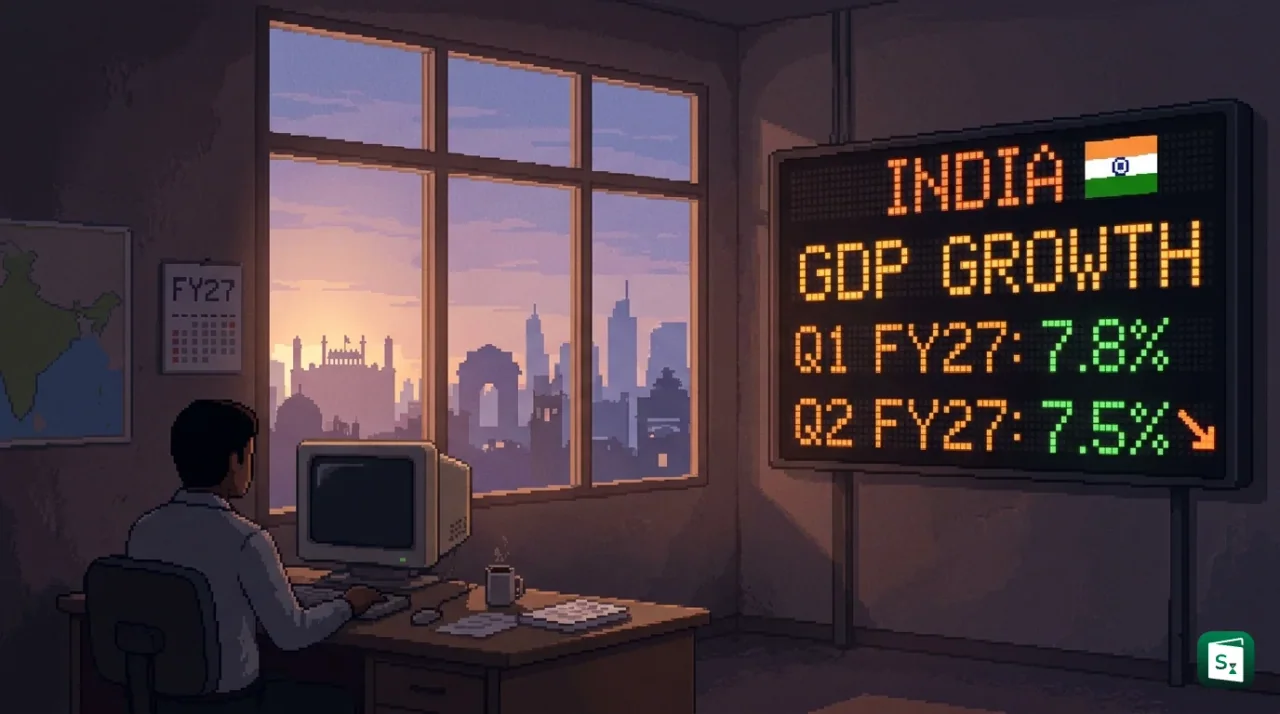
ICRA Ltd has projected India GDP growth at 7.5 percent year on year in Q2 FY27, the July to September 2026 quarter, easing from 7.8 percent in Q1 FY27. The forecast released on 17 November 2026 is still above the Reserve Bank of India Monetary Policy Committee forecast of 7.2 percent for the quarter. ICRA expects the slowdown to be broad based and has kept its full year FY27 growth estimate at 7.1 percent.
What Is the ICRA Forecast for Q2 FY27?
ICRA projects India real GDP growth at 7.5 percent year on year in Q2 FY27, down from 7.8 percent in Q1 FY27 and 8.2 percent in Q2 FY26. ICRA released this estimate on 17 November 2026, ahead of the official quarterly data due on 30 November 2026. At 7.5 percent, growth would mark a five quarter low but stay resilient despite external and monsoon pressures.
The agency also expects growth in Gross Value Added (GVA) to ease to 7.2 percent in Q2 FY27 from 8.2 percent in Q1 FY27. GVA measures the value of goods and services produced after subtracting input costs. Gross Domestic Product (GDP) equals total GVA plus net taxes on products. ICRA notes that GDP growth in Q2 will be about 0.3 percentage points higher than GVA growth because healthy growth in net indirect taxes will support the headline number.
ICRA Ltd, formerly Investment Information and Credit Rating Agency of India Limited, was set up in 1991 and is headquartered in Gurugram, Haryana. It is an affiliate of Moody’s Corporation and is listed on the Bombay Stock Exchange and National Stock Exchange. The Q2 assessment was led by Aditi Nayar, Chief Economist and Head of Research and Outreach at ICRA.
| Indicator for Q2 FY27 | Q1 FY27 Actual | Q2 FY27 ICRA Estimate |
|---|---|---|
| Real GDP growth | 7.8 percent | 7.5 percent |
| Real GVA growth | 8.2 percent | 7.2 percent |
| Agriculture GVA growth | 3.6 percent | 0.2 percent |
| Industry GVA growth | 7.7 percent | 7.2 percent |
| Services GVA growth | 10.0 percent | 9.1 percent |
Why Is Growth Expected to Ease to 7.5 Percent?
ICRA expects the moderation to be broad based across farms, factories and services. High frequency data for industry and services stayed strong in July to September 2026. Weak monsoon, slower central government spending and external headwinds linked to the West Asia crisis pulled overall momentum down.
Sharp Slowdown in Farm Output
ICRA estimates GVA growth in agriculture, forestry and fishing at only 0.2 percent in Q2 FY27, down from 3.6 percent in Q1 FY27 and 3.2 percent in Q2 FY26. Area sown under kharif crops fell by 1.0 percent from last year. Rice sowing declined by 3.5 percent, with large shortfalls in Karnataka, Andhra Pradesh, Telangana and Tamil Nadu due to sub par rain during the Southwest Monsoon season.
Uneven rain in space and time is also likely to have cut crop yields. First advance estimates of crop production were not yet available when ICRA released its forecast. Low reservoir storage in October 2026 added risks for rabi sowing and farm incomes, which may dampen rural demand in the second half of the year.
Industry Holds Up Despite Cost Pressures
ICRA estimates industry GVA growth at 7.2 percent in Q2 FY27, easing from 7.7 percent in Q1 FY27. Manufacturing and mining led the moderation. Investment signals stayed largely favourable. Output of infrastructure goods grew 7.7 percent in Q2 against 7.2 percent in Q1, while capital goods grew 14.9 percent against 15.2 percent, staying in double digits.
Government capital spending showed a mixed picture. The central government capex growth slowed sharply to 2.8 percent in Q2 from 23.7 percent in Q1. Capital spending by 25 state governments rose to double digits during July to August 2026, which provided some support.
Services Stay Strong but Government Spending Slips
ICRA expects services GVA growth to ease to about 9.1 percent in Q2 FY27 from 10.0 percent in Q1 FY27. The slowdown is spread across trade, hotels, transport, communication services and financial, real estate and professional services. Many private indicators for these segments actually improved over Q1, so underlying business activity remained quite strong.
Public spending was the drag. The central government non interest revenue expenditure contracted by 0.8 percent in Q2 after a sharp 19.5 percent rise in Q1. The combined non interest revenue spending of 25 state governments grew 4.9 percent in July to August 2026, up from 2.6 percent in Q1. ICRA also flags deficient rain, rising inflation and high input prices as risks for demand and business margins in the second half of FY27.
How Do ICRA Estimates Compare With RBI, IMF and World Bank Forecasts?
ICRA projection of 7.5 percent for Q2 FY27 is higher than the central bank forecast of 7.2 percent for the same quarter. ICRA, RBI and the World Bank now all place full year FY27 growth at 7.1 percent, while the IMF places it at 7.0 percent. This convergence follows the strong Q1 outcome of 7.8 percent.
The Reserve Bank of India Monetary Policy Committee projected real GDP growth of 7.1 percent for FY27 in its meeting held from 5 to 7 October 2026 under Governor Sanjay Malhotra. The central bank raised the FY27 forecast from 6.7 percent projected in August. It placed Q2 growth at 7.2 percent, Q3 at 6.9 percent and Q4 at 6.8 percent. In the same meeting, the committee raised the policy repo rate by 25 basis points to 5.50 percent. The repo rate is the rate at which the RBI lends money to banks for the short term.
The World Bank raised India growth forecast to 7.1 percent for FY27 in its India Development Update released on 6 October 2026, up from 6.6 percent in April. The International Monetary Fund raised its forecast to 7.0 percent for FY27 in its World Economic Outlook released in October 2026, up by 60 basis points from July. On a calendar year basis, the IMF expects 7.4 percent growth in 2026 and 7.0 percent in 2027. Both institutions described India as among the fastest growing major economies, supported by resilient domestic demand and robust services activity.
| Institution | Q2 FY27 Forecast | FY27 Full Year Forecast | Release |
|---|---|---|---|
| ICRA | 7.5 percent | 7.1 percent | 17 November 2026 |
| RBI Monetary Policy Committee | 7.2 percent | 7.1 percent | 7 October 2026 |
| World Bank | Not given quarterly | 7.1 percent | 6 October 2026 |
| IMF | Not given quarterly | 7.0 percent | October 2026 World Economic Outlook |
ICRA expects growth to moderate in H2 FY27 because of deficient rain, rising inflation, high base from GST rate rationalisation and elevated input costs. ICRA projects nominal GDP growth to improve to about 12.5 percent in FY27 from 8.6 percent in FY26 because prices are rising faster. The second quarter official estimate from the National Statistical Office is scheduled for 30 November 2026.
What Is GDP and How Is It Calculated in India?
Gross Domestic Product in India is the total value of all final goods and services produced within the country during a year or quarter. The National Statistical Office compiles the estimates under the Ministry of Statistics and Programme Implementation. Growth can be measured in nominal terms at current prices or in real terms at constant prices after removing price rises.
Real GDP growth uses the expenditure formula C plus I plus G plus X minus M, where C is private consumption, I is investment, G is government spending, X is exports and M is imports. In Q1 FY27, private consumption grew 7.1 percent and fixed investment grew 11.9 percent, while exports rose 12.0 percent and imports fell 1.1 percent. The GDP formula in common use is GDP equals consumption plus investment plus government spending plus net exports.
GDP differs from GVA, GNP and per capita income in clear ways. GVA is output minus intermediate consumption such as raw materials. GDP equals total GVA plus product taxes minus product subsidies. GNP adds net income from abroad to GDP, while GDP per capita divides GDP by population to show average income.
| Term | What It Measures |
|---|---|
| GDP | Total final output within India plus net product taxes |
| GVA | Output value minus input costs, measured at basic prices |
| GNP | GDP plus net income earned from abroad |
| Nominal GDP | Output valued at current market prices |
| Real GDP | Output valued at base year prices, without inflation effect |
India moved to a new GDP series with base year 2022-23 on 27 February 2026, replacing the 2011-12 base. The base year is the reference year used to remove price effects. Under the new series, the manufacturing sector uses double deflation, which removes price changes separately for outputs and inputs to give a clearer picture of real value added. The method was earlier used only for agriculture because reliable input price data was limited. The new series also uses over 300 item level price indices and Supply and Use Tables to reduce gaps between production and spending estimates.
For reference, real GDP in Q1 FY27 stood at ₹81.36 lakh crore with 7.8 percent growth, while nominal GDP stood at ₹88.27 lakh crore with 10.3 percent growth. Real GVA stood at ₹73.82 lakh crore with 8.2 percent growth.
Where Does India Stand in Global GDP Rankings?
India is among the top five economies in the world by nominal GDP, with total output valued at more than $4 trillion. The country remains the fastest growing major economy at a time when advanced economies are projected to grow near 1.8 percent in 2027. Strong domestic demand, a large home market and continued reforms support this lead.
The size gap with average living standards remains wide. GDP per capita in India, which divides total output by population, is still modest compared to advanced economies. That is why policy discussion pairs headline growth with jobs, rural incomes and inflation control. Sustained real growth above 7 percent, as seen in Q1 FY27 and forecast for Q2, helps raise incomes while keeping India on track toward a larger $5 trillion economy goal over the coming years.
Key Takeaways
- ICRA projected India real GDP growth at 7.5 percent in Q2 FY27, easing from 7.8 percent in Q1 FY27.
- ICRA expects GVA growth at 7.2 percent in Q2 FY27, with agriculture at 0.2 percent, industry at 7.2 percent and services at 9.1 percent.
- The RBI Monetary Policy Committee projected Q2 FY27 growth at 7.2 percent and full year FY27 growth at 7.1 percent in October 2026.
- The World Bank projects FY27 growth at 7.1 percent and the IMF projects FY27 growth at 7.0 percent.
- The National Statistical Office will release official Q2 FY27 GDP data on 30 November 2026 under the new base year 2022-23 adopted on 27 February 2026.