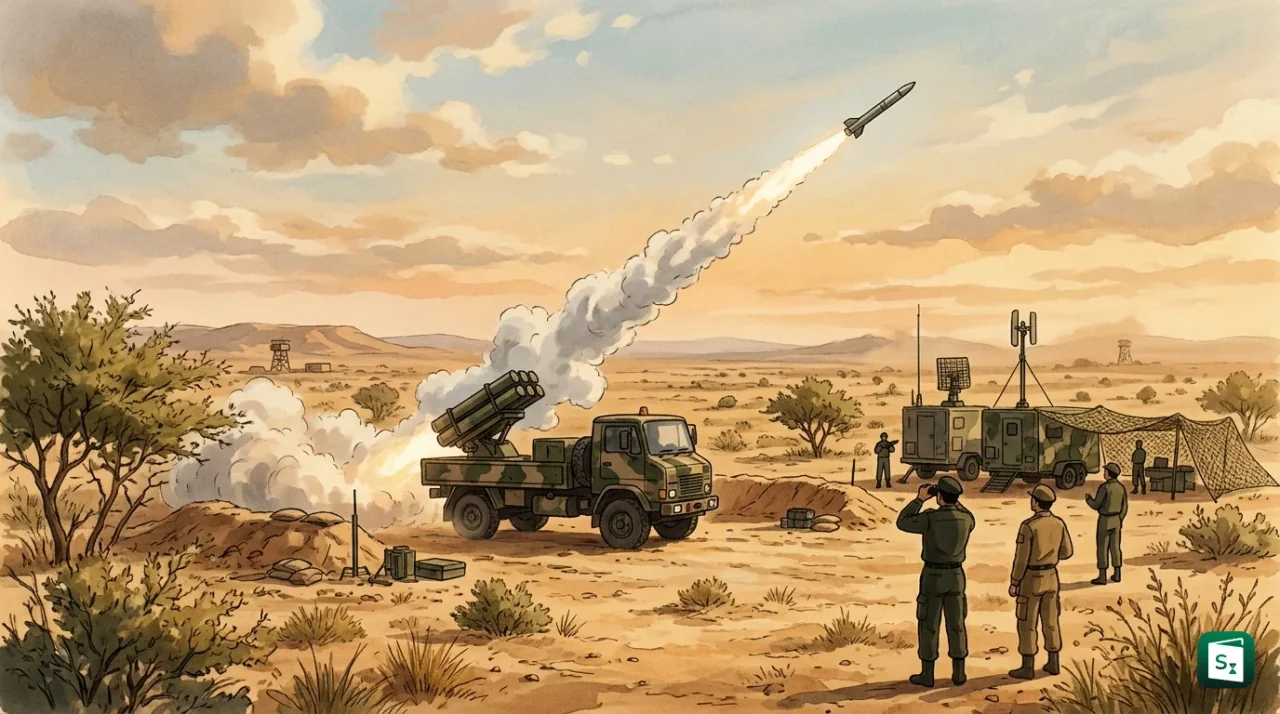
IG Defence test-fired the JWALA MK-1 counter-drone micro-missile system at the Pokhran field firing range in Rajasthan on 23 November 2026. The company describes JWALA MK-1 as India’s first indigenous, private-sector autonomous Counter-Unmanned Aircraft System micro-missile, with a strike range of 2 km to 5 km and an altitude cover of 50 m to 5,000 m. The test puts a low-cost hard-kill option on the table at a time when cheap attack drones are forcing armies to rethink air defence.
What Is the JWALA MK-1 Missile System?
The JWALA MK-1 is a short-range surface-to-air micro-missile built only to kill hostile drones. IG Defence lists it as a truck-mounted interceptor with an engagement range of 2 km to 5 km and an engagement altitude of 50 m to 5,000 m. The company calls it India’s first private-sector autonomous Counter-Unmanned Aircraft System micro-missile.
An anti-drone system is a set of sensors and weapons that finds, confirms and stops enemy drones before they can watch or strike. A counter-drone system does this in three steps: detect the object in the sky, identify if it is friendly or hostile, and then defeat it. A micro-missile is a small, short-range missile designed for this last step. It is far smaller than a regular air defence missile and is meant to hit small, low-flying targets at low cost.
JWALA MK-1 is designed and made in India by IG Defence, a Noida-headquartered defence technology firm. The firm began in 2018 as IG Drones, working on survey and industrial drones, and later changed its name to IG Defence as it moved fully into defence systems. Its corporate office is in Sector 63, Noida, Uttar Pradesh, while research work continues in Bhubaneswar. The company says its systems saw operational use during Operation Sindoor, when India faced large drone incursions.
How JWALA MK-1 Detects and Destroys Drones
JWALA MK-1 follows the standard counter-drone kill chain of detection, identification and interdiction, but IG Defence says much of it runs without human input. The core of this autonomy is GRID, the company’s AI-powered Mission Autonomy and Battle Management System. GRID fuses sensor inputs, detects the aerial object, classifies it as a drone type, decides on engagement and guides the missile to the target. The company describes GRID as the brain that runs the complete kill sequence from search to hit.
The missile itself is built for speed and mobility. IG Defence launched the test round from a multi-canister launcher mounted on a 4x4 vehicle, which allows the unit to move with ground troops and protect moving columns or fixed sites. The company claims a reaction time of less than 7 seconds from target detection to launch. That short loop matters because small drones fly low and give defenders only a few seconds to respond.
| Feature | JWALA MK-1 Specification |
|---|---|
| Platform type | Short-range surface-to-air missile |
| Mission role | Air defence against UAVs |
| Engagement range | 2 km to 5 km |
| Engagement altitude | 50 m to 5,000 m |
| Propulsion | Dual-pulse solid rocket motor with fin control |
| Warhead | 0.5 kg to 1.5 kg pre-fragmented high-explosive with proximity fuze |
| Accuracy | Circular error probable of less than 2 m at maximum range |
| Launcher | Truck-mounted multi-canister launcher on 4x4 vehicle |
| Reaction time | Less than 7 seconds from detection to launch |
| Autonomy | GRID AI mission autonomy and battle management system |
A dual-pulse solid rocket motor burns in two controlled pulses instead of one long burn. The first pulse pushes the missile out of the canister and toward the target area. The second pulse fires later in flight to keep speed high during the final chase. Fin controls then steer the body with small wing movements.
The warhead uses a pre-fragmented design with a proximity fuze. Instead of needing a direct hit, the fuze senses when the missile is close to the drone and bursts the case into fast metal fragments. The fragment cloud can tear through the drone and can also damage nearby drones in a swarm attack.
Why a Micro-Missile Changes the Cost of Counter-Drone Warfare
Modern armies face a cost problem. A surveillance or suicide drone can cost a few thousand dollars. A conventional air defence interceptor can cost lakhs or crores of rupees per shot. No force can keep firing expensive missiles at endless waves of cheap drones without emptying its stocks.
Counter-drone warfare therefore uses two broad methods. Soft-kill tools disrupt the drone without touching it, through jamming of radio links, spoofing of satellite navigation, or takeover of control signals. Hard-kill tools destroy the drone in the air, through guns, lasers, interceptor drones, or missiles like JWALA MK-1. Soft kill is cheap and clean but fails against autonomous drones that do not need a radio link, or against fibre-optic drones that cannot be jammed. Hard kill works regardless of the link, but it has been costly until now.
| Method | How It Stops Drones | Strength | Limit |
|---|---|---|---|
| Soft kill (jamming, spoofing) | Blocks radio and satellite signals | Low cost per use, no debris | Fails against autonomous or fibre-guided drones |
| Gun with programmable shells | Fires bursts at close range | Low cost, high fire rate | Short range, needs clear line of sight |
| Laser directed-energy weapon | Burns parts with a beam | Very low cost per shot, repeatable | Needs heavy power, weak in clouds and dust |
| Micro-missile (JWALA MK-1 type) | Hits or bursts near the drone | Longer reach, works in all weather | Each round costs more than a jammer pulse |
Conflicts in Ukraine and West Asia showed how small drones and loitering munitions can force even strong air defences to spend heavily. During Operation Sindoor in May 2025, Pakistan launched large numbers of low-grade drones along with rockets and cruise missiles of Chinese and Turkish origin. India stopped them with a layered grid that included the Russian S-400, indigenous Akash missiles, air defence guns, and the DRDO-developed D-4 Drone-Detect, Deter and Destroy system. The D-4 combines radar and radio detection with jamming and a laser kill option and is made by Bharat Electronics Limited.
The lesson drawn by the Chief of Defence Staff was clear. India needs indigenous counter-drone grids that mix sensors, jammers, guns, lasers and kinetic interceptors under one command network. A micro-missile fills the hard-kill gap between guns that reach only short distances and large missiles that are too costly for drones. Private systems such as Bhargavastra, which targets drone swarms, and JWALA MK-1 are now adding to the public-sector options from the Defence Research and Development Organisation (DRDO).
How the Pokhran Test Fits Into India’s Private Defence Push
The test took place at the Pokhran field firing range in Jaisalmer district of Rajasthan. Pokhran town lies about 112 km east of Jaisalmer city in the Thar Desert. The range is controlled by the Indian Army and has four sub-ranges for artillery, armour, air force practice and restricted trials. The same complex hosted India’s first nuclear test, Smiling Buddha, on 18 May 1974, and the five Operation Shakti tests on 11 and 13 May 1998. Its open desert land, low population and secure military control make it the standard site for missile and weapon trials.
For IG Defence, Pokhran marks the move from component tests to a full flight trial. In October 2026 the company test-fired two solid rocket motors for the JWALA programme at around 4 am to prove propulsion. By then it said it had already built the seeker, target-acquisition unit, avionics, warhead and electronic subsystems. In September 2026 it showed only the airframe of the JWALA MK-1 to Indian Air Force officers during Dronathon 2026. The November firing is the first time the integrated missile has been flown from its truck launcher.
The test also reflects the wider entry of private firms into missile work. IG Defence says it builds its electronics, software, aerodynamics and integration in-house to cut import dependence. It reports more than 5,000 drones sold, a manufacturing capacity of up to 1 lakh first-person-view drones, and growth in revenue from about ₹5.17 crore in FY24 to ₹22.4 crore in FY25. The company raised about $5 million in March 2026 from India Accelerator and Finvolve to expand production and is also developing KAL, a long-range loitering munition with a claimed range of up to 1,000 km.
IG Defence has not disclosed how many targets JWALA MK-1 engaged at Pokhran, the exact test conditions, the cost per shot, or a production and induction schedule. Further trials and independent assessment by the Army and Air Force will decide if the claimed range, accuracy and 7-second reaction hold under field conditions. The system will also need to prove it can link with radars, electro-optical sensors and command networks that form India’s planned counter-drone grid.
Key Takeaways
- IG Defence test-fired the JWALA MK-1 autonomous counter-drone micro-missile at the Pokhran field firing range in Rajasthan on 23 November 2026.
- JWALA MK-1 has an engagement range of 2 km to 5 km and an engagement altitude of 50 m to 5,000 m.
- The system is guided by GRID, IG Defence’s AI-powered mission autonomy and battle management system for detection, classification and engagement.
- The interceptor uses a dual-pulse solid rocket motor, fin controls and a 0.5 kg to 1.5 kg pre-fragmented warhead with a proximity fuze.
- The launcher is a truck-mounted multi-canister system on a 4x4 vehicle with a claimed reaction time of less than 7 seconds.