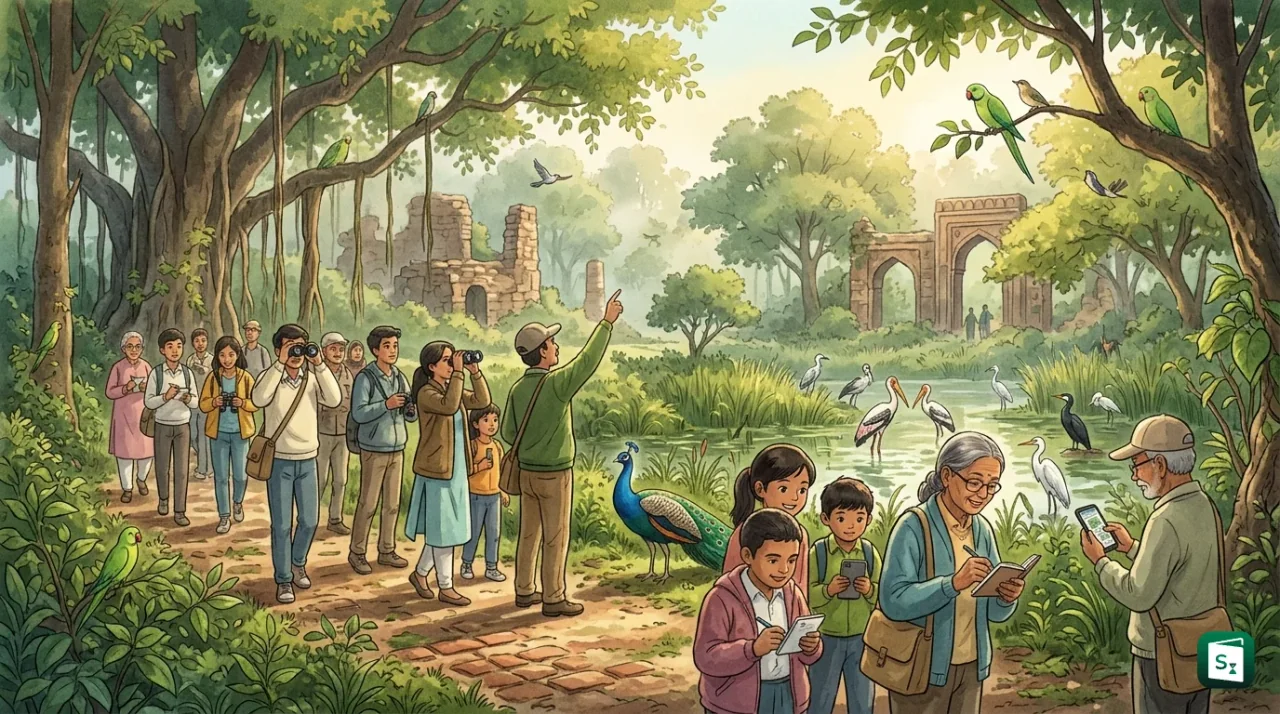
The National Zoological Park, New Delhi organised the 22nd edition of its Sunday Bird Walk on 22 November 2026 from 7:30 AM to 10:30 AM. Ten nature enthusiasts joined resource experts and volunteers to document 45 bird species and more than 400 individual birds inside the zoo. The programme is part of the zoo’s regular citizen science initiative to connect bird watching with biodiversity documentation and wildlife conservation in India.
What Did the 22nd Sunday Bird Walk Record?
The National Zoological Park held the walk on 22 November 2026 between 7:30 AM and 10:30 AM inside its campus. Ten participants took part, including students, wildlife photographers and local bird watchers. Resource experts and trained volunteers guided the group along a fixed route and helped them spot birds and record counts.
Bird watching is the observation and identification of birds in their natural surroundings, often using binoculars, field guides and bird viewer tools such as telescopes. A bird walk is a short guided outing where a group observes birds together and notes species names and numbers. During the 22nd walk, the group documented 45 bird species and more than 400 individual birds. Participants learned field identification skills and the basics of bird behaviour, ecology and habitat use.
Discussions during the walk focused on the ecological value of birds. Birds help control insect pests in farms and gardens. They spread seeds and pollinate plants. They also act as indicators of environmental quality, because a fall in bird numbers often signals pollution, loss of wetlands or habitat damage.
Dr Sanjeet Kumar, Director of the National Zoological Park, said such walks connect people with nature and improve understanding of food webs and ecological relationships. The programme ended with an interactive discussion, a feedback session and a group photograph. Each Sunday Bird Walk is limited to 20 to 25 participants to allow close learning. Prior registration is mandatory, with bookings opening Monday to Friday on a first come, first served basis through the zoo website and the NZP Saathi mobile application. The previous 21st walk on 15 November 2026 had recorded 42 species and more than 600 birds, which shows steady public interest and seasonal variation in sightings.
Where Is the National Zoological Park and How Did It Begin?
The National Zoological Park is located on Mathura Road near Purana Qila in New Delhi, between Purana Qila and Humayun’s Tomb. The zoo covers 176 acres and functions as a subordinate office under the Ministry of Environment, Forest and Climate Change. It houses about 1,350 animals belonging to nearly 130 species of mammals, birds and reptiles from India and abroad.
The idea of a zoo in the national capital emerged soon after independence. The Indian Board for Wildlife, set up in 1951, stressed the need for zoos in large cities at its first meeting in 1952. An ad hoc committee of nature lovers, including Indira Gandhi, met on 9 September 1953 and selected the present site. N. D. Bachkheti of the Forest Service took charge as superintendent on 1 October 1955 to execute the project.
The design drew on two foreign experts. Major Weinmann, then Director of the Colombo Zoological Garden, gave an early plan. Carl Hagenbeck of Hamburg in West Germany then proposed open moat enclosures instead of caged bars, a concept where deep moats separate visitors from animals and create a natural look. The Government of India approved the revised layout on 31 December 1956.
Construction of roads, waterways, moats, ponds and animal houses was largely complete by late 1959. Gifts of tigers, leopards, bears, deer and birds had already arrived from state governments and were kept near Azimganj Sarai before shifting to permanent homes. Punjab Rao Deshmukh, then Union Minister, formally inaugurated the park on 1 November 1959 as the Delhi Zoo. In 1982, the park received the status of National Zoological Park with the aim of serving as a model zoo for the country.
| Milestone of National Zoological Park Delhi | Detail |
|---|---|
| Initial proposal | Indian Board for Wildlife meeting, 1952 |
| Site approved | 9 September 1953, between Purana Qila and Humayun’s Tomb |
| Execution starts | 1 October 1955 under N. D. Bachkheti |
| Plan approved | 31 December 1956 |
| Inaugurated | 1 November 1959 by Punjab Rao Deshmukh |
| National status | 1982 as National Zoological Park |
| Area and location | 176 acres on Mathura Road, New Delhi |
Why Does Bird Watching Matter for Conservation?
Bird watching matters because birds reveal the health of an ecosystem quickly and at low cost. A stable mix of resident and migratory birds usually means clean water, healthy trees and safe food chains. A sudden drop in counts can warn of wetland loss, pesticide load or climate stress. Regular counts also build long term records that help managers protect habitats.
Biodiversity documentation means systematic recording of species names, numbers, locations and behaviour in a defined area. Bird spotting and bird viewing walks are simple tools for this work. They need only binoculars, a notebook and consistent effort, yet they produce data on distribution, abundance and seasonal change.
Delhi is a strong location for such work. The city lies on the migratory path used by birds breeding in Siberia and Central Asia. Many species cross the Himalaya and follow the Yamuna river corridor to winter in north India between October and March. Nearby wetlands such as the Okhla Bird Sanctuary, spread over about 4 square kilometres at the Delhi to Uttar Pradesh border, host thousands of winter visitors each year.
Common winter visitors around Delhi include the Northern Shoveler, Gadwall, Northern Pintail, Common Teal, Ruddy Shelduck and Bar headed Goose. Some of these ducks and geese also rest in water bodies inside the zoo campus. November counts, like the 22nd Sunday Bird Walk, are timed well because winter arrivals peak from November to February while many resident species such as peafowl, parakeets and hornbills remain visible through the year.
What Is Citizen Science and How Does It Help Wildlife Conservation in India?
Citizen science is scientific research in which members of the public collect and share data under expert guidance. Volunteers record what they see, while scientists design the method, check the quality and use the results for study and policy. Bird counts are among the oldest and most successful examples because birds are visible, diverse and sensitive to change.
The National Zoological Park applies this idea through regular public walks. Apart from Sunday Bird Walks, the zoo has organised butterfly and dragonfly walks and activities during Wildlife Week, observed from 2 to 8 October each year. These events build environmental awareness, which means public understanding of nature and the need to protect it. They also train students in field skills and create local support for conservation.
Two national programmes show the scale of this approach. The Great Backyard Bird Count is a four day global count held each February through the eBird platform. In India in February 2025, more than 6,600 bird watchers uploaded over 65,000 checklists and recorded 1,084 species from every state and union territory. The Asian Waterbird Census is an annual January count held as part of the International Waterbird Census. In India, the Bombay Natural History Society, founded in 1883 and headquartered in Mumbai, jointly coordinates the census with Wetlands International. Counts submitted between December and February help track wetland health and support protection of Ramsar sites and Important Bird Areas along the Central Asian Flyway.
Data from such efforts feed into assessments like the State of India’s Birds 2023 report, which used more than 30 million observations to review 942 species. The Sunday Bird Walk contributes at the local level. Repeated counts inside one campus, when stored and compared year after year, show which species are stable, which are declining and which new migrants are arriving.
Which Authority Regulates Zoos in India?
The Central Zoo Authority (CZA) regulates zoos in India. The Authority is a statutory body under the Ministry of Environment, Forest and Climate Change and is headquartered in New Delhi. It was set up in 1992 after the Wildlife (Protection) Act, 1972 was amended in 1991. The amendment added Chapter IVA, containing Sections 38A to 38J, to provide legal backing for the Authority. The Authority was formally constituted on 3 February 1992.
The Central Zoo Authority lays down minimum standards for housing, upkeep and veterinary care in zoos. It grants recognition to zoos and can derecognise those that fail to meet norms under the Recognition of Zoo Rules, 1992, later amended in 2009 and 2013. It approves animal exchanges, including exchanges of endangered species listed in Schedules I and II of the Act, and coordinates planned conservation breeding. Conservation breeding means breeding of threatened species in human care to build safe populations outside the wild. This is called ex situ conservation, or conservation outside natural habitats, which supports in situ conservation, or protection inside natural habitats.
The Authority also maintains studbooks, which are official records of the ancestry of captive animals, and trains zoo staff in management and care. The National Zoological Park takes part in the Authority’s breeding programmes for the Bengal tiger, Asiatic lion, Indian rhinoceros, swamp deer, brow antlered deer or sangai found in Manipur, and red junglefowl. The zoo thus works both as a public display space and as a centre for breeding, education and research.
Key Takeaways
- The 22nd Sunday Bird Walk was held on 22 November 2026 at the National Zoological Park, New Delhi from 7:30 AM to 10:30 AM.
- Participants recorded 45 bird species and more than 400 individual birds with guidance from resource experts and volunteers.
- The National Zoological Park was inaugurated on 1 November 1959 and received national status in 1982 as a model zoo on 176 acres on Mathura Road.
- Bird watching supports conservation because birds control pests, spread seeds and act as indicators of environmental quality.
- The Central Zoo Authority was set up in 1992 under the Wildlife (Protection) Act, 1972 to set standards and grant recognition to zoos in India.