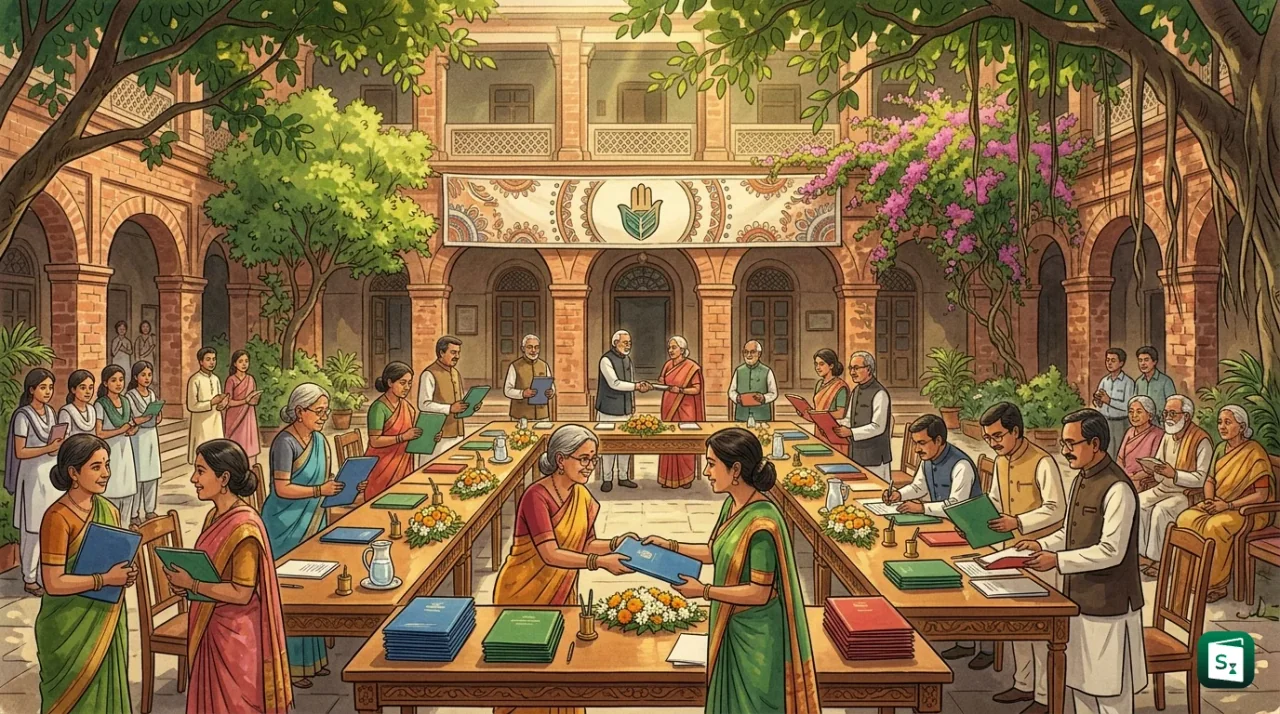
The National Institute of Social Defence exchanged 23 Memoranda of Understanding with universities and institutions from across India at its Dwarka campus in New Delhi on 21 November 2026. Union Minister of Social Justice and Empowerment Dr Virendra Kumar attended the ceremony along with Ministry Secretary Sudhansh Pant. With these agreements, the institutional partnerships of NISD rose from 7 to 30 to expand training and research in drug prevention, senior citizen care, transgender welfare and beggary prevention.
What Is Social Defence and What Does NISD Do?
Social defence refers to the full set of government policies and programmes that protect society from social harm and help vulnerable people live with dignity. The National Institute of Social Defence (NISD) is the nodal training and research institute in this field. NISD works under the Ministry of Social Justice and Empowerment and is headquartered at Plot No. G-2, Sector-10, Dwarka, in New Delhi.
NISD was first set up in 1961 as the Central Bureau of Correctional Services under the Ministry of Home Affairs. The Bureau moved to the then Department of Social Security in 1964 and functioned as a subordinate office under the social justice ministry from 1975. NISD became an autonomous body on 15 July 2002 and is registered under the Societies Registration Act, 1860 with the Government of NCT of Delhi.
The mandate of NISD is to support the social defence programmes of the central government through training, research and documentation. The institute reviews policies, builds preventive and rehabilitative models, advises central and state governments, and serves as a link between governments, universities, voluntary organisations and international agencies.
NISD focuses on four main areas today. These are prevention of substance abuse, care of older persons, welfare of transgender persons, and prevention of beggary. Its work is organised through three main divisions, the National Centre for Drug Abuse Prevention (NCDAP) set up in 1998, the Old Age Care Division, and the Social Defence Division.
What the 23 New MoUs Cover
NISD organised the MoU exchange ceremony at its Dwarka campus on 21 November 2026. NISD Director Gaurav Singh Rajawat hosted the event in the presence of Dr Virendra Kumar, Joint Secretary Sandeep Rewaji Rathod and Secretary Sudhansh Pant. Out of the 23 partners, 15 institutions joined the ceremony in person and 8 institutions joined online.
The scope of the MoUs covers five types of joint work. These are prevention education, research, training and capacity building, curriculum development, and outreach and advocacy. The partnerships will support institutional collaboration, knowledge exchange, training opportunities and development of effective interventions.
The subject areas under the MoUs are drug abuse prevention, welfare of senior citizens, transgender welfare, and prevention of beggary. These four areas match the core programmes of the Department of Social Justice and Empowerment.
Drug abuse prevention links to the National Action Plan for Drug Demand Reduction (NAPDDR), in force from 1 April 2018. NAPDDR funds preventive education, treatment centres such as Integrated Rehabilitation Centres for Addicts (IRCAs), Community Based Peer Led Intervention (CPLI) units, Outreach and Drop In Centres (ODICs) and District De-addiction Centres (DDACs). Its community campaign, the Nasha Mukt Bharat Abhiyaan, started on 15 August 2020 in 272 vulnerable districts and now covers all districts. The national drug helpline 14446 also operates under this plan.
Senior citizen welfare links to the Maintenance and Welfare of Parents and Senior Citizens Act, 2007 and the Atal Vayo Abhyuday Yojana. Transgender welfare links to the Transgender Persons (Protection of Rights) Act, 2019 and the SMILE umbrella scheme for transgender persons and persons engaged in begging, launched on 12 February 2022. SMILE funds scholarships, skill training, composite medical care, Garima Greh shelter homes and the National Portal for Transgender Persons launched on 25 November 2020.
Which Universities and Institutions Signed the MoUs
The 23 partners include central universities, state and private universities, law universities, rural development institutes and medical and training bodies. The mix shows that NISD wants both classroom teaching strength and field training reach.
| Type | Institutions |
|---|---|
| Rural and local governance training institutes | State Institute of Rural Development, Ranchi in Jharkhand; State Institute of Rural Development, Meghalaya; State Institute of Rural Development, Manipur; Telangana Institute of Rural Development in Telangana; Andhra Pradesh State Institute of Panchayat Raj and Rural Development; Kerala Institute of Local Administration in Kerala; Administrative Training Centre of the Indian Institute of Public Administration in Puducherry |
| Central and general universities | Central University of Andhra Pradesh; Central University of Karnataka; Babasaheb Bhimrao Ambedkar University, Lucknow; Dr Manmohan Singh Bengaluru City University, Karnataka; Jamia Millia Islamia, New Delhi; Aligarh Muslim University, Uttar Pradesh; Mahatma Gandhi Central University, Bihar; CHRIST University, Bengaluru; Yenepoya Deemed to be University, Karnataka |
| Law and skill universities | National Law University, Jodhpur; Maharashtra National Law University, Chhatrapati Sambhajinagar; Maharashtra National Law University, Nagpur; Chanakya National Law University, Patna; Shri Vishwakarma Skill University, Haryana |
| Specialised bodies | AIIMS Jodhpur in Rajasthan; Indian Adult Education Association, New Delhi |
Before this ceremony, NISD had MoUs with only 7 institutions. The new additions take the total network to 30 institutional partnerships across states.
Why Colleges and Rural Institutes Matter for Social Defence
Dr Virendra Kumar said partnerships with universities, rural development institutes and reputed institutions can strengthen training, capacity building, rehabilitation, livelihood support and social inclusion. He said the goal is to help persons affected by substance use, transgender persons, senior citizens and persons vulnerable to beggary lead dignified and self-reliant lives.
Sudhansh Pant underlined the role of educational institutions in preventing drug abuse among young people. He asked partner institutions to hold regular anti-drug awareness activities and pledges, so students carry the message of prevention from campuses to families, peers and communities. He also stressed regular coordination, monitoring and joint short-term training programmes within campuses.
The choice of partners reflects this plan. Universities and colleges give direct access to youth, who are the main focus of prevention education under NAPDDR. Rural development and panchayat institutes train panchayat functionaries, field workers and local officials who identify elderly persons in need, connect beggars to shelters and link transgender persons to welfare boards and protection cells.
At the ceremony, the Minister administered the Senior Citizen Pledge and the Anti Drug Pledge to the participants. The pledges call for respect, dignity, health care and welfare of senior citizens, along with treatment and rehabilitation of persons affected by substance use. The Ministry said the expanded network will create a steady system for training, awareness, research and evidence-based action in social defence.
Key Takeaways
- NISD exchanged 23 MoUs on 21 November 2026 at its Dwarka campus, taking its institutional partnerships from 7 to 30.
- NISD is an autonomous body under the Ministry of Social Justice and Empowerment, first set up in 1961 and granted autonomy on 15 July 2002.
- The MoUs cover prevention education, research, training, curriculum development and outreach in drug prevention, senior citizen care, transgender welfare and beggary prevention.
- The partners include Jamia Millia Islamia, Aligarh Muslim University, AIIMS Jodhpur, central universities and rural development institutes from Jharkhand, Meghalaya, Manipur, Telangana, Kerala and other states.
- The drug prevention work links to NAPDDR and the Nasha Mukt Bharat Abhiyaan launched on 15 August 2020, while transgender work links to the Transgender Persons Act, 2019 and the SMILE scheme.