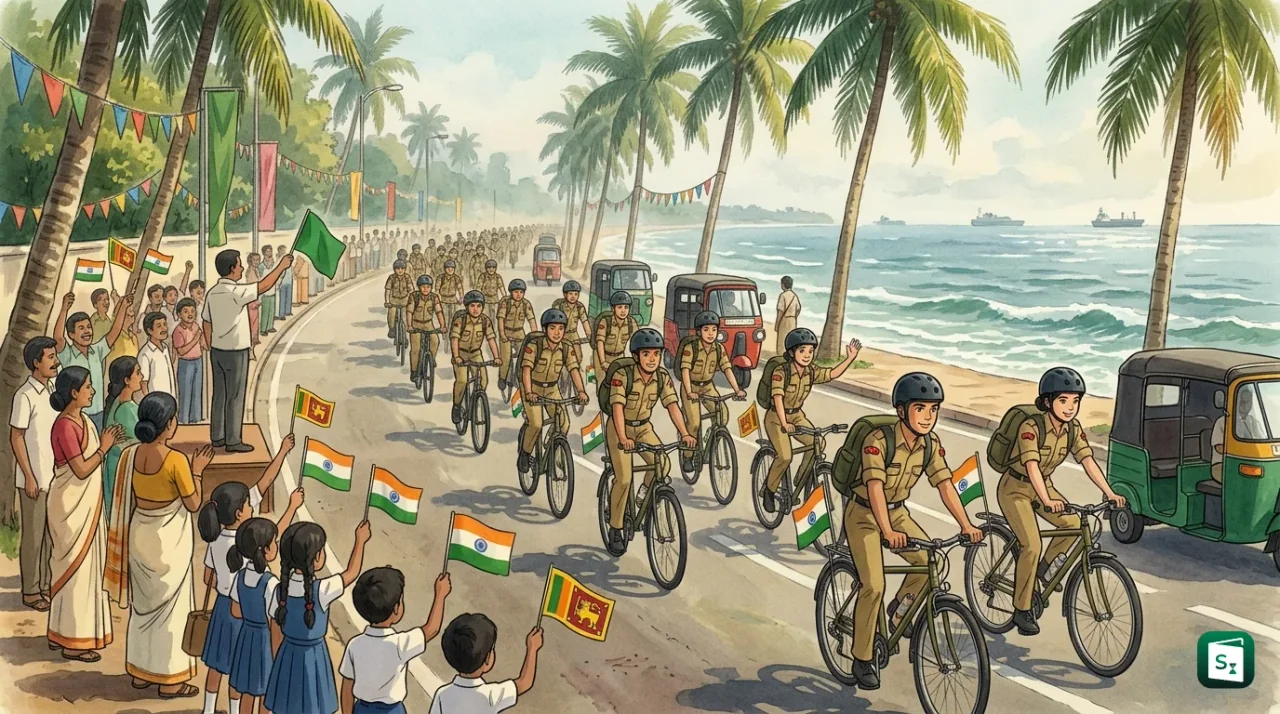
The Maitri Setu Yatra 2027 was flagged off on 15 November 2026 from Galle Face Green in Colombo. The 75 day India Sri Lanka National Cadet Corps (NCC) cycling expedition will carry 24 Indian and Sri Lankan cadets over 3,500 km to New Delhi. The team will conclude the journey in January 2027 at the NCC Prime Minister’s Rally in the national capital.
What Is the Maitri Setu Yatra 2027?
The Maitri Setu Yatra 2027 is the first international cycling expedition organised by the National Cadet Corps (NCC) of India together with the National Cadet Corps of Sri Lanka. The expedition brings together 24 cyclists, including 14 Indian and 10 Sri Lankan NCC personnel, for a 75 day journey that links Colombo with New Delhi. The name means bridge of friendship, and the organisers present the ride as a moving message of peace, friendship and cooperation between the two neighbours.
The Sri Lankan phase was flagged off on 15 November 2026 at Galle Face Green in Colombo. India’s High Commissioner to Sri Lanka Santosh Jha and Sri Lanka’s Minister of Youth Affairs and Sports Sunil Kumara Gamage attended the ceremony. Sri Lanka’s Defence Secretary Sampath Thuyacontha, Director General NCC India Lieutenant General Virendra Vats and Director NCC Sri Lanka Major General A.K.C.S. De Silva were also present.
Before the flag off, the combined team completed joint training at Vallikavu near Karunagappally in Kollam, Kerala, from 1 to 13 November 2026. An 11 member Sri Lankan delegation joined the 14 Indian cadet cyclists and a 10 member Indian technical team at the camp. The NCC Directorate for Kerala and Lakshadweep, working with NCC Group Headquarters Kollam, directed the training, logistics and operational control for this phase.
How the 3,500 km Colombo to New Delhi Route Will Unfold
The Maitri Setu Yatra covers about 3,500 km in 75 days. The Sri Lankan leg covers nearly 500 km from Colombo through historic centres such as Anuradhapura and Jaffna. Anuradhapura was a centre of ancient Buddhist learning, while Jaffna anchors the cultural life of northern Sri Lanka.
The contingent will then cross by sea to India for the longer Indian leg of about 3,000 km. The Indian route passes through 11 states and Union Territories before reaching New Delhi. The exact state wise halt list will be released by the NCC during the course of the ride.
| Leg | Distance | Key Points |
|---|---|---|
| Colombo to northern Sri Lanka | About 500 km | Colombo, Anuradhapura, Jaffna, then sea crossing to India |
| India sea landing to New Delhi | About 3,000 km | 11 states and Union Territories, ending in New Delhi |
| Finale | January 2027 | Flag in at the NCC Prime Minister’s Rally |
The expedition will end with a formal flag in at the NCC Prime Minister’s Rally in New Delhi in January 2027. The rally is held at the Cariappa Parade Ground in Delhi Cantonment. It marks the close of the month long NCC Republic Day Camp, which is held from 1 to 29 January each year and brings together more than 2,000 cadets from across India along with youth contingents from over 20 friendly countries.
What Is the National Cadet Corps?
The National Cadet Corps (NCC) is a youth organisation that gives school and college students basic military training, drill and lessons in leadership, service and citizenship. Cadets wear a uniform and train with the Army, Navy and Air Force wings, but they carry no liability for active military service. Both India and Sri Lanka maintain a separate National Cadet Corps under their own laws.
NCC of India
The NCC of India came into existence on 16 July 1948 under the NCC Act XXXI of 1948. The NCC traces its roots to the University Corps created under the Indian Defence Act of 1917, which became the University Training Corps in 1920 and the University Officers Training Corps in 1942. A committee led by Pandit H. N. Kunzru, set up in 1946, recommended a national cadet body, and Prime Minister Jawaharlal Nehru raised the first NCC unit in Delhi in November 1948.
The NCC functions under the Ministry of Defence with headquarters in New Delhi. The corps is headed by a Director General of the rank of Lieutenant General. It is a Tri Services body with Army, Naval and Air wings. The Girls Division started in 1949, the Air Wing in 1950 and the Naval Wing in 1952.
The motto of the Indian NCC is Unity and Discipline. The motto was discussed at the 11th Central Advisory Committee meeting on 11 August 1978 and finally adopted on 12 October 1980. The present aims, laid down in 1988, focus on character, comradeship, discipline, secular outlook, spirit of adventure and selfless service, and on creating trained youth leaders for all walks of life, including the Armed Forces.
NCC training was made compulsory in 1963 after the 1962 war with China and made voluntary again in 1968. During the wars of 1965 and 1971, NCC cadets served as a second line of defence by helping ordnance factories, assisting in rescue and traffic control, and joining patrol duties. Today the Indian NCC has grown from 14 lakh to about 20 lakh cadets, which makes it among the largest uniformed youth bodies in the world. NCC Day is observed on the fourth Sunday of November each year.
NCC of Sri Lanka
The NCC of Sri Lanka began in 1881 at Royal College in Colombo, where Principal John B. Cull formed a cadet platoon to build discipline through drill. The platoon grew into the Cadet Battalion of the Ceylon Light Infantry, then the Ceylon Cadet Corps in 1950 and the Sri Lanka Cadet Corps in 1972. In 1988, the government merged the corps with the Police Cadet Corps under the Mobilisation and Supplementary Forces Act No. 40 of 1985 to create the present National Cadet Corps.
The Sri Lankan NCC works directly under the Ministry of Defence, with headquarters in Colombo and a main training centre at Rantambe, opened in 1990. The corps covers schools across the island through more than 30 battalions, including the 20th Battalion in Jaffna, and trains about 85,000 cadets with over 3,000 officers. Like the Indian NCC, the Sri Lankan corps stresses leadership, discipline and service to the nation.
What Is Maitri Setu and Which River Does It Cross?
The word Maitri Setu means bridge of friendship. The cycling expedition uses this name as a symbol of friendship, but it should not be confused with the physical bridge of the same name on the India Bangladesh border.
The Maitri Setu bridge is a 1.9 km road bridge over the Feni River. The bridge links Sabroom in Tripura, India, with Ramgarh in Bangladesh. Prime Minister Narendra Modi and Bangladesh Prime Minister Sheikh Hasina inaugurated the bridge on 9 March 2021 through video conferencing.
| Fact | Detail |
|---|---|
| River | Feni River, a 116 km trans boundary river that rises in South Tripura, flows through Sabroom and enters Bangladesh before meeting the Bay of Bengal |
| Length | 1.9 km including approaches, with a 150 metre main span of pre stressed concrete |
| Builder and cost | Built under a project cost of ₹133 crore and maintained by the National Highways and Infrastructure Development Corporation Limited (NHIDCL), which was set up in 2014 under the Ministry of Road Transport and Highways |
| Purpose | Gives landlocked Northeast India road access to Chattogram Port, only about 80 km from Sabroom, and cuts the Agartala to Kolkata route via Bangladesh to about 450 km compared with about 1,600 km through the Siliguri Corridor |
The Yatra does not ride over this bridge. The Yatra borrows the idea of a friendship bridge to describe people to people ties between India and Sri Lanka across the Palk Strait.
Why the Yatra Matters for India Sri Lanka Defence Cooperation
The India Sri Lanka relationship is more than 2,500 years old and rests on shared Buddhist heritage, ancient trade routes and close people to people contact. Sri Lanka holds a central place in India’s Neighbourhood First policy and the Security and Growth for All in the Region (SAGAR) vision. Defence ties form a strong pillar of this partnership, and the Yatra adds a youth and training link to the existing military link.
India remains the largest provider of foreign training assistance to the Sri Lankan Armed Forces. The two militaries hold an annual Defence Dialogue between Defence Secretaries and conduct regular staff talks and ship visits. Two annual bilateral drills anchor field cooperation. SLINEX is the bilateral naval exercise between the Indian Navy and the Sri Lanka Navy. Mitra Shakti is the bilateral army exercise between India and Sri Lanka.
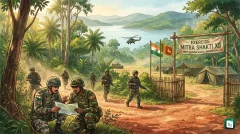
Mitra Shakti started in 2012 and is held alternately in the two countries. The 12th edition, Mitra Shakti 2026, ran from 13 to 26 November 2026 at the Army Training School at Maduru Oya in Sri Lanka. The Indian contingent of about 170 personnel came mainly from the Rajputana Rifles, with support from other arms and the Indian Air Force. The drill focused on counter terrorism operations by a battalion combat team in a semi urban setting under a United Nations mandate, including road block operations, urban patrolling, convoy protection and area ambush.
The Yatra complements this hard security cooperation with soft contact. It gives young cadets shared experience in endurance, navigation, first aid, teamwork and public interaction across languages and cultures. The route choice through Anuradhapura and Jaffna connects the riders to Buddhist sites and to the northern province, where wider participation in national youth bodies supports reconciliation and integration. When the riders enter New Delhi for the Prime Minister’s Rally, the expedition will place India Sri Lanka friendship before a national audience of cadets, officers and foreign youth delegations.
Key Takeaways
- The Maitri Setu Yatra 2027 was flagged off on 15 November 2026 from Galle Face Green in Colombo.
- The Yatra is the first international cycling expedition by the NCC of India and covers 3,500 km in 75 days from Colombo to New Delhi.
- The team includes 24 cyclists, with 14 Indian and 10 Sri Lankan NCC personnel, and will end at the NCC Prime Minister’s Rally in New Delhi in January 2027.
- The NCC of India was raised on 16 July 1948 under the NCC Act, has headquarters in New Delhi, and follows the motto Unity and Discipline.
- The physical Maitri Setu bridge stands over the Feni River and links Sabroom in Tripura with Ramgarh in Bangladesh, while Mitra Shakti is the annual army exercise between India and Sri Lanka.