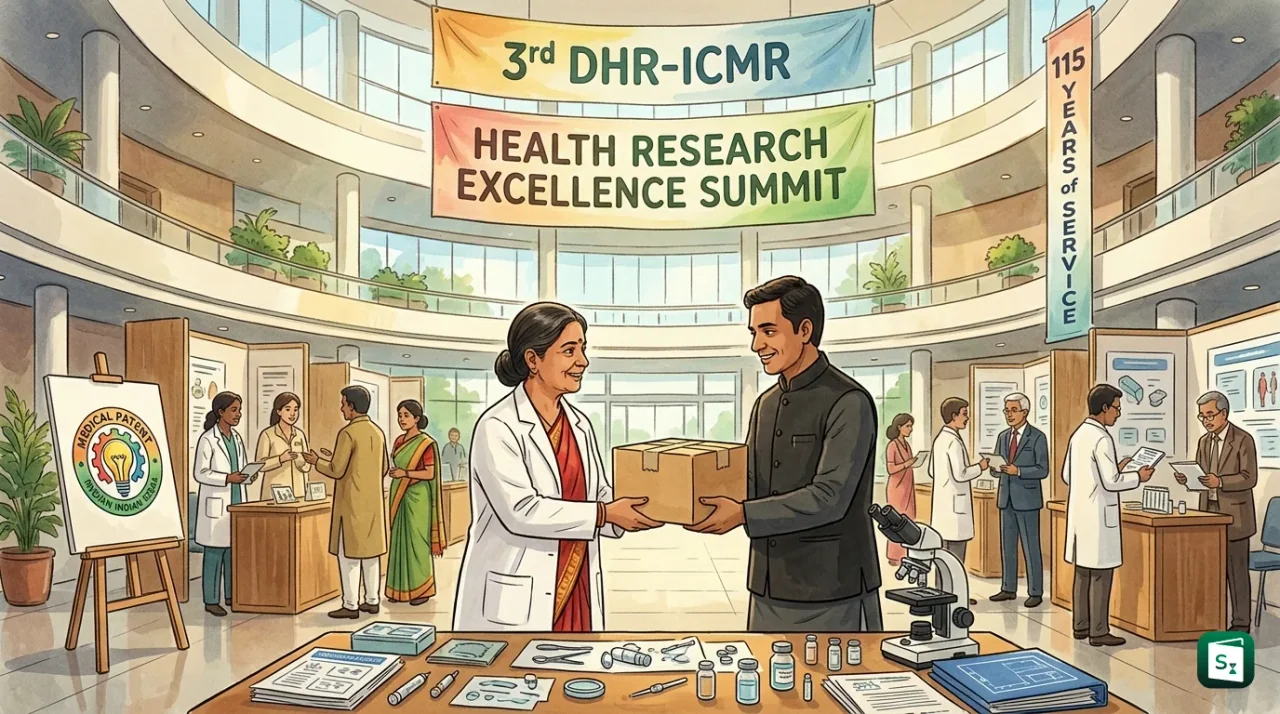
The Department of Health Research and the Indian Council of Medical Research organised the 3rd Health Research Excellence Summit on 16 and 17 November 2026 at Bharat Mandapam in New Delhi. The event marked 115 years of ICMR service and brought together more than 600 scientists, researchers and policymakers. ICMR announced 100 technology transfer deals and three new initiatives to link research with public health action.
What Is ICMR?
The Indian Council of Medical Research (ICMR) is the apex body in India for the formulation, coordination and promotion of biomedical research. ICMR is headquartered in New Delhi and functions under the Department of Health Research (DHR) of the Ministry of Health and Family Welfare. The Director General of ICMR also serves as the Secretary of DHR, a post currently held by Dr Rajiv Bahl.
ICMR was set up in 1911 as the Indian Research Fund Association (IRFA) by the then British Government of India. Sir Harcourt Butler established the association on 15 November 1911 to fund and coordinate medical research. After Independence, IRFA was renamed as ICMR in 1949 with a wider mandate. This history makes ICMR one of the oldest medical research bodies in the world, now completing 115 years of service.
Today ICMR works through a network of 28 national institutes and regional centres across India. These include the National Institute of Nutrition (NIN) in Hyderabad, the National Institute of Virology (NIV) in Pune and the National Institute of Malaria Research (NIMR) in New Delhi. ICMR supports both intramural research at its own institutes and extramural research at medical colleges, universities and other institutions. It also publishes the Indian Journal of Medical Research (IJMR), which started in 1913, and maintains the Clinical Trials Registry of India (CTRI) for registration of clinical trials.
3rd Health Research Excellence Summit at Bharat Mandapam
The Department of Health Research and ICMR organised the 3rd Health Research Excellence Summit on 16 and 17 November 2026 at Bharat Mandapam in New Delhi. Bharat Mandapam, located at Pragati Maidan, is India’s large international convention centre for summits and expos. The two day summit brought together more than 600 scientists, researchers, innovators, administrators and policymakers from ICMR institutes, partner institutions, government bodies and academia.
The summit is a national platform to recognise excellence in health research and to turn scientific evidence into practical results. It showcased contributions from ICMR institutes and extramural partners in research publications, technologies, patents and research management. A dedicated track discussed research administration and finance, including grant management, procurement and financial processes.
The 2026 edition had special significance. It marked 115 years of ICMR service to the nation. It also included a special session to mark the Golden Jubilee of ICMR NIMR, which completed 50 years of work on malaria research and control.
ICMR Crosses 100 Technology Transfers Under Patent Mitra
At the summit, ICMR announced that it had completed 100 successful technology transfer deals. At the Technology Transfer Ceremony, ICMR exchanged 20 licensing agreements covering 8 technologies with 9 Indian companies. These 20 deals took the total tally to 100.
This milestone was reached in less than two years under the Medical Innovations Patent Mitra initiative. Union Health and Family Welfare Minister J P Nadda launched Patent Mitra in March 2025 during the International Symposium on Health Technology Assessment. The initiative was developed with guidance from NITI Aayog, in partnership with the Department of Pharmaceuticals and with support from the Department for Promotion of Industry and Internal Trade (DPIIT).
An Innovation Exhibition at the summit showcased 17 indigenous health technologies developed by ICMR institutes and extramural partners. A separate session on Technologies and Patents presented 10 technologies and 8 patents, showing the range of work in diagnostics, devices, vaccines and other areas.
What Is Technology Transfer and How Does ICMR License It?
Technology transfer means a research body gives a company the legal right to make and sell a product developed in a laboratory. In the case of ICMR, this can be a diagnostic kit, a device, a vaccine process or another medical tool. The company gets a tested product, while the research reaches patients and the health system.
The Medical Innovations Patent Mitra platform gives end to end help for this process. It supports patentability assessment, filing of patents in India, prosecution and maintenance of patents, and transfer of technologies to industry. The service is fully funded by the government and runs through an online portal. It is open to ICMR institutes, ICMR extramural grantees, medical colleges, DPIIT recognised startups and institution led biomedical innovators.
Under ICMR rules, technologies are usually licensed on a non exclusive basis so that more than one company can produce them and public access remains wide. Any technology proposed for licensing must have a patent filing and independent validation. Companies applying for a licence must be incorporated in India with majority Indian ownership and must have manufacturing capacity as per good manufacturing practices. When a product is commercialised, ICMR receives royalty at 2 percent of net sales for 10 years from the start of commercial sales.
Three New Initiatives Launched at the Summit
DHR and ICMR launched three new initiatives at the summit to strengthen policy use of research, disease surveillance and research training. The table below gives a quick view before the details.
| Initiative | Nodal framework | What it will do |
|---|---|---|
| Research to Action Vertical | Department of Health Research | Turn research evidence into decision ready products for policy and programmes |
| Syndromic Surveillance | Virus Research and Diagnostic Laboratories (VRDL) scheme | Create an early warning network for outbreaks across 70 VRDLs and Infectious Disease Research and Diagnostic Laboratories (IRDLs) |
| Dr M K Bhan Young Medical Faculty PhD Portal | DHR human resource scheme for health research | Give centralised online information to prospective PhD applicants |
DHR Research to Action Vertical
The Research to Action Vertical is a new DHR unit to close the gap between studies and decisions. It will convert clinical, laboratory and field findings into short, decision ready products such as policy briefs, guidelines and programme inputs. The aim is to help central and state health programmes use Indian evidence faster.
Syndromic Surveillance Across 70 Laboratories
Syndromic surveillance tracks groups of symptoms before a final laboratory diagnosis is confirmed. For example, a sudden rise in high fever with rash or in severe respiratory illness in one district can trigger an alert even while samples are still being tested. This helps health teams judge the size, spread and speed of a possible outbreak days or weeks earlier.
Under the DHR Virus Research and Diagnostic Laboratories scheme, the new network will link 70 VRDLs and IRDLs. VRDLs study viral infections, while IRDLs cover a wider set of infectious diseases. The network will use real time or near real time health data for rapid analysis and feedback for epidemiological investigation.
ICMR has also listed priority pathogens for four major syndromes to guide this work. These are acute febrile illness, acute encephalitis syndrome, acute respiratory illness and acute diarrhoeal disease. The lists were prepared after 44 meetings with clinicians, laboratory experts and epidemiologists, along with a review of Indian and global studies. Pathogens are graded from Priority 1A, which covers common pathogens that must be tested before treatment starts, to Priority 3, which covers rare pathogens detected only during specialised surveillance. The lists will guide doctors, laboratories and policymakers, and will also help Indian companies design low cost and locally suited tests and tools.
Dr M K Bhan Young Medical Faculty PhD Portal
The Dr M K Bhan Young Medical Faculty PhD Portal is a centralised digital platform for doctors and faculty who want to pursue doctoral research. It gives information on eligibility, partner centres, the application process and research support in one place.
The portal supports the DHR scheme for medical PhD training. The scheme has two tracks. The Medical PhD Programme is for MBBS and BDS graduates and postgraduates such as MD, MS, DM, MCh, DNB and MDS holders. The Young Medical Faculty PhD Programme is for regular faculty in recognised medical and dental colleges, research universities and institutes of national importance. The upper age limit for both tracks is 45 years. Selected faculty can register for PhD at a recognised university or under the Academy of Scientific and Innovative Research ICMR Faculty of Medical Research, and can receive research support of up to ₹50 lakh spread over five years. The portal is named after the late Dr M K Bhan, a noted paediatrician and scientist known for work on child health, vaccines and biotechnology.
Other Highlights on Research Quality and Young Talent
ICMR released the Antimicrobial Resistance (AMR) Annual Report with standard operating procedures at the summit. Antimicrobial resistance means disease causing microbes stop responding to medicines such as antibiotics. The report brings together national evidence on resistance levels and sets uniform laboratory methods for testing.
ICMR also released a compendium with 25 stories of research translated into outcomes for people. The Research Excellence Showcase featured shortlisted publications, while the Innovation Excellence Showcase featured shortlisted technologies and patents. Researchers and institutions were honoured across nine categories for publications, technologies, patents and institutional performance.
The summit recognised the top 100 school students selected through the SHINE National Competition. SHINE stands for Science and Health Innovation for the NextGen Explorers. It is a nationwide ICMR initiative for students in Grades 9 to 12 from government, aided and private schools. It aims to build scientific temper and encourage careers in biomedical and health research.
Key Takeaways
- The 3rd DHR ICMR Health Research Excellence Summit was held on 16 and 17 November 2026 at Bharat Mandapam, New Delhi with more than 600 participants.
- ICMR crossed 100 technology transfer deals, including 20 licensing agreements for 8 technologies with 9 Indian companies.
- The milestone was achieved in less than two years under the Medical Innovations Patent Mitra initiative launched in March 2025.
- The new Syndromic Surveillance network will link 70 VRDLs and IRDLs for early warning of outbreaks.
- ICMR was set up in 1911 as IRFA, renamed in 1949, is headquartered in New Delhi and works under the Department of Health Research.