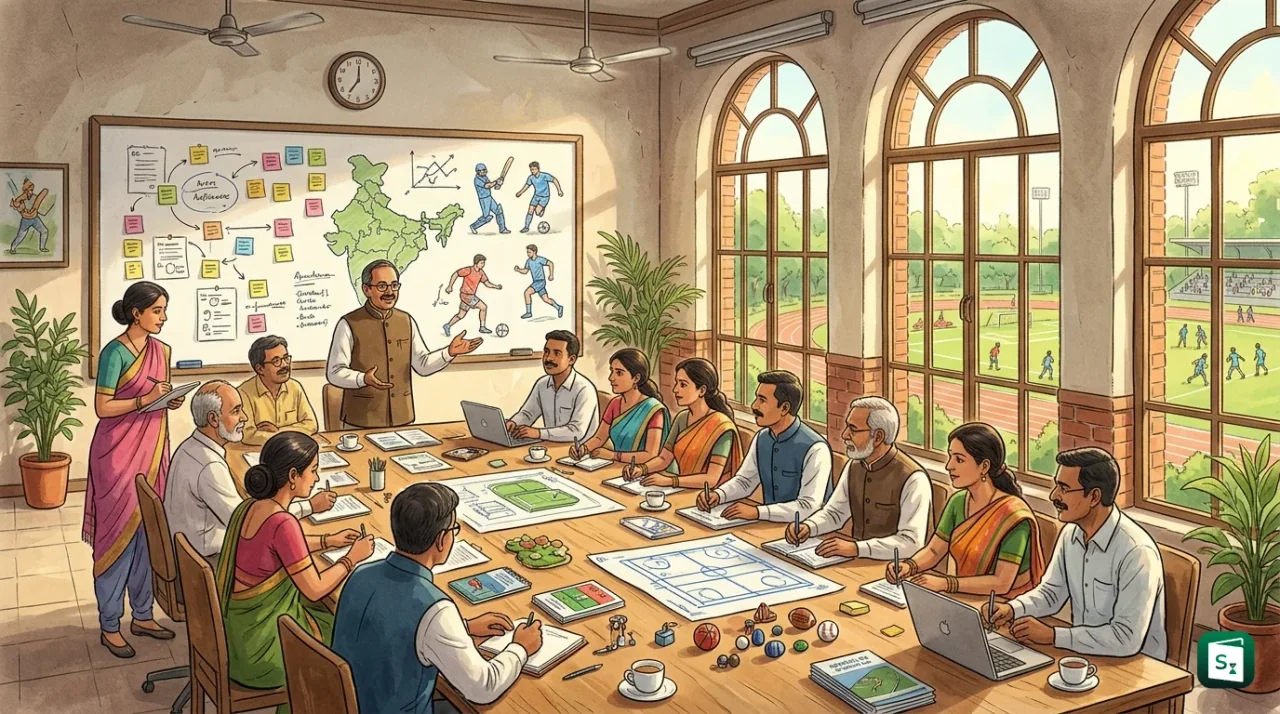
The Ministry of Youth Affairs and Sports constituted a 14 member committee on 18 November 2026 to design a professionally managed and financially sustainable ecosystem for sports leagues in India. The committee is led by convener Kunal, Joint Secretary for Governance. Its report, due within eight weeks, will guide how Olympic sports, women’s sport, youth sport and indigenous games get viable league structures.
What Is the New 14 Member Committee on Sports Leagues?
The 14 member committee is a task force set up by the Department of Sports under the Ministry of Youth Affairs and Sports to write a full plan for league based sport in India. A sports league is a structured competition in which city or region based franchise teams play each other on a fixed calendar, sell media and sponsorship rights, and share income with teams and players. The committee will study why many Indian leagues struggle to survive and will suggest practical models to make them regular, well governed and financially stable.
The move fits the vision of Khelo Bharat Niti and Viksit Bharat 2047. Khelo Bharat Niti is the common name for the National Sports Policy 2025, which replaced the National Sports Policy 2001 and aims to make India a global sporting power by the 2036 Olympic Games bid cycle and beyond. The Ministry argues that strong leagues will give athletes regular high quality matches, help spot talent early, bring private money into sport, and create jobs in management, broadcasting, technology, events and related services. The Ministry is headed by Union Minister Mansukh Mandaviya, with Minister of State Raksha Khadse, and it works through two departments for youth affairs and sports.
Who Are the Members of the Sports League Committee?
The Ministry named Kunal, Joint Secretary for Governance in the Department of Sports, as convener of the committee. The panel blends government officials with leaders from franchises, broadcasters and sport administration. This mix is deliberate. Officials bring policy and public funding tools. Industry members bring experience in running teams, selling rights and filling stadiums.
| Role in Committee | Name and Organisation |
|---|---|
| Convener | Kunal, Joint Secretary (Governance), Department of Sports |
| Member | Vineel Krishna, Joint Secretary (Khelo India) |
| Member | Raghuram Iyer, Chief Executive Officer, Indian Olympic Association (IOA) |
| Member | B Srinivasan, Reliance Industries |
| Member | Hemang Amin, Chief Operating Officer of the Indian Premier League (IPL), Board of Control for Cricket in India (BCCI) |
| Member | P K S V Sagar, GMR Sports |
| Member | Sanjay Adesara, Adani Sportsline |
| Member | Divyanshu Singh, JSW Sports |
| Member | Ishan Chatterjee, JioHotstar |
| Member | Rajesh Kaul, Sony Pictures |
| Member | Anupam Swaroop, DD Sports |
| Member | Parag Darade, Zee Entertainment |
| Member | Abhijit Bhattacharya, BVL |
| Member | Advocate Nandan Kamath, sports law expert |
The Indian Olympic Association, founded in 1927 and based at Olympic Bhawan in New Delhi, is the national body for the Olympic movement in India. Its chief executive Raghuram Iyer thus links the committee to National Sports Federations, the sport wise bodies that select national teams and set competition rules. The committee can consult these federations along with existing league operators, investors and sports technology firms. It will meet in physical, online or hybrid mode and submit final recommendations within eight weeks of its formation.
Why Do Many Indian Leagues Struggle to Survive?
The Ministry notes that several leagues have found success, but many disciplines face commercial problems in the early years. A new league needs large spending on player salaries, venues, travel, production and marketing long before ticket sales and sponsorships cover costs. If broadcast income falls or a title sponsor leaves, franchises bleed cash and owners walk away.
Recent experience shows the risk. The Pro Kabaddi League, launched in 2014, took nearly a decade to break even and posted only a small profit of about ₹2 crore in 2022 to 23. Its five season media rights deal worth about ₹905 crore ended after season 12 in October 2025, and reports in November 2026 said the next season may slip to June to July 2027 for want of a new broadcaster. The Hockey India League stopped for seven years for financial reasons, returned in a shorter format, and then saw three franchises pull out before the 2026 season. The Indian Super League, India’s top men’s football league launched in 2014, has faced delays over commercial rights and scheduling, while most clubs continue to report losses.
The table below places these leagues against the model they chase.
| League | Started | Organiser | Scale and Status |
|---|---|---|---|
| Indian Premier League | 2008 | Board of Control for Cricket in India | Ten city teams. Media rights for 2023 to 2027 sold for about ₹48,391 crore. Valued at more than $10 billion. Profitable benchmark. |
| Pro Kabaddi League | 2014 | Mashal Sports, backed by Star India, now JioStar | Twelve teams. Cumulative reach of 245 million viewers in season 10. Awaiting fresh broadcast deal. |
| Indian Super League | 2014 | Football Sports Development, with All India Football Federation | Longest running national football league. Strong pockets of support but clubs face cash stress. Future commercial model under discussion. |
| Hockey India League | First run 2013 to 2017, revived 2024 to 25 | Hockey India | Men’s and women’s editions. Low cost restart with single venues and salary caps. Still financially fragile. |
The Indian Premier League works because cricket already had deep grassroots networks, large stadiums and assured television demand when the league began in 2008. Most other sports started leagues without that base. The committee must therefore fix the base first and not copy the IPL playbook blindly.
What Will the Committee Examine on Funding and Governance?
The Ministry has asked the committee to study the full money chain of leagues. That includes the cost of starting a league, the revenue from tickets, sponsorship, media rights and merchandise, and the gap that keeps new leagues in loss in the first few seasons. For priority areas such as Olympic sports, women’s sport, youth sport, indigenous games and emerging sports, the panel will match each sport with an operating model that suits its fan base and earning power.
On public support, the committee will test tools such as Viability Gap Funding (VGF), direct and indirect financial help, and cheaper access to government stadiums. VGF is a one time capital grant paid by the government to make a socially useful but commercially weak project viable for private investors. It is normally given under public private partnership rules through open bidding and is capped as a share of project cost. The idea here is to help a hockey or kabaddi league survive the early loss making years without permanent subsidy.
To draw private money, the panel will suggest ways to attract franchise owners, sponsors and broadcasters. It will look at sale of broadcasting and digital rights, central sponsorship pools shared with teams, and Corporate Social Responsibility (CSR) funds. CSR refers to the legal duty of large companies in India to spend a share of profits on social causes, and sport development counts in defined cases. The committee will also propose rules for financial transparency, timely player payments, athlete welfare, anti doping education, clean officiating and protection of integrity. Its final output will be a phased plan that sets who does what and by when, drawing on global practices without copying them wholesale.
How Will Leagues Link With Schools, Colleges and Local Clubs?
The Ministry wants leagues to feed talent upward instead of sitting on top as stand alone shows. The committee will propose ways to connect professional leagues with schools, colleges, universities and local clubs. The goal is regular playing time for young athletes, especially girls and women, and a clear path from district matches to state trials to national leagues.
This task connects directly with the Khelo India competition ladder. Khelo India, which means Let Us Play India, is the national programme for development of sports launched in the financial year 2016 to 17. It aims to combine mass participation with excellence at the top. Its annual events include the Khelo India Youth Games, first held as School Games in New Delhi in 2018, the Khelo India University Games from 2020, the Khelo India Winter Games from 2020, the Khelo India Para Games from 2023, and newer formats such as beach games and tribal games. More than 50,000 athletes have taken part across 17 editions of these games up to 2025.
The Sports Authority of India (SAI) runs much of this system on the ground. SAI was set up in 1984 after the Ninth Asian Games in New Delhi in 1982 to promote sport and build excellence. It is registered as a society and functions from the Jawaharlal Nehru Stadium in New Delhi. It maintains major Delhi stadiums, runs regional centres across India, trains elite athletes and implements schemes such as Khelo India, assistance to federations and the Target Olympic Podium Scheme. Under Khelo India guidelines for 2026 to 27 to 2030 to 31, new formats such as school leagues, university leagues and regional or sport specific leagues will create weekly competition and feed data on talent into training centres. Women focused ASMITA leagues will expand playing chances for girls. The new committee is expected to align professional league calendars with this school to university pipeline so that scouting, rankings and selection stay joined up.
What Is the Policy Backdrop for the League Push?
The National Sports Policy 2025, approved by the Union Cabinet on 1 July 2025, provides the policy base for the committee. The policy replaces the 2001 policy and sets the goal of making India a global sporting power and a strong contender at international events including the 2036 Olympic Games bid. It rests on clear aims such as excellence on the world stage, use of sport for economic growth, use of sport for social inclusion, making sport a people’s movement, and linking sport with education under the National Education Policy 2020.
The policy calls for more competitive leagues and competitions, better rural and urban infrastructure, stronger governance of federations, use of sports science and data, and private funding through public private partnerships and CSR. Khelo India is its main delivery arm for participation and talent. The scheme was revamped with an outlay of ₹1,756 crore for 2017 to 18 to 2019 to 20 and extended with ₹3,790.50 crore for 2021 to 22 to 2025 to 26. About ₹2,358 crore has been earmarked over five years to strengthen flagship events, thematic events and structured league pathways. The new league framework is thus the next step in turning policy words on league culture into funded, governed competitions.
Key Takeaways
- The Ministry of Youth Affairs and Sports set up a 14 member committee on 18 November 2026 for sports leagues in India.
- Convener Kunal, Joint Secretary for Governance, leads the panel that must submit its report within eight weeks.
- The committee will test Viability Gap Funding, cheaper access to government stadiums and CSR backed finance for new leagues.
- Khelo India, launched in 2016 to 17, runs annual Youth, University, Para and Winter Games with over 50,000 athletes covered so far.
- The National Sports Policy 2025 was approved on 1 July 2025 and replaced the 2001 policy to target excellence by the 2036 Olympic Games cycle.
- The Sports Authority of India was set up in 1984 and the Indian Olympic Association was founded in 1927 to anchor elite training and Olympic movement governance.