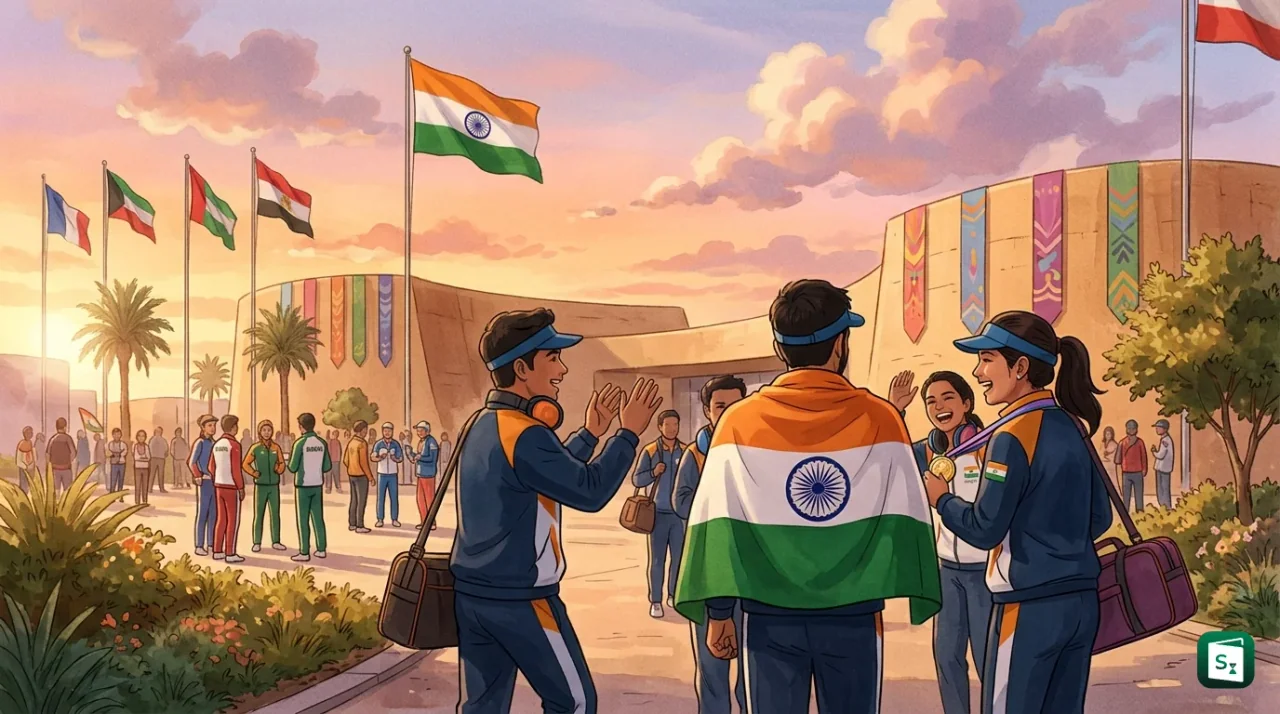
India finished third on the medal table at the 55th ISSF World Championship Rifle/Pistol/Shotgun in Doha with 13 medals, including two gold, seven silver and four bronze. The championship was held from 1 to 14 November 2026 at the Lusail Shooting Complex in Doha, Qatar, with more than 1,000 shooters from 91 countries. India also secured three quota places for the Los Angeles 2028 Olympics, making Doha its best start to an Olympic shooting cycle in recent years.
What Is the ISSF and Its World Championship?
The International Shooting Sport Federation (ISSF) is the world governing body for shooting events at the Olympic Games. The ISSF was founded in 1907 and is headquartered in Munich, Germany. It also regulates several non Olympic shooting events and organises the World Championship, World Cup and other international competitions.
The ISSF currently governs five groups of disciplines. These are pistol, rifle, shotgun, running target and target sprint. At the Olympics, only rifle, pistol and shotgun events are held. Rifle and pistol shooters aim at stationary targets indoors from distances of 10 metres, 25 metres and 50 metres. Shotgun shooters compete outdoors and shoot flying clay targets with a 12 gauge shotgun.
The Doha meet was the 55th edition of the ISSF World Championship Rifle/Pistol/Shotgun. It was held from 1 to 14 November 2026 at the Lusail Shooting Complex in Doha, Qatar. The championship brought together 1,041 athletes from 91 countries representing 99 member federations. A total of 123 medals were awarded across 41 events, with 41 gold, 41 silver and 41 bronze. The Doha championship was also the first qualification event for the Los Angeles 2028 Olympics, with 36 quota places on offer, three in each of the 12 individual Olympic events.
How the Medal Table Finished in Doha
China topped the medal table in Doha with 27 medals, including 13 gold, six silver and eight bronze. Italy finished second with eight medals, including three gold, one silver and four bronze. India finished third with 13 medals, including two gold, seven silver and four bronze.
The Republic of Korea finished fourth with 10 medals, including two gold, five silver and three bronze. Czechia was fifth with eight medals, including two gold, two silver and four bronze. In total, 41 nations reached the medal table and 23 nations won at least one gold medal.
| Rank | Country | Gold | Silver | Bronze | Total |
|---|---|---|---|---|---|
| 1 | China | 13 | 6 | 8 | 27 |
| 2 | Italy | 3 | 1 | 4 | 8 |
| 3 | India | 2 | 7 | 4 | 13 |
| 4 | Korea | 2 | 5 | 3 | 10 |
| 5 | Czechia | 2 | 2 | 4 | 8 |
Where Did India’s 13 Medals Come From?
India won two gold, seven silver and four bronze in Doha. Both gold medals came in team events. The men’s 50m pistol team of Ravinder Singh, Saurabh Chaudhary and Amanpreet Singh won the first gold. The women’s 25m pistol team of Esha Singh, Manu Bhaker and Divya Thadigol Subbaraju won the second gold with a combined score of 1761-68x, ahead of Korea and Vietnam. Esha scored 590-25x, Manu scored 587-24x and Divya scored 584-19x.
Seven of India’s medals came in team competitions, which are not part of the Olympic programme. Three more medals came in individual non Olympic events such as 50m pistol and 25m standard pistol. Only three medals came in individual Olympic events, and all three also carried LA28 quota places.
| Event | Medal | Indian Shooters |
|---|---|---|
| Men’s 50m pistol team | Gold | Ravinder Singh, Saurabh Chaudhary, Amanpreet Singh |
| Women’s 25m pistol team | Gold | Esha Singh, Manu Bhaker, Divya Thadigol Subbaraju |
| Men’s 10m air pistol individual | Silver | Jaypal Malviya |
| Men’s trap individual | Silver | Vivaan Kapoor |
| Men’s 50m pistol individual | Silver | Ravinder Singh |
| Women’s 10m air rifle team | Silver | Elavenil Valarivan, Sonam Maskar, Shambhavi Kshirsagar |
| Women’s 10m air pistol team | Silver | Manu Bhaker, Suruchi Inder Singh, Sainyam |
| Women’s 25m standard pistol team | Silver | Niveditha Veloor Nair, Manvi Jain, Simranpreet Kaur Brar |
| Men’s 25m centre fire pistol individual | Silver | Ankur Goel |
| Men’s 50m rifle 3 positions individual | Bronze | Niraj Kumar |
| Women’s 25m standard pistol individual | Bronze | Niveditha Veloor Nair |
| Men’s 50m rifle 3 positions team | Bronze | Aishwary Pratap Singh Tomar, Akhil Sheoran, Niraj Kumar |
| Men’s 25m centre fire pistol team | Bronze | Ankur Goel, Amanpreet Singh, Rajkanwar Singh Sandhu |
How India Secured Three LA28 Quota Places
India secured three quota places for the Los Angeles 2028 Olympics (LA28) in Doha. All three came in men’s events and all three came with individual medals. Jaypal Malviya won silver in the men’s 10m air pistol on 5 November. He finished behind Hu Kai of China. Niraj Kumar won bronze in the men’s 50m rifle 3 positions on 11 November with 346.5 points. Dmitrii Pimenov, competing as an Individual Neutral Athlete, won gold with a junior world record of 362.8, while Patrik Jany of Slovakia won silver. Vivaan Kapoor won silver in the men’s trap on 12 November. He finished level with Abdulrahman Alfaihan of Kuwait on 29 hits in the final and lost the shoot off 3 to 2.
An Olympic quota place belongs to the country, not to the shooter who wins it. The place is allotted to the National Olympic Committee, which in India’s case acts through the National Rifle Association of India (NRAI). The NRAI was founded on 17 April 1951 by G. V. Mavlankar, the first Speaker of the Lok Sabha, and is headquartered in New Delhi. It selects the final Olympic shooting team through domestic trials. Winning a quota does not guarantee that the same shooter will compete at the Olympics.
Doha offered 36 quota places, three in each of the 12 individual Olympic events. China won seven quotas, while India and Korea won three each. The full LA28 shooting qualification period runs from 31 July 2026 to 1 May 2028. In total, 316 individual quota places will be decided through ISSF and continental competitions. Twelve host country places and 12 universality places will take the total shooting field at LA28 to 340 athletes. To use a quota, a shooter must also achieve the Minimum Qualification Score set by the ISSF.
What Is Trap Shooting and How Does It Differ From Skeet?
Trap and skeet are the two Olympic shotgun events. In both events, shooters fire at clay targets that fly at more than 100 kilometres per hour. Each target counts as a hit or a miss. There are no points rings like in rifle and pistol.
Trap shooting means shooting at clays thrown away from the shooter. The machines are hidden in a trench 15 metres in front of five shooting stations. Targets fly out at different angles and heights. Shooters move through all five stations. In qualification, shooters aim at 125 targets over two days. In the final, the top six shooters compete over 50 targets.
Skeet shooting means shooting at clays that cross in front of the shooter. The clays come from two houses at the ends of a semicircular field. The high house on the left throws targets from left to right. The low house on the right throws targets from right to left. Shooters move around eight stations and shoot singles and doubles. Qualification also has 125 targets, while the final has 60 targets.
| Feature | Trap | Skeet |
|---|---|---|
| Direction of targets | Away from the shooter | Across in front of the shooter |
| Throwing machines | 15 machines in a trench in front | Two houses on left and right ends |
| Shooting stations | 5 stations in a line | 8 stations in a semicircle |
| Qualification | 125 targets | 125 targets |
| Olympic status | Men, women and mixed team at LA28 | Men and women at LA28 |
India’s quota in Doha came in men’s trap through Vivaan Kapoor, who is related to trap and skeet as a shotgun specialist. No Indian skeet shooter reached the podium in Doha.
What Is 10m Air Pistol Shooting?
The 10m air pistol is an Olympic precision shooting event governed by ISSF rules. Shooters use a 4.5 mm air pistol, also called .177 calibre, and fire from a standing position at a distance of 10 metres. The pistol must be held and fired with one hand only, without support. The target is 17 cm by 17 cm, with the inner ten ring only 11.5 mm wide.
In qualification, each shooter fires 60 shots in 75 minutes. The top eight shooters enter the final. The final has 24 shots in elimination format. Qualification uses whole number scoring up to 10 points per shot. The final uses decimal scoring up to 10.9 points per shot. Most top events now use electronic targets that show scores instantly.
India’s first LA28 quota in Doha came in this event through Jaypal Malviya’s silver in men’s 10m air pistol. In the women’s 10m air pistol, Manu Bhaker finished fifth and Suruchi Inder Singh finished sixth, so India did not win a quota in that event. Manu Bhaker, born on 18 February 2002 in Haryana, is a double bronze medallist from the Paris 2024 Olympics in 10m air pistol individual and mixed team. Esha Singh, born on 1 January 2005 in Hyderabad, led India’s gold winning women’s 25m pistol team in Doha. The men’s 50m rifle 3 positions, where Niraj Kumar won bronze and a quota, is a different rifle event in which shooters fire a .22 calibre rifle from kneeling, prone and standing positions.
Key Takeaways
- The 55th ISSF World Championship Rifle/Pistol/Shotgun was held from 1 to 14 November 2026 at the Lusail Shooting Complex in Doha.
- India finished third with 13 medals (2 gold, 7 silver and 4 bronze), behind China with 27 medals and Italy in second place.
- India’s two golds came from the men’s 50m pistol team and the women’s 25m pistol team of Esha Singh, Manu Bhaker and Divya Thadigol Subbaraju (1761-68x).
- India won three LA28 quota places through Jaypal Malviya (10m air pistol silver), Niraj Kumar (50m rifle 3 positions bronze) and Vivaan Kapoor (trap silver).
- The International Shooting Sport Federation (ISSF) was founded in 1907 and is headquartered in Munich, Germany.