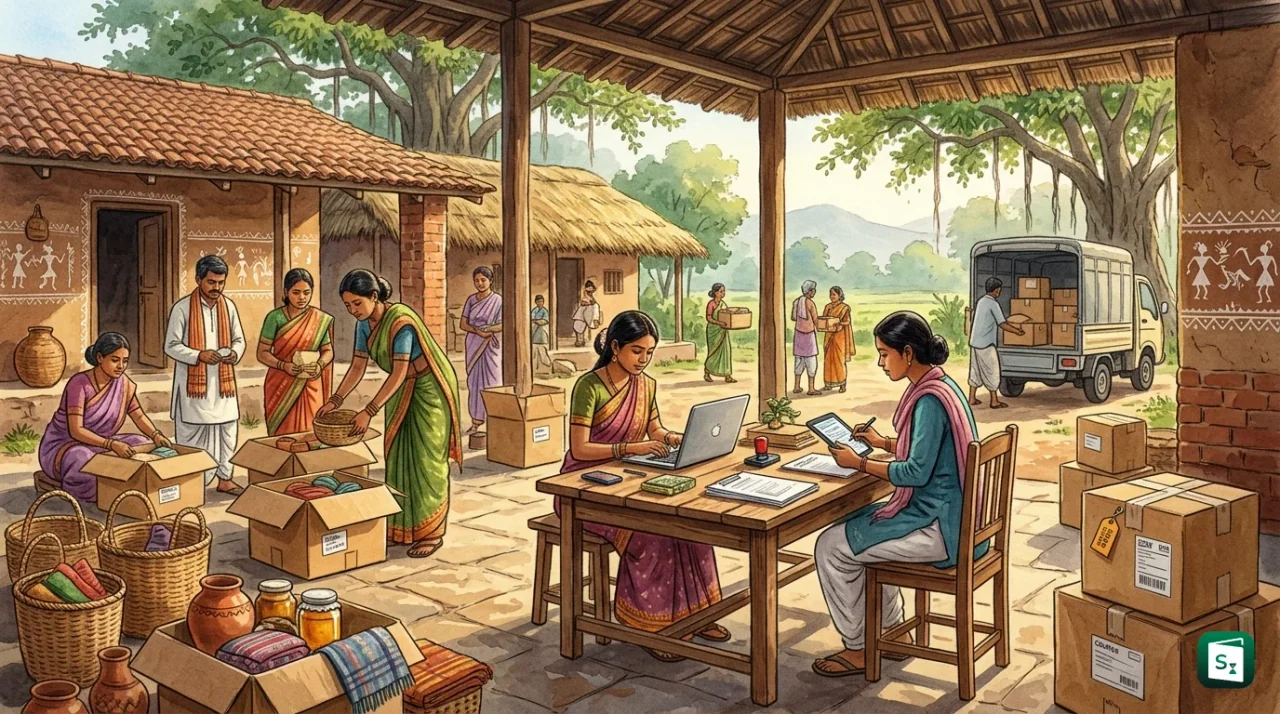
The Government e Marketplace signed a Memorandum of Understanding with the Tribal Indian Chamber of Commerce and Industry on 20 November 2026 to expand access for tribal entrepreneurs to public procurement. The agreement was signed by GeM Additional CEO Ajit B. Chavan and TICCI Founder and Chairman Sudhakar Dharavath. It aims to bring more tribal enterprises onto the GeM portal through outreach, training, onboarding help and continuous handholding.
What Is the Government e Marketplace (GeM Portal)?
The Government e Marketplace, usually called the GeM portal, is the national online platform where central and state government departments buy goods and services from registered sellers. GeM stands for Government e Marketplace. The portal was launched on 9 August 2016 by the Ministry of Commerce and Industry to make public buying transparent, paperless and contactless.
The GeM portal is owned and run by the GeM Special Purpose Vehicle (GeM SPV). GeM SPV is a 100 percent government owned, non profit company registered under Section 8 of the Companies Act, 2013. The company was incorporated on 17 May 2017 and functions under the Department of Commerce. The current Chief Executive Officer of GeM is Mihir Kumar, an officer of the Indian Defence Accounts Service who took charge in April 2025.
GeM serves more than 1.37 lakh buyer organisations, including ministries, departments, public sector undertakings, autonomous bodies, local bodies, panchayats and cooperatives. By August 2026, GeM had crossed ₹20 lakh crore in cumulative Gross Merchandise Value through over 3.78 crore orders. The seller base had grown from 3,339 sellers in 2016 to 25.45 lakh sellers, with buying spread across more than 10,900 product categories and about 350 service categories.
| GeM Fact | Detail |
|---|---|
| Full form | Government e Marketplace |
| Launched on | 9 August 2016 |
| Nodal ministry | Ministry of Commerce and Industry |
| Operating company | GeM SPV, incorporated 17 May 2017 |
| Current CEO | Mihir Kumar |
| Portal address | gem.gov.in |
What Did the GeM TICCI MoU Agree On?
The GeM TICCI Memorandum of Understanding was signed on 20 November 2026 in New Delhi. GeM Additional CEO Ajit B. Chavan signed for GeM. TICCI Founder and Chairman Sudhakar Dharavath signed for TICCI. GeM CEO Mihir Kumar said the partnership would raise awareness among tribal entrepreneurs, build their skills and deepen their inclusion in transparent public procurement.
Under the MoU, TICCI will identify and mobilise tribal entrepreneurs across regions. It will organise regional and national outreach programmes. It will provide field level support and build a network of trainers and mentors. GeM will supply training resources and help sellers complete registration and product listing. GeM will also support capacity building and a system to resolve problems faced on the portal.
| Partner | Agreed Role |
|---|---|
| TICCI | Identify tribal entrepreneurs, run outreach, give field support, create trainer and mentor network |
| GeM | Provide learning material, assist onboarding, run capacity building, address seller issues |
| Joint work | Prepare action plans, track progress, collect entrepreneur feedback to improve participation |
Both sides will jointly prepare action plans and review progress at intervals. Feedback from tribal sellers will be used to adjust training and support. The MoU does not fix a public target for the number of sellers or a timeline for completion. Its stated aim is steady improvement in onboarding and active bidding by tribal enterprises.
Who Is TICCI and Whom Does It Represent?
The Tribal Indian Chamber of Commerce and Industry (TICCI) is a non government, non profit industry body for tribal businesses. TICCI was established in 2012 by Sudhakar Dharavath and describes itself as India’s largest tribal business network. It works as a voice for tribal industry with policymakers and supports members from small firms to large companies.
TICCI focuses on first generation tribal entrepreneurs who face gaps in capital, skills and market links. It offers mentorship, skill development programmes and help in preparing business plans. It connects members with buyers, suppliers and investors at district, state and national levels. It also helps members approach banks, financial institutions and government credit schemes for loans and working capital.
The chamber also pushes for policy changes that shift support from welfare handouts to enterprise growth. State chapters, such as the Maharashtra chapter set up in 2018, run buyer seller meets and vendor development efforts with bodies like the National Small Industries Corporation and state industry centres. TICCI encourages tribal youth to build ventures around food, crafts, handlooms, art and forest based products, so traditional knowledge adds value in modern markets.
How GeM Buying Works and What Support MSEs Receive
GeM buying follows Rule 149 of the General Financial Rules, 2017. The rule directs central ministries and departments to procure common goods and services through GeM. The system records every stage online, from listing and bidding to order, delivery and payment. This record keeps competition open and reduces face to face discretion.
Government buyers use different modes based on order value and need. Direct purchase suits low value needs. Comparison based L1 purchase suits mid value needs. Electronic bidding and reverse auction suit high value or complex needs and help discover the lowest workable price.
| GeM Buying Mode | Purpose in Brief |
|---|---|
| Direct purchase | Buyer selects a listed product that meets quality and delivery terms for small value orders |
| L1 purchase | Buyer compares offers from at least three makers and selects the lowest priced compliant offer |
| e Bid and reverse auction | Sellers compete online for large orders and prices fall through open bidding |
| Forward auction | Government disposes scrap or surplus goods through competitive online auction |
| Custom and BoQ bids | Buyers define special items or item wise quantity schedules for works and projects |
The Public Procurement Policy for Micro and Small Enterprises Order, 2012 shapes GeM demand for small firms. The policy was notified under the Micro, Small and Medium Enterprises Development Act, 2006 and became mandatory from 1 April 2015. Central ministries, departments and central public sector enterprises must source at least 25 percent of yearly procurement from micro and small enterprises. Within that goal, 4 percent is earmarked for enterprises owned by Scheduled Caste and Scheduled Tribe entrepreneurs and 3 percent for enterprises owned by women.
On GeM, micro and small sellers receive specific support linked to this policy. Validated MSE sellers get exemption from earnest money deposit when they offer their own manufactured goods or core services. Buyers can relax prior turnover and past experience conditions for MSEs where the policy allows. A price band facility also lets eligible MSEs within L1 plus 15 percent match the lowest price and share part of the order. Traders alone do not qualify for these MSE benefits.
Why Tribal Participation Matters for Inclusive Procurement
Tribal enterprises form a small share of formal suppliers despite a large presence in handicrafts, handlooms, forest produce, food processing and light manufacturing. Distance from cities, limited digital access and weak credit history often keep them out of tenders. A chamber led outreach model can bridge this gap because local mentors speak the language of first time sellers and follow up after training ends.
Recent GeM data shows why inclusion efforts carry weight. In 2025-26, GeM facilitated orders worth ₹5.03 lakh crore and cumulative orders since launch reached ₹18.4 lakh crore by March 2026. Micro and small enterprises executed 68 percent of orders in 2025-26 and accounted for 47.1 percent of order value. More than 11 lakh MSEs won orders worth ₹2.36 lakh crore in that year.
Orders to enterprises owned by Scheduled Caste and Scheduled Tribe entrepreneurs crossed ₹6,000 crore in 2025-26, a rise of nearly 28 percent over the previous year. Women led MSEs won orders above ₹28,000 crore, also up about 28 percent. Startups secured orders above ₹19,000 crore, up more than 36 percent. State buying on GeM grew 38.3 percent, which widens the market for district based tribal suppliers that serve state departments and local bodies.
Key Takeaways
- GeM signed an MoU with TICCI on 20 November 2026 to expand tribal entrepreneur participation in government procurement.
- The MoU was signed by GeM Additional CEO Ajit B. Chavan and TICCI Founder and Chairman Sudhakar Dharavath.
- The GeM portal, launched on 9 August 2016 under the Ministry of Commerce and Industry, is run by GeM SPV.
- The MSE Procurement Policy of 2012 requires 25 percent central procurement from MSEs, including 4 percent from SC and ST owned MSEs.
- SC and ST owned enterprises received GeM orders worth over ₹6,000 crore in 2025-26, up nearly 28 percent.