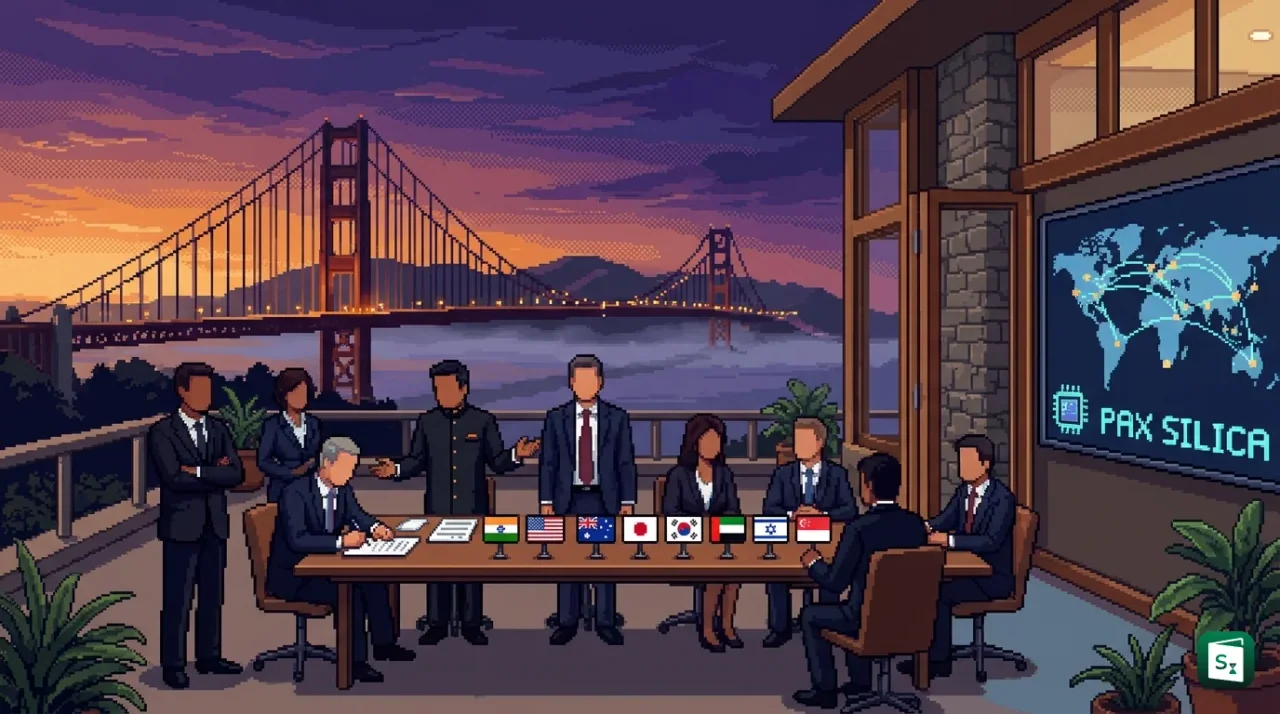
India signed the San Francisco Declaration on the Secure Foundations of Enduring Prosperity on 15 November 2026 at the Pax Silica Founders Retreat in San Francisco. The Pax Silica initiative is a United States led coalition to secure supply chains for artificial intelligence, semiconductors, critical minerals and related infrastructure. India joined nine other governments in declaring that economic security is fundamental to national security and that protecting these supply chains is a shared endeavour.
What Is Pax Silica?
Pax Silica is a United States led strategic initiative to build secure, resilient and innovation driven supply chains for the technologies that support artificial intelligence (AI). The United States Department of State launched the initiative in December 2025 and held its first Pax Silica Summit in Washington on 12 December 2025. The name combines the Latin word pax, meaning peace and stability, with silica, the compound refined into silicon used in computer chips.
The initiative focuses on the full physical stack behind AI. This includes critical minerals, energy inputs, advanced manufacturing, semiconductors, compute infrastructure, data centres, logistics and communications networks. It does not regulate AI models themselves. It secures the materials, factories, energy and transport systems needed to build and run them.
Pax Silica works as a political and economic security partnership, not a trade agreement. Membership is by invitation from the United States. Washington selects countries that are broadly aligned on economic security and that make a material contribution to AI supply chains, such as chip design, fabrication, mining and refining, logistics hubs or energy capacity.
| Milestone | Date | Detail |
|---|---|---|
| Launch and first Pax Silica Summit | 12 December 2025 | Seven countries signed the Pax Silica Declaration in Washington: the United States, Australia, Japan, South Korea, Singapore, Israel and the United Kingdom |
| Second Pax Silica Summit | June 2026 | Membership widened to more than 20 signatories including European and Latin American partners |
| India joins Pax Silica | 20 February 2026 | India signed the Pax Silica Declaration on the margins of the India AI Impact Summit in New Delhi |
| Pax Silica Founders Retreat | 15 November 2026 | Ten founding participants signed the San Francisco Declaration in San Francisco |
What Does the San Francisco Declaration Say?
The San Francisco Declaration on the Secure Foundations of Enduring Prosperity sets out a common understanding among the ten participants about what must be protected to keep AI supply chains secure. The United States Department of State released the text on 15 November 2026 after the Founders Retreat convened by Jacob Helberg, the United States Under Secretary of State for Economic Affairs. The declaration states that the security of people cannot be separated from the security of economies and trusted supply chains.
The text defines two foundations for Super Intelligence supply chains. Super Intelligence is the term used in the declaration for large scale AI systems, and a footnote notes that for some participants the term simply means artificial intelligence.
First, sensitive technologies include goods, software, materials, knowledge, components and production equipment essential to AI supply chains. These are items whose theft, illegal transfer or acquisition by hostile actors would give military or intelligence advantage, create unfair economic leverage, or pose serious risks to national security.
Second, critical infrastructure includes the physical and digital systems that support those supply chains. This covers ports, terminals, transport and logistics networks, information and communications technology systems, energy infrastructure and the digital platforms that manage them. Disruption, hostile control or unauthorised exposure of data flowing through these systems would cause serious harm to economic function and essential services.
The declaration affirms that safeguarding these technologies and infrastructure is a shared endeavour and that the security of each participant is strengthened by the vigilance of all. It also calls for coordinated action against economic coercion, supply chain disruptions and non-market policies and practices that distort competition through overcapacity and unfair dumping, while protecting private investment and fair competition.
Five Working Groups to Turn Principles Into Practice
The San Francisco Declaration resolves to set up working groups to carry common purpose into common practice. The United States Department of State announced five proposed groups. Participants reviewed what these groups could deliver over the next six months, but the declaration announced no funds, timelines or binding enforcement rules.
| Working Group | Focus Area |
|---|---|
| Pro-innovation policy frameworks | Regulations that support AI innovation, investment and entrepreneurship |
| Super Intelligence adoption in key sectors | Use of AI in industry, science, public services and other priority sectors |
| Supply chain cooperation across the Super Intelligence stack | Joint work on semiconductors, critical minerals, compute, energy and logistics |
| Safe harbours and supply chain security hubs | Trusted locations and arrangements for secure production, storage and movement of sensitive inputs |
| Super Intelligence security and resilience | Protection of technologies and infrastructure from theft, disruption and hostile control |
The groups are meant to identify weak points, share information, align investment screening and support joint projects and co-investment. The emphasis is on reducing excessive dependence on single sources, building trusted capability across participants and keeping markets open among partners.
Which Countries Signed the San Francisco Declaration?
The San Francisco Declaration was signed by ten governments at the Founders Retreat in San Francisco. The Indian delegation was led by S Krishnan, Secretary of the Ministry of Electronics and Information Technology (MeitY), the nodal ministry for digital and electronics policy in India.
| Signatory | Region |
|---|---|
| United States of America | North America |
| India | South Asia |
| Australia | Oceania |
| Israel | West Asia |
| Japan | East Asia |
| Republic of Korea | East Asia |
| Qatar | West Asia |
| Singapore | Southeast Asia |
| United Arab Emirates | West Asia |
| United Kingdom | Europe |
These ten are the founding participants who attended the retreat. The wider Pax Silica Declaration itself had grown to 26 signatories by late 2026, including the European Union, Germany, the Netherlands, Finland, Sweden, Norway, Italy, Greece, the Philippines, Kazakhstan, Argentina, Chile, Costa Rica, Panama, El Salvador and Paraguay. Taiwan has endorsed the principles through a separate joint statement with the United States. The San Francisco text was signed only by the ten retreat participants, not by the full wider group.
Why India Joined Pax Silica
India formally joined Pax Silica on 20 February 2026 on the margins of the India AI Impact Summit held in New Delhi from 16 to 20 February 2026. The documents were signed by S Krishnan, United States Ambassador to India Sergio Gor and Jacob Helberg in the presence of Electronics and Information Technology Minister Ashwini Vaishnaw. India also signed a bilateral addendum with the United States called the Joint Statement on the India-United States AI Opportunity Partnership.
The United States described India as a strategic and essential addition because of its large engineering talent pool, critical mineral processing potential, expanding AI infrastructure and growing semiconductor design base. The partnership links to two earlier frameworks. The first is the Initiative on Critical and Emerging Technology launched in 2023. The second is the Transforming the Relationship Utilizing Strategic Technology initiative, known as TRUST, outlined by the leaders of the two countries to deepen cooperation in strategic technology.
For India, membership supports domestic priorities in semiconductors, critical minerals and AI compute. In semiconductors, the India Semiconductor Mission, launched in 2021, supports fabrication, packaging and design, and the Union Budget 2026-27 announced Mission 2.0 with a provision of ₹1,000 crore for equipment, materials, design intellectual property and workforce training. In critical minerals, the National Critical Mineral Mission covers exploration, mining, processing, recycling and overseas acquisition, and the government has cited lithium resources in Jammu and Kashmir, rare earth corridors in Odisha and Kerala, and incentives for recycling and magnet manufacturing. In AI compute, the IndiaAI Mission supports sovereign compute capacity, data centre expansion and access to processors for startups and researchers.
Pax Silica does not by itself create factories or remove import dependence. India still imports a large share of semiconductors, chipmaking equipment and rare earths. The value for India lies in access to trusted supply chains, joint research, investment flows and technology partnerships with firms and governments across the coalition.
How the Declaration Strengthens AI and Semiconductor Supply Chains
An AI system depends on a long chain that crosses many countries. A chip may be designed in one country, built with equipment from another, packaged in a third and installed in a data centre in a fourth. Minerals such as lithium, cobalt, gallium and rare earths must be mined, refined and processed before they enter factories. Energy, fibre optic cables, ports and logistics hold the chain together.
This spread creates two risks. A disruption at one point can halt production elsewhere. Heavy dependence on a single supplier can also create pressure and allow coercion. Pax Silica responds with a supply side strategy. Instead of acting only as buyers, members plan to coordinate as producers, investors and technology holders across the full stack from mines to models.
For India, diversified sourcing can lower the risk of shortages in chips, minerals and equipment, while joint ventures and co-investment can help India move from raw material supply and chip design into refining, fabrication and packaging. Pro-innovation rules and venture capital flows can also help startups test and scale AI products faster. The test for the San Francisco Declaration will be whether the five working groups produce shared protection lists, aligned investment screening and concrete projects.
Key Takeaways
- The San Francisco Declaration was signed on 15 November 2026 at the Pax Silica Founders Retreat in San Francisco by ten governments.
- Pax Silica is a United States led initiative launched in December 2025 to secure AI, semiconductor, critical mineral, energy and logistics supply chains.
- India joined Pax Silica on 20 February 2026 at the India AI Impact Summit in New Delhi, with S Krishnan signing for India.
- The declaration defines sensitive technologies and critical infrastructure as the two foundations that must be protected as a shared endeavour.
- The ten signatories agreed to set up five working groups on innovation policy, AI adoption, supply chain cooperation, safe harbours and security resilience.