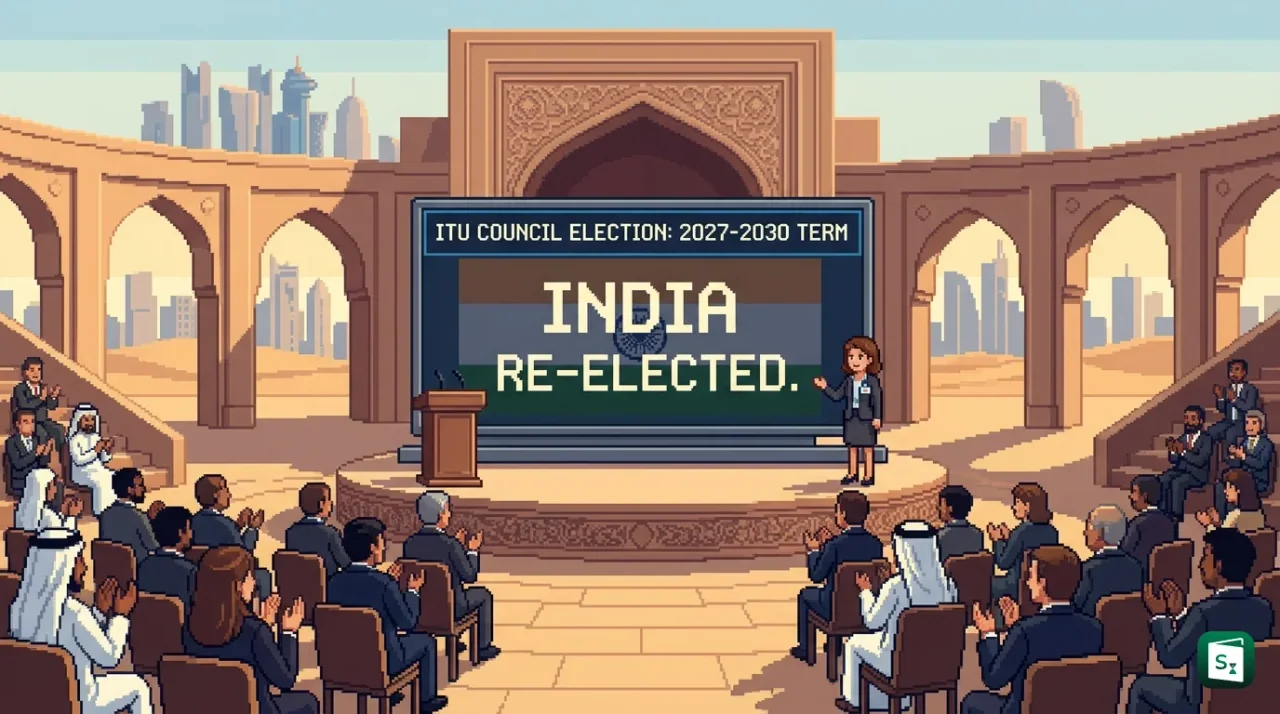
India was re-elected to the Council of the International Telecommunication Union for the 2027-2030 term on 16 November 2026 at the Plenipotentiary Conference in Doha, Qatar. India secured 151 votes in the Asia and Australasia group, finishing third among 15 candidates competing for 13 seats. The result keeps India in the 48-member governing body that shapes global rules on spectrum, satellites and telecom standards.
What Is the International Telecommunication Union?
The International Telecommunication Union (ITU) is the United Nations specialised agency for information and communication technologies. It sets global rules for radio spectrum and satellite orbits, develops technical standards that let networks connect across borders, and supports digital access in developing countries. Its membership includes 194 Member States along with more than 1,000 companies, universities and international organisations.
ITU is the oldest agency in the UN family. It was founded in Paris on 17 May 1865 as the International Telegraph Union to manage the first international telegraph networks. It took the present name International Telecommunication Union in 1932 and became a UN specialised agency in 1947. The date 17 May is now observed as World Telecommunication and Information Society Day.
The headquarters of ITU is located at Geneva in Switzerland. The headquarters was first set up in Berne and was moved to Geneva in 1948. ITU also works through regional and area offices on every continent. In March 2022, India signed a Host Country Agreement with ITU for an Area Office in New Delhi, housed at the Centre for Development of Telematics building at Mehrauli. The office serves India, Nepal, Bhutan, Bangladesh, Sri Lanka, Maldives, Afghanistan and Iran.
The full form of ITU is International Telecommunication Union. ITU stands for the same name in short, and it is sometimes described as the International Telecommunication Organisation in general use. Its core work covers allocation of radio frequency bands, registration of frequency assignments and orbital positions to avoid harmful interference, worldwide standardisation of telecom services with satisfactory quality, and technical assistance to developing countries.
What Is the ITU Council?
The ITU Council is the governing body of ITU that acts on behalf of the Plenipotentiary Conference in the four years between conferences. It oversees ITU activities, policies and strategies, supervises the management of the Union, approves the biennial budget, and prepares draft strategic and financial plans for the next conference.
The Council has 48 Member States, which is one fourth of the total ITU membership. Members are elected by the Plenipotentiary Conference with due regard to equitable geographical distribution across five administrative regions. There is no limit on the number of candidates or on the number of terms a country can serve. The Council meets every year in Geneva in an ordinary session of about nine days, and it can hold an extraordinary session in an emergency.
Seats are divided region wise as shown below.
| Region | Area covered | Seats |
|---|---|---|
| Region A | The Americas | 9 |
| Region B | Western Europe | 8 |
| Region C | Eastern Europe and Northern Asia | 5 |
| Region D | Africa | 13 |
| Region E | Asia and Australasia | 13 |
The Council works through working groups and expert groups on specific issues set by the conference or the Council itself. It also prepares reports on policy and strategic planning, coordinates work programmes, controls finances and expenditure, and supports the implementation of the ITU Constitution, the ITU Convention and the Radio Regulations.
What Are the Three ITU Sectors?
The three ITU sectors are Radiocommunication, Telecommunication Standardization and Telecommunication Development. They are known as ITU-R, ITU-T and ITU-D. Each sector works through study groups, assemblies or conferences, advisory groups and a specialised Bureau headed by an elected Director.
ITU-R, or the Radiocommunication Sector, manages the global radio frequency spectrum and satellite orbit resources. Radio spectrum and satellite orbits are limited natural resources in high demand for fixed and mobile services, broadcasting, space research, meteorology, navigation, emergency telecom and safety of life at sea and in the skies. ITU-R allocates bands, registers frequency assignments and orbital positions, and adopts recommendations. The Radio Regulations Board (RRB), a 12-member independent authority within ITU-R, approves rules for applying the Radio Regulations, hears appeals in disputes and advises radiocommunication conferences.
ITU-T, or the Telecommunication Standardization Sector, develops international standards known as ITU-T Recommendations. Experts from governments and industry work together in study groups on topics such as future networks, broadband, transport and access networks, multimedia, security, Internet of Things and smart cities. These standards keep networks interoperable, so voice, video and data can move across countries and devices without breakage.
ITU-D, or the Telecommunication Development Sector, promotes telecom growth in developing countries. It organises technical cooperation, capacity building, policy advice and project support, including help for least developed countries, landlocked developing countries and small island developing states. It acts in the dual role of a UN specialised agency and an executing agency for development projects.
What Happened at the Plenipotentiary Conference 2026 in Doha?
The Plenipotentiary Conference is the supreme organ of ITU. It meets every four years to set general policies, adopt four year strategic and financial plans, and elect the top leadership, the Council and the Radio Regulations Board. The 2026 conference, called PP-26, was held in Doha, Qatar from 9 to 27 November 2026 under the chairmanship of Ahmad Abdulla AlMuslemani.
Elections began on 12 November with voting for the Secretary General, Deputy Secretary General and the three Bureau Directors. Voting for the Council and the Radio Regulations Board took place on 16 November 2026 and completed the election cycle for the 2027-2030 term. PP-26 will also finalise the ITU strategic and financial plans for 2028-2031, with focus areas including universal connectivity and sustainable digital transformation.
India was re-elected from Region E, which covers Asia and Australasia and holds 13 of the 48 Council seats. Fifteen countries contested these 13 seats. India received 151 votes and stood third, behind Qatar with 165 votes and Saudi Arabia with 155 votes.
| Country in Region E | Votes received | Result |
|---|---|---|
| Qatar | 165 | Elected |
| Saudi Arabia | 155 | Elected |
| India | 151 | Elected |
| Japan | 149 | Elected |
| United Arab Emirates | 149 | Elected |
| Indonesia | 148 | Elected |
| Kuwait | 147 | Elected |
| Malaysia | 145 | Elected |
| Australia | 144 | Elected |
| Korea (Rep. of) | 144 | Elected |
| China | 139 | Elected |
| Thailand | 139 | Elected |
| Bahrain | 125 | Elected |
| Pakistan | 115 | Not elected |
| Iraq | 106 | Not elected |
The full Council elected for 2027-2030 is given below.
| Region | Members elected for 2027-2030 |
|---|---|
| Region A, The Americas, 9 seats | Argentina, Brazil, Canada, Cuba, Dominican Republic, Jamaica, Mexico, Paraguay, United States |
| Region B, Western Europe, 8 seats | France, Germany, Italy, Spain, Sweden, Switzerland, Türkiye, United Kingdom |
| Region C, Eastern Europe and Northern Asia, 5 seats | Azerbaijan, Bulgaria, Czech Republic, Poland, Romania |
| Region D, Africa, 13 seats | Algeria, Côte d’Ivoire, Egypt, Ghana, Kenya, Mauritius, Morocco, Nigeria, Rwanda, Senegal, South Africa, Tanzania, Tunisia |
| Region E, Asia and Australasia, 13 seats | Australia, Bahrain, China, India, Indonesia, Japan, Korea (Rep. of), Kuwait, Malaysia, Qatar, Saudi Arabia, Thailand, United Arab Emirates |
The 12-member Radio Regulations Board for 2027-2030 was also elected on the same day, with three seats for Africa, three for Asia and Australasia, and two each for the other three regions.
Who Will Lead the ITU During 2027-2030?
Member States re-elected Doreen Bogdan-Martin of the United States as Secretary General of ITU. She won 164 votes out of 173 votes cast on 12 November 2026 in the first round, well above the required majority of 83. She was running unopposed. Her new four year term will run from 1 January 2027 to 31 December 2030.
Bogdan-Martin first took office as Secretary General in 2023 after serving as Director of the Telecommunication Development Bureau from 2018 to 2022. She is the first woman to hold both posts. She has over three decades of experience in international telecom policy. During her first term, the Partner2Connect Digital Coalition crossed 120 billion dollars in commitments for global connectivity, and total ITU membership grew to more than 1,000 companies, universities and organisations alongside 194 Member States.
Her stated priorities for the second term include connecting the nearly 2 billion people who remain offline, ensuring that artificial intelligence and other emerging technologies create opportunity for all, strengthening digital resilience and cybersecurity, expanding digital skills, and continuing internal reforms to make ITU more agile and transparent.
The other top officials elected at PP-26 for 2027-2030 are listed below.
| Post | Person elected | Country |
|---|---|---|
| Deputy Secretary General | Adel Darwish | Bahrain |
| Director, Radiocommunication Bureau | Eric Fournier | France |
| Director, Telecommunication Standardization Bureau | Seizo Onoe | Japan, re-elected |
| Director, Telecommunication Development Bureau | Nele Leosk | Estonia |
Adel Darwish won 90 votes in the fourth round against Stephen Bereaux of the Bahamas, who received 85 votes. Eric Fournier won 94 votes against Alexander Kuhn of Germany. Seizo Onoe was re-elected with 169 votes. Nele Leosk won 93 votes against Cosmas Luckyson Zavazava of Zimbabwe.
Why Does the ITU Council Seat Matter for India?
India has been a Member State of ITU since 1 January 1869 and a continuous member of the ITU Council since 1952. The Department of Telecommunications (DoT) under the Ministry of Communications represents India at ITU. The Telecommunication Engineering Centre, the technical wing of DoT, coordinates national work relating to ITU study groups on standards.
A Council seat gives India a direct role in setting global telecom norms. Council decisions affect how spectrum is shared, how satellite slots are registered, which technical standards become global benchmarks, and how development funds and programmes are directed. India has used this platform to balance the priorities of developed and developing countries and to press for affordable access and inclusive growth.
The win reflects the scale of India’s recent digital expansion. Internet subscriptions in India have grown from about 250 million to more than 1.1 billion. Fifth generation mobile services now reach 99.9 percent of districts. Through BharatNet, the national rural broadband network, more than 220,000 village councils are broadband ready, with a further investment of 15 billion dollars planned for expansion. In 2024, India hosted the World Telecommunication Standardization Assembly in New Delhi.
The seat also matters for future technologies. India released the Bharat 6G Vision document in March 2023, prepared by the Technology Innovation Group on 6G set up in November 2021, with the goal of becoming a frontline contributor to 6G design and deployment by 2030. Frequency bands such as 4400 to 4800 MHz, 7125 to 8400 MHz and 14.8 to 15.35 GHz are under study at ITU for international mobile telecom use, with a decision expected at the World Radiocommunication Conference in 2027. Presence on the Council helps India protect its interests in these studies, which will shape 5G expansion, 6G rollout and satellite internet services.
India’s long engagement with ITU includes senior leadership roles. Manohar Balaji Sarwate, who served as Wireless Adviser to the Government of India, held the post of ITU Secretary General during 1965 to 1967. For the 2027-2030 cycle, India had also nominated M. Revathi, Joint Wireless Adviser in DoT and member of the Radio Regulations Board for 2023-2026, for the post of Director of the Radiocommunication Bureau.
Key Takeaways
- India was re-elected to the 48-member ITU Council for the 2027-2030 term on 16 November 2026 at PP-26 in Doha, Qatar.
- India secured 151 votes in Region E, finishing third behind Qatar with 165 votes and Saudi Arabia with 155 votes.
- The International Telecommunication Union, founded in 1865 and headquartered in Geneva, is the UN specialised agency for telecoms with 194 Member States.
- The ITU works through three sectors: ITU-R for radiocommunication, ITU-T for standardisation and ITU-D for development.
- Doreen Bogdan-Martin of the United States was re-elected as ITU Secretary General with 164 votes for a second term from 2027 to 2030.