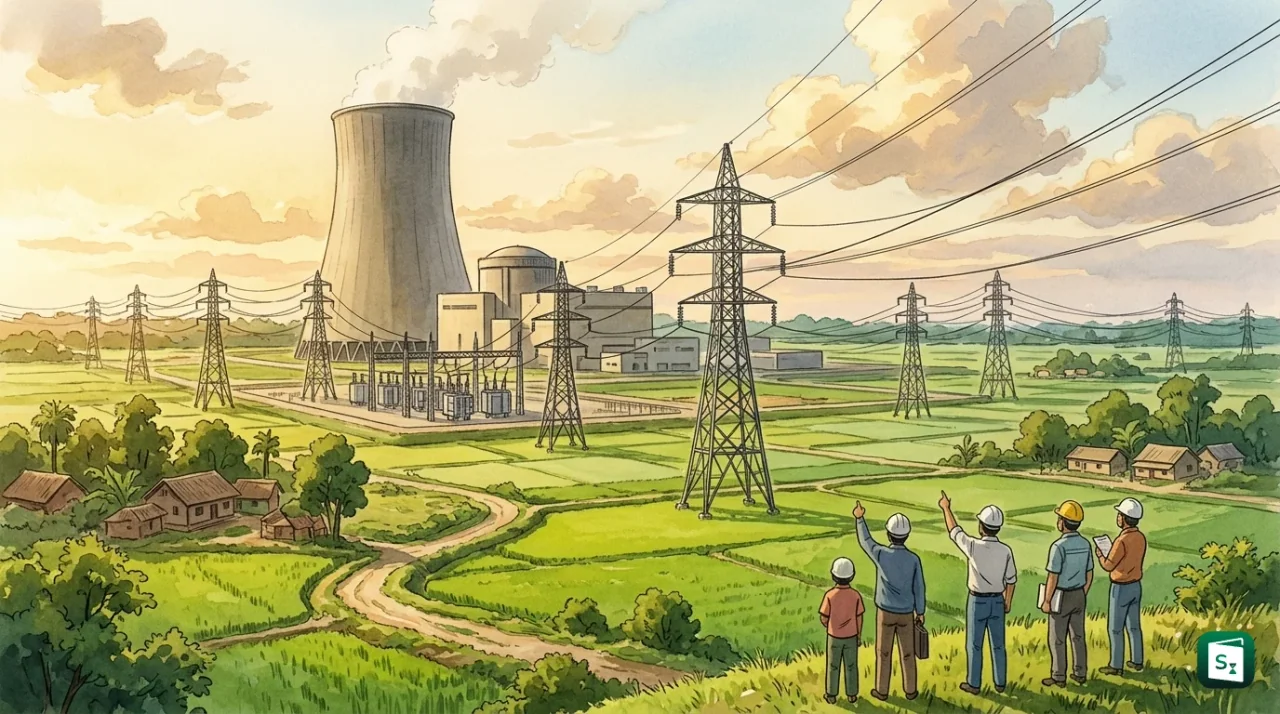
Bangladesh connected Unit 1 of the Rooppur Nuclear Power Plant to the national grid on 17 November 2026 in a trial run that fed about 350 MW from Ishwardi in Pabna district. The synchronisation at 3:16 pm marked the first flow of nuclear electricity in the history of Bangladesh. With this step, Bangladesh became the 33rd producer of nuclear electricity in the world.
What Is the Rooppur Nuclear Power Plant?
The Rooppur Nuclear Power Plant (RNPP) is the first nuclear power plant of Bangladesh. The Bangladesh Atomic Energy Commission (BAEC) owns the plant, and the Nuclear Power Plant Company Bangladesh Limited (NPCBL) will operate it as the designated operating organisation.
The plant stands at Rooppur in Ishwardi Upazila of Pabna district in Rajshahi Division, on the bank of the Padma River, about 160 km northwest of Dhaka. The site covers a large secured zone with four natural draft cooling towers that use water from the Padma for cooling.
Russia is building the plant for Bangladesh. Rosatom, the Russian state nuclear corporation, is the supplier through its engineering arm Atomstroyexport, which holds the engineering, procurement and construction contract. The framework began with an intergovernmental agreement in February 2011, followed by the general contract on 25 December 2015 valued at about $12.65 billion. Construction of Unit 1 started on 30 November 2017 and Unit 2 started on 14 July 2018.
The project is the most expensive development project in the history of Bangladesh. About 90 percent of the cost is financed through a Russian state export credit of about $11.38 billion, to be repaid over 30 years. Bangladesh bears the remaining share. By 2026 the approved cost had risen to about Tk 1.39 lakh crore because of time overruns and the fall in the value of the taka against the dollar. Each unit is designed for a service life of 60 years, with a possible extension of 20 years.
What Is the Capacity, Fuel Need and Cost of the Rooppur Plant?
The Rooppur plant has two identical units with a combined gross capacity of 2,400 MW. Each unit has a gross capacity of 1,200 MW and a net capacity of about 1,080 MW that can be sent out after internal use. Each reactor produces 3,200 MW of heat energy, which the turbine converts into electricity.
| Feature | Unit 1 | Unit 2 |
|---|---|---|
| Reactor model | VVER 1200/523 | VVER 1200/523 |
| Gross capacity | 1,200 MW | 1,200 MW |
| Net capacity | About 1,080 MW | About 1,080 MW |
| Construction start | 30 November 2017 | 14 July 2018 |
| Present stage in November 2026 | Trial grid connection | Under construction |
The reactors use low enriched uranium as fuel and light water as both coolant and moderator. The core of each unit holds 163 fuel assemblies. TVEL, the fuel company of Rosatom, will supply fuel for the full life of the plant under a long term contract. The first fuel reached the site in October 2023, which gave the site the status of a nuclear facility under international safeguards. Spent fuel will be sent back to Russia under the agreement.
When both units run at full capacity, Rooppur is expected to meet more than 10 percent of the electricity demand of Bangladesh and provide steady base load power day and night. The purchase price of this power is still being finalised. The Bangladesh Power Development Board first estimated about Tk 6.72 per unit, but officials have indicated that the final tariff could rise to about Tk 10 per unit after full accounting of construction, operation and maintenance costs.
How Unit 1 Reached the Trial Grid Connection Stage
The trial connection on 17 November 2026 was the result of a long commissioning sequence. Commissioning tests each system first without fuel and then with fuel before power is allowed to flow to the grid.
| Date | Milestone |
|---|---|
| October 2023 | First batch of nuclear fuel arrives at Rooppur, site recognised as a nuclear facility |
| 16 April 2026 | Bangladesh Atomic Energy Regulatory Authority (BAERA) issues operating licence for Unit 1 |
| 28 April to 12 May 2026 | Loading of 163 fuel assemblies completed |
| 11 October 2026 | Unit 1 achieves first criticality at 3:34 pm, which means the start of a controlled and self sustaining chain reaction at very low power |
| 29 October 2026 | BAERA clears power start up, heat from the reactor begins to produce steam |
| 17 November 2026 | First trial synchronisation at 3:16 pm, supply of up to 350 MW for 8 to 10 hours |
| 23 November 2026 | Second trial connection at 10:20 am, supply of about 320 MW for nearly 30 hours, valued at about Tk 7.06 crore |
First criticality was delayed by more than two months because two automatic pressure relief valves failed during tests. Russian specialists repaired the valves and the system passed high pressure tests at 16.2 MPa before BAERA issued the B-2 licence for criticality.
During the November trials, engineers tested the turbine, generator, control systems and grid stability. Output was first raised to 350 MW and then held at 300 MW to keep the national grid stable. The unit was disconnected after each run for detailed checks. Trial power could still be used by consumers, but officials said steady and uninterrupted supply could not be guaranteed at this stage.
BAERA must issue C and D licences for the next phases. Generation will rise in steps toward the full 1,200 MW over several months. Officials hope the unit will reach full capacity by late January or early February. After that, Unit 1 must complete a 10 month trial operation, including at least three days of continuous run at full capacity, before Rosatom hands it over provisionally to BAEC for permanent commercial operation.
What Is the VVER 1200 Reactor Used at Rooppur?
The VVER 1200 is a pressurised water reactor of Russian design. VVER is the short form for a water cooled and water moderated reactor. In this design, light water acts as both coolant and moderator. Heat from the reactor core produces steam in a two circuit system with four cooling loops, and the steam drives the turbine to make electricity.
VVER 1200 is an advanced version of the VVER 1000 used at the Kudankulam Nuclear Power Plant in Tamil Nadu. The model used at Rooppur is VVER 1200/523. It belongs to the Generation III+ family, which meets safety standards set after the Fukushima accident in Japan in 2011. It produces about 20 percent more power than VVER 1000 from a plant of similar size. It is designed for a 60 year life, an 18 month refuelling cycle and a capacity factor of about 90 percent.
Safety rests on a mix of active systems that need power and operator action, and passive systems that work without power or human action. Key features include double containment with a steel lined inner dome and an outer concrete shield, a core catcher that holds and cools molten core material in a severe accident, a Passive Heat Removal System that uses air cooled exchangers to remove decay heat during a blackout, emergency core cooling tanks filled with boric acid solution, and hydrogen removers that prevent hydrogen build up inside the containment. The reactor building is designed to resist earthquakes, cyclones, tornadoes and external impact.
Is Bangladesh Now a Nuclear Power Country?
Yes. With the trial feed on 17 November 2026, Bangladesh became the 33rd producer of nuclear electricity in the world. The count treats Taiwan as a separate economy along with 31 countries that already had operating commercial reactors. If Taiwan is not counted as a country, Bangladesh is the 32nd country on some lists.
Bangladesh is the third country in South Asia to generate nuclear electricity, after India and Pakistan. The other producers include the United States, France, China, Russia, South Korea, Canada, Japan, Ukraine, the United Kingdom, Spain, Sweden, the Czech Republic, Finland, Slovakia, the United Arab Emirates, Switzerland, Hungary, Argentina, Belarus, Belgium, Bulgaria, Brazil, South Africa, Mexico, Romania, Iran, Slovenia, the Netherlands and Armenia, along with Taiwan.
About 400 reactors operate worldwide. Egypt at El Dabaa and Turkiye at Akkuyu are building their first plants and are expected to join the list next. Formal recognition as a regular commercial producer will come when Rooppur completes its 10 month trial operation and begins full commercial supply. The International Atomic Energy Agency (IAEA), headquartered in Vienna and set up in 1957 to promote peaceful uses of nuclear energy, sets the safety standards and safeguards followed during this process.
What Is the Role of India in the Rooppur Project?
India has a limited but important supporting role in Rooppur under a trilateral framework with Russia and Bangladesh. India signed a civil nuclear cooperation agreement with Bangladesh in 2015. The Department of Atomic Energy (DAE) of India then signed a pact with BAEC through the Global Centre for Nuclear Energy Partnership (GCNEP) at Bahadurgarh in Haryana for training and consultancy.
A tripartite memorandum was signed on 1 March 2018 in Moscow between Rosatom, the Ministry of Science and Technology of Bangladesh and the DAE of India. The memorandum provides for training and mentoring of Bangladeshi personnel, exchange of experience and consultancy support. Indian companies can take part in construction and installation work and supply materials and equipment of non critical category.
Bangladeshi engineers have received training at the Kudankulam plant in Tamil Nadu, which uses similar Russian VVER technology. Indian firms have also worked at the Rooppur site. The Hindustan Construction Company has been engaged in turbine generator buildings, while Paharpur Cooling Towers has worked on cooling towers and pump houses.
India is not a member of the Nuclear Suppliers Group (NSG), the 48 member group that controls global nuclear trade, and is not a signatory to the Nuclear Non Proliferation Treaty. India therefore cannot supply reactors or critical nuclear systems directly. Its participation stays within training, services and non critical supplies, and this model is seen as an example of cooperation in a third country.
Key Takeaways
- Unit 1 of the Rooppur Nuclear Power Plant began trial supply to the national grid on 17 November 2026 with about 350 MW from Ishwardi in Pabna district.
- Bangladesh became the 33rd nuclear electricity producer in the world with this trial connection, and the third in South Asia after India and Pakistan.
- Rooppur has two VVER 1200 units of 1,200 MW each, built by Rosatom through Atomstroyexport at a cost of about $12.65 billion.
- Unit 1 achieved first criticality on 11 October 2026 after loading of 163 fuel assemblies, and must complete a 10 month trial operation before full commercial supply.
- India supports the project under the 1 March 2018 tripartite memorandum through training at Kudankulam and non critical works, as India is not a member of the Nuclear Suppliers Group.